

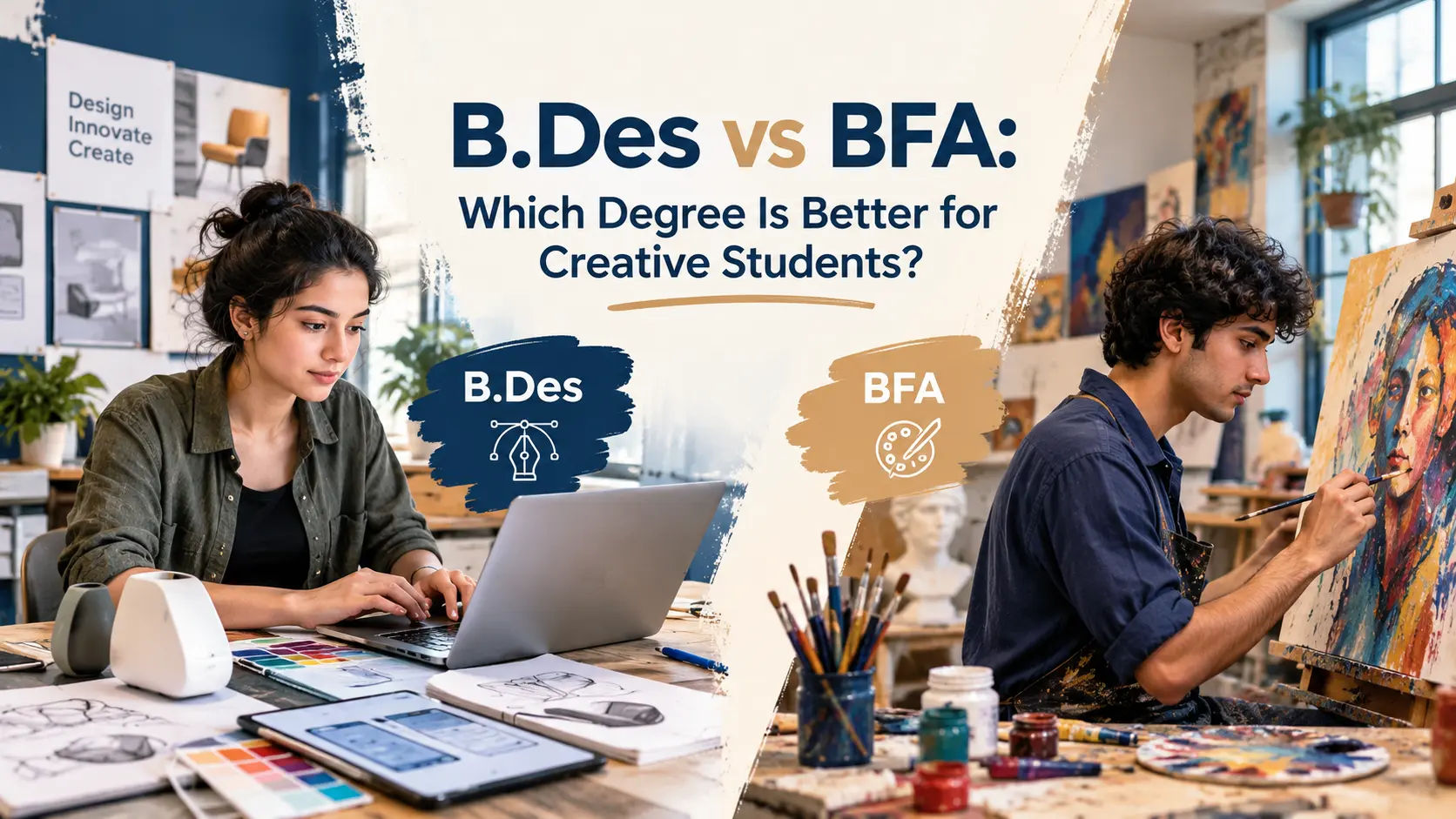
B.Des vs BFA: Which Degree Is Better for Creative Students?
Choosing between a Bachelor of Design (B.Des) and a Bachelor of Fine Arts (BFA) can be challenging when you enjoy creativity but are unsure which career path to follow. Both degrees help students develop artistic skills, explore ideas, and build a creative career. However, their learning approaches, specialisations, and professional opportunities can differ significantly.
The right choice depends on what you want to create. Do you want to design websites, products, fashion collections, or digital experiences? Or do you prefer painting, illustration, sculpture, and developing your own artistic style?
This guide explains the difference between B.Des and BFA, including course structure, career opportunities, skills, costs, and prospects, so you can make an informed decision.
What Is B.Des (Bachelor of Design)?
A Bachelor of Design is an undergraduate degree focused on creating useful, attractive, and meaningful products, services, and experiences. Students learn how to understand users, research problems, develop ideas, and turn concepts into practical design solutions.
Depending on the institution, a B.Des programme may include design theory, studio projects, digital tools, prototyping, research, and industry-oriented assignments.
Popular B.Des Specialisations
- Graphic and Communication Design: Creating brand identities, advertisements, packaging, and visual campaigns.
- UI/UX Design: Designing websites, mobile applications, and digital experiences that are easy to use.
- Fashion Design: Developing clothing collections, textiles, and fashion concepts.
- Product Design: Designing physical products with attention to usability, materials, and appearance.
- Interior Design: Planning functional and visually appealing indoor environments.
- Animation and Game Design: Developing animated content, interactive experiences, and game visuals.
Who Should Choose B.Des?
B.Des may suit you if you enjoy creativity but also like technology, research, planning, and solving problems. You might enjoy understanding why people use a particular app, how a product can become easier to handle, or how a brand can communicate its message visually.
For example, a student who enjoys creating social media graphics and wants to progress into branding, digital product design, or user experience could explore a relevant B.Des spécialisations.
What Is BFA (Bachelor of Fine Arts)?
A Bachelor of Fine Arts is an undergraduate degree that develops artistic ability, visual communication, creative thinking, and individual expression. The exact curriculum varies, but many programmes place significant emphasis on studio practice, artistic techniques, art history, experimentation, and the development of a personal style.
BFA students learn to communicate ideas, emotions, and perspectives through different forms of art.
Popular BFA Specialisations
- Painting: Developing artistic techniques using different media.
- Sculpture: Creating three-dimensional artwork using suitable materials.
- Drawing and Illustration: Producing visual narratives, character illustrations, and artwork.
- Applied Arts: Applying artistic principles to visual communication and commercial projects.
- Printmaking: Creating artwork through printing techniques.
- Digital Art: Exploring digital illustration and other contemporary artistic practices where offered.
Specialisations and degree names differ between countries and institutions. Some universities offer related programmes under titles such as Bachelor of Visual Arts.
Who Should Choose BFA?
BFA may be a strong choice if you enjoy creating original artwork, experimenting with materials, developing visual ideas, and expressing your perspective through art.
For example, a student who spends time painting, sketching characters, creating illustrations, or preparing work for exhibitions may find a fine arts programme more aligned with their interests.
B.Des vs BFA: Key Differences
| Main focus | Applied design and problem-solving | Artistic practice and expression |
| Learning approach | Research, design projects, prototyping | Studio practice, experimentation, artwork |
| Typical subjects | UI/UX, product, fashion, communication design | Painting, sculpture, drawing, illustration |
| Practical outcomes | Products, interfaces, brands, design concepts | Artwork, illustrations, exhibitions, creative portfolios |
| Career directions | UX designer, product designer, graphic designer | Fine artist, illustrator, art educator |
| Work settings | Design studios, companies, agencies, freelance | Studios, galleries, educational institutions, freelance |
| Portfolio focus | Solving design problems and showing process | Demonstrating artistic skill, originality, and development |
Important: These are general distinctions, not strict boundaries. BFA graduates can enter commercial creative roles, and B.Des graduates can pursue highly artistic work.
B.Des vs BFA: Course Duration and Eligibility
In many institutions, both degrees take approximately three to four years, although four-year programmes are common in several countries and educational systems. Some institutions offer different structures, credit requirements, or progression routes.
Eligibility depends on the university and country. In India, many undergraduate programmes accept students after Class 12, but admission requirements vary.
Before applying, check:
- Whether your previous educational qualification is accepted.
- Whether mathematics or another subject is compulsory.
- Whether an entrance examination is required.
- Whether you must submit a portfolio or attend an interview.
- Whether the programme has additional drawing, aptitude, or practical assessments.
Students from science, commerce, and humanities backgrounds may be eligible for certain programmes. Do not assume that every B.Des or BFA course has identical requirements.
Career Opportunities After B.Des
B.Des graduates can pursue different roles depending on their specialisation, practical experience, and portfolio.
Common career options include:
- UI/UX designer
- Graphic designer
- Product designer
- Fashion designer
- Interior designer
- Communication designer
- Animation or game design professional
- Design researcher
- Freelance design consultant
For instance, a student specialising in UI/UX may work with a digital product team, while someone specialising in fashion may work with a clothing brand or develop an independent label.
The most useful preparation includes completing real-world projects, learning relevant software, understanding client or user needs, and presenting a clear portfolio.
Career Opportunities After BFA
BFA graduates can build careers in traditional and contemporary art, commercial illustration, education, and creative industries.
Potential career options include:
- Fine artist
- Illustrator
- Painter
- Sculptor
- Digital artist
- Art instructor or educator, subject to applicable qualifications
- Exhibition or gallery professional
- Freelance visual artist
- Applied arts professional
Some graduates work independently, selling commissioned artwork or participating in exhibitions. Others collaborate with publishers, studios, advertising agencies, and media businesses.
Income and career stability can vary considerably, particularly for independent artists. Building professional relationships, maintaining a consistent portfolio, and understanding how to price creative work are valuable skills.
Which Degree Has Better Salary and Job Opportunities?
There is no universal salary winner between B.Des and BFA. Earnings depend on your country, city, specialisation, experience, employer, and the quality of your work.
B.Des graduates may find structured employment opportunities in areas such as digital product design, branding, fashion, and user experience. However, competition for entry-level positions can be strong, and a degree alone does not guarantee employment.
BFA graduates may build income through employment, commissions, exhibitions, teaching, illustration, or freelance projects. Earnings can be less predictable for some independent artistic careers, particularly at the beginning.
| Employment pathway | Often linked to design teams and commercial projects | Often linked to art practice and creative projects |
| Freelancing | Branding, interfaces, products, and other design services | Artwork, illustration, commissions, and creative services |
| Portfolio priority | Design process, usability, outcomes, and problem-solving | Artistic technique, originality, and visual development |
| Income predictability | Depends on role, employer, and experience | Depends on employment type, demand, and sales |
When comparing colleges, look beyond advertised salary packages. Review verified placement reports, internship access, alumni outcomes, course fees, and the quality of student projects.
Benefits and Challenges of B.Des and BFA
Benefits of B.Des
- Offers several specialisations connected to design industries.
- Encourages structured problem-solving and practical projects.
- Can combine creativity with technology and research.
- May provide opportunities for internships and industry collaboration.
Potential challenges: Some programmes involve demanding project deadlines, technical learning, teamwork, and repeated revisions based on feedback.
Benefits of BFA
- Supports artistic experimentation and personal expression.
- Builds foundational skills in visual art and creative techniques.
- Can lead to independent artistic practice and diverse creative work.
- Encourages the development of an individual artistic identity.
Potential challenges: Building a sustainable career may require time, self-promotion, networking, business skills, and a strong body of work.
How to Choose Between B.Des and BFA: A Step-by-Step Guide
Step 1: Identify What You Enjoy Creating
List the activities you naturally enjoy. These could include painting, sketching, editing visuals, designing clothing, creating digital graphics, or developing product ideas.
Your interests can reveal which course deserves closer attention.
Step 2: Explore the Actual Curriculum
Do not select a course based only on its name. Compare the subjects, studio hours, software training, project requirements, internships, and elective options offered by individual colleges.
Step 3: Review Student Portfolios
Look at projects created by students in both programmes. Ask yourself whether you would enjoy producing similar work and developing those skills over several years.
Step 4: Compare Fees and Resources
Calculate tuition, materials, equipment, accommodation, and other expenses. Check whether the college offers suitable studios, software access, workshops, scholarships, and internship support.
Step 5: Consider Your Preferred Career
If you want to design digital interfaces, products, or brand experiences, investigate B.Des programmes in relevant fields. If you want to focus on painting, sculpture, or independent art, explore BFA curricula.
Step 6: Check Admission Requirements
Confirm the eligibility criteria, application deadlines, entrance tests, and portfolio requirements directly with each institution before applying.
Students who need help narrowing down their options can also explore the career and educational guidance resources available through Vidya Udbhav.
Tools and Skills Creative Students Should Develop
The best tools depend on the course and specialisation. Start with the skills you need rather than purchasing expensive software immediately.
| Digital illustration | Krita, Procreate |
| Graphic and visual design | Canva, Adobe Photoshop, Adobe Illustrator |
| UI/UX and interface design | Figma |
| 3D modelling and product concepts | Blender |
| Digital painting and artwork | Adobe Photoshop, Krita |
Some tools offer free versions or free alternatives, while others require a subscription or paid licence. Check current terms before using them for commercial projects.
Beyond software, practise observation, communication, visual research, time management, and constructive feedback. These skills support both design and fine arts careers.
Common Mistakes to Avoid When Selecting a Creative Degree
Here is where many students make mistakes: they choose a course because it sounds popular rather than because its curriculum matches their goals.
Avoid these common errors:
- Choosing a degree solely because friends are applying for it.
- Assuming B.Des always leads to higher salaries.
- Believing BFA graduates cannot work in commercial industries.
- Ignoring the quality of faculty, studios, and student work.
- Selecting a college without checking accreditation and recognition where applicable.
- Underestimating the importance of a portfolio.
- Overlooking the total cost of studying.
A better approach is to compare at least three institutions, speak to current students or alumni, and examine the actual work produced during the course.
Future Trends: Where Are Creative Careers Heading?
Creative careers increasingly involve digital experiences, interactive media, sustainable products, visual storytelling, and emerging technologies. Artificial intelligence is also changing how designers and artists generate ideas, experiment, and develop concepts.
For B.Des students, areas such as user experience, accessible interfaces, digital products, and sustainable design may offer relevant learning opportunities. For BFA students, digital illustration, mixed media, animation-related artwork, and online art portfolios can expand how work is presented and commissioned.
These developments do not make traditional artistic skills less valuable. Strong visual judgment, originality, cultural awareness, and the ability to communicate ideas remain important across creative disciplines.
Students should treat technology as a tool, not a replacement for learning the fundamentals of their chosen field.
Conclusion: B.Des vs BFA — Which Degree Is Better for You?
The choice between B.Des and BFA becomes easier when you focus on the kind of work you want to do.
Choose B.Des if you are interested in applied design, digital experiences, products, fashion, branding, or solving practical problems through creativity. Choose BFA if your interests centre on artistic expression, painting, sculpture, illustration, and developing a distinctive creative practice.
Neither degree guarantees success, and neither is suitable for every creative student. Your decision should reflect your interests, preferred learning environment, budget, and long-term career plans.
Before making a final choice, compare course curricula, review student portfolios, check eligibility, and investigate career outcomes. A well-chosen programme combined with consistent practice and a strong portfolio can help you build a more confident foundation for your creative future.
Frequently Asked Questions
1. Is B.Des better than BFA?
B.Des may be better for students who want careers in applied design, digital products, fashion, or user experience. BFA may suit students who prefer fine arts and independent artistic expression. The better choice depends on your goals.
2. Which degree is better for graphic design, B.Des or BFA?
Both can lead to graphic design careers. A B.Des in graphic or communication design may provide structured training in branding, typography, visual communication, and design processes. Some BFA or applied arts programmes also develop relevant commercial skills.
3. Can I pursue B.Des or BFA after Class 12?
Yes, many institutions offer undergraduate entry after Class 12 or an equivalent qualification. Eligibility, subject requirements, entrance examinations, and portfolio expectations vary by programme and institution.
4. Which degree offers better job opportunities?
B.Des can provide direct routes into specialised design roles, while BFA can lead to employment and independent artistic careers. Opportunities depend on specialisation, practical skills, location, experience, and portfolio quality.
5. Can BFA graduates become UI/UX designers?
Yes. BFA graduates can move into UI/UX design by learning user research, interaction design, interface design, prototyping, and usability testing. A relevant portfolio and practical experience can help demonstrate their readiness.
6. Is drawing compulsory for B.Des and BFA?
Not always, but visual thinking and observation are valuable in both. Some institutions require drawing tests or artistic portfolios, while others assess aptitude, creativity, problem-solving, or previous work differently.
7. Can students from commerce or science choose BFA?
Some institutions accept students from different Class 12 streams. However, admission policies vary, so applicants should check the requirements of their preferred colleges.
8. Can I pursue higher studies after B.Des or BFA?
Yes. Depending on your background and eligibility, options may include a Master of Design, Master of Fine Arts, specialised postgraduate programmes, art education, or related interdisciplinary courses.
9. Which degree is better for freelancing?
Both can support freelancing. B.Des graduates may offer branding, UI/UX, product, or communication design services, while BFA graduates may offer illustration, commissions, painting, or other art-related services. Business skills and portfolio quality matter in both paths.
10. How should I choose the right college for B.Des or BFA?
Compare curriculum, faculty, facilities, total fees, recognition, internships, portfolio outcomes, and graduate career paths. Choose the programme that best supports your preferred specialisation rather than relying only on rankings or promotional claims.