

Introduction
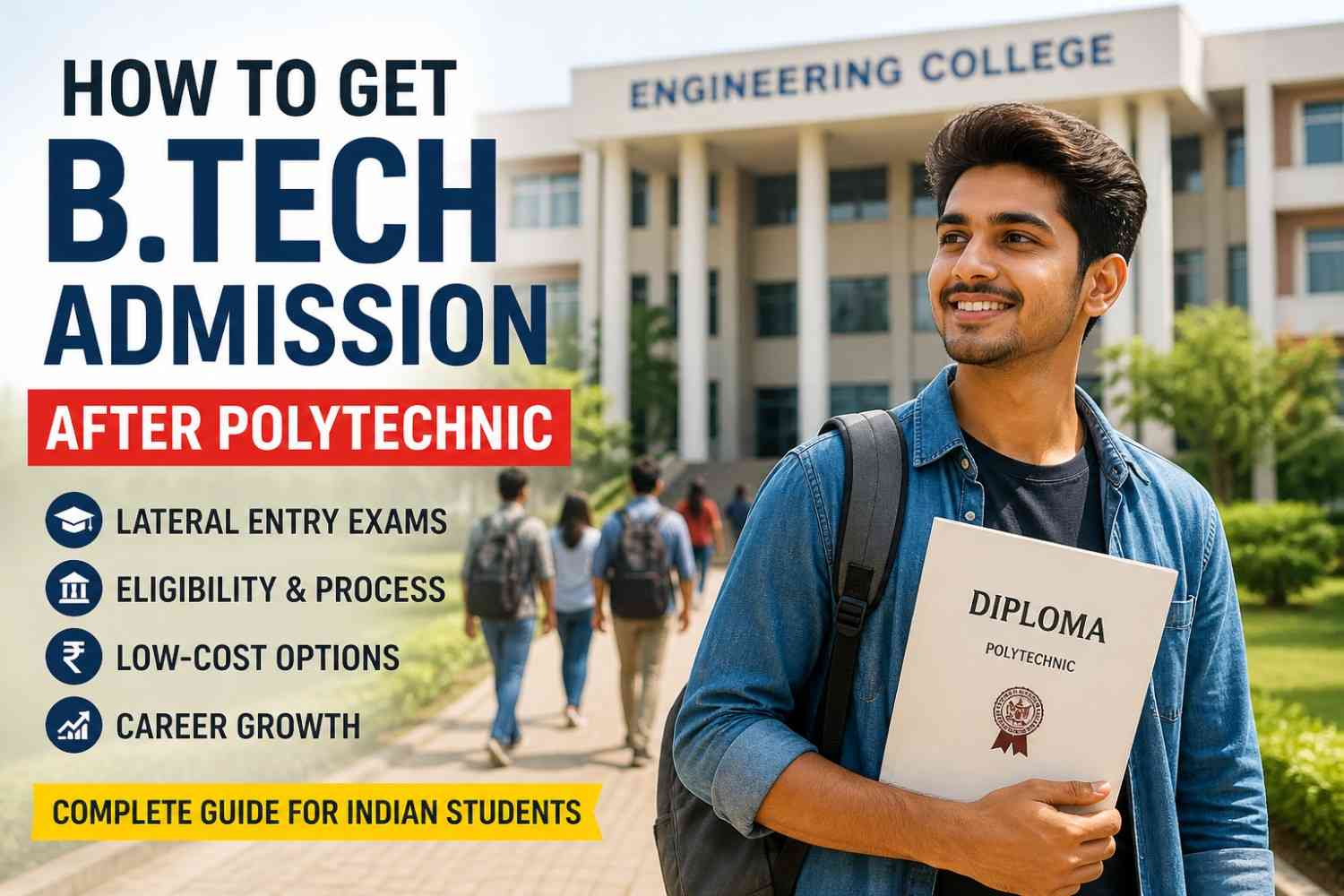
If you have completed your diploma or polytechnic and are now thinking about a B.Tech degree, you are already on a smart path.
Many Indian students choose polytechnic after 10th because it is affordable, skill-based, and gives early industry exposure. But after finishing it, one big question comes:
“Can I join B.Tech directly? And how?”
You might be thinking that the process is complicated or that only toppers can do it. But that is not true.
Thousands of students in India successfully move from a diploma to B.Tech every year through something called lateral entry.
In this guide, I will explain everything in simple terms:
- What lateral entry is
- Eligibility criteria
- Entrance exams
- Step-by-step admission process
- Budget-friendly options
- Real Indian examples
- Mistakes to avoid
This is not just theory. This is practical guidance like a mentor would give.
What is B.Tech Lateral Entry?
Simple Explanation
Lateral entry means direct admission into the 2nd year of B.Tech after polytechnic.
Instead of starting from the 1st year, you skip it and save:
- 1 year of time
- Fees for one full academic year
Example
Let’s say:
- Ravi completed a Diploma in Mechanical Engineering from a government polytechnic in UP.
- Instead of joining B.Tech from the 1st year, he gives an entrance exam
- He directly gets admission in the 2nd year B.Tech Mechanical.
This is what lateral entry is.
Why Choose B.Tech After Polytechnic?
Many students stop after their diploma and start working. That is okay. But if you want better career growth, B.Tech gives a strong advantage.
Key Benefits
- Better Job Opportunities
- Diploma holders often get technician roles.
- B.Tech graduates can apply for engineering and management roles.
- Higher Salary
- B.Tech degree increases earning potential significantly.
- Eligibility for Government Jobs
- Many PSU and government exams require a degree.
- Further Studies
- You can pursue M.Tech, MBA, or study abroad.
- Career Growth
- Promotions come faster with a degree.
Eligibility Criteria for B.Tech After Polytechnic
Before applying, you must check eligibility.
Basic Requirements
Most colleges in India require:
- Diploma (Polytechnic) in a relevant engineering field
- Minimum 50% to 60% marks (varies by state/college)
- Final year students can also apply.
Branch Requirement
You must choose a related branch.
| Mechanical | Mechanical, Automobile |
| Civil | Civil Engineering |
| Electrical | Electrical, Electronics |
| Computer Science | CSE, IT |
| Electronics | ECE |
Entrance Exams for Lateral Entry in India
Most admissions happen through entrance exams.
Popular Exams
1. State-Level Lateral Entry Exams
Each state has its own system.
Examples:
- UP: JEECUP (Lateral Entry)
- Haryana: LEET
- Delhi: CET
- West Bengal: JELET
- Kerala: LET
These are affordable and widely used.
2. Direct Admission (Private Colleges)
Some private colleges offer admission based on:
- Diploma marks
- No entrance exam
But choose carefully (quality matters).
Step-by-Step Admission Process
Let’s break this into simple steps.
Step 1: Decide Your Branch
Choose based on:
- Your diploma subject
- Interest
- Career goals
Do not blindly follow friends.
Step 2: Check Entrance Exams
Find out:
- Which exam is valid in your state
- Application dates
Most forms are released between:
- March to June
Step 3: Fill Application Form
Basic details required:
- Diploma marks
- Personal information
- Documents
Application fees are usually:
- ₹300 to ₹1000
Step 4: Prepare for Exam
Subjects usually include:
- Diploma core subjects
- Basic engineering concepts
No need to panic. Questions are not very advanced.
Step 5: Appear for the Exam
- Online or offline mode
- MCQ-based questions
Step 6: Counseling Process
After results:
- You get a rank
- Choose colleges and branches.
Step 7: Final Admission
- Document verification
- Fee payment
- College allotment
Low-Cost and Budget-Friendly Options
This is important for Indian students.
Government Colleges
Best option because:
- Low fees (₹20,000 to ₹80,000/year)
- Good quality education
Examples:
- State engineering colleges
- Government universities
Private Colleges (Budget Range)
If the rank is low, you can consider:
- Tier 2 and Tier 3 colleges
Fees:
- ₹60,000 to ₹1.5 lakh/year
Distance or Online Options (Limited)
Not recommended for core engineering.
Useful Platforms for Preparation
Here are some practical tools:
Free Resources
- YouTube channels for diploma subjects
- NPTEL courses
- Government e-learning portals
Paid but Affordable
- Unacademy
- Testbook
- Gradeup
You do not need expensive coaching.
Study Strategy for Entrance Exams
Here is what actually works.
1. Focus on Diploma Subjects
- Do not go into deep theory.
- Revise basics
2. Solve Previous Year Papers
- Most important step
- Pattern repeats
3. Daily Study Plan
Example:
- 2 hours theory
- 1 hour practice
- 30 min revision
4. Use Short Notes
Make notes for:
- Formulas
- Key concepts
5. Mock Tests
Give weekly tests to check progress.
Common Mistakes to Avoid
Many students lose opportunities because of small mistakes.
1. Not Applying on Time
Deadlines are strict.
2. Choosing the Wrong Branch
Do not choose a branch just because:
- A friend is choosing it.
- It sounds trendy
3. Ignoring Government Colleges
Always try for them first.
4. No Exam Preparation
Even basic preparation can improve rank.
5. Taking Admission in Low-Quality Colleges
Check:
- Placement record
- Faculty
- Infrastructure
Real-Life Example
Let’s take a relatable example.
Neha from Ghaziabad
- Completed a Diploma in Computer Science
- Scored 62%
- Appeared for the lateral entry exam
- Got admission in a government college
- Completed B.Tech in 3 years
- Got placed in an IT company with a ₹4.5 LPA package
This is very common. You do not need extraordinary marks.
Career Opportunities After B.Tech
Once you complete B.Tech, options open up.
Job Roles
- Software Engineer
- Civil Engineer
- Mechanical Engineer
- Electrical Engineer
Government Jobs
You can apply for:
- SSC JE
- PSU jobs
- State government jobs
Higher Studies
- M.Tech
- MBA
- Study abroad
Practical Tips for Success
Here are some real tips that actually help.
1. Start Early
Do not wait for results.
2. Keep Backup Options
Apply to multiple colleges.
3. Improve Communication Skills
Important for placements.
4. Learn Practical Skills
For example:
- Coding (for CSE)
- AutoCAD (for Civil/Mechanical)
5. Stay Consistent
Small daily effort matters.
How Vidya Udbhav Can Help You
If you are confused about:
- Which college to choose
- Which branch is best
- Admission process
They provide student-focused guidance to help you make better decisions.
Final Advice
Let me tell you something honestly.
Coming from a polytechnic is not a disadvantage. In fact, it is a strength.
You already have:
- Practical knowledge
- Technical understanding
Now you just need to upgrade your qualification.
Do not overthink.
Take action:
- Check exams
- Apply
- Prepare
- Move forward
Your future depends on decisions you take today.