

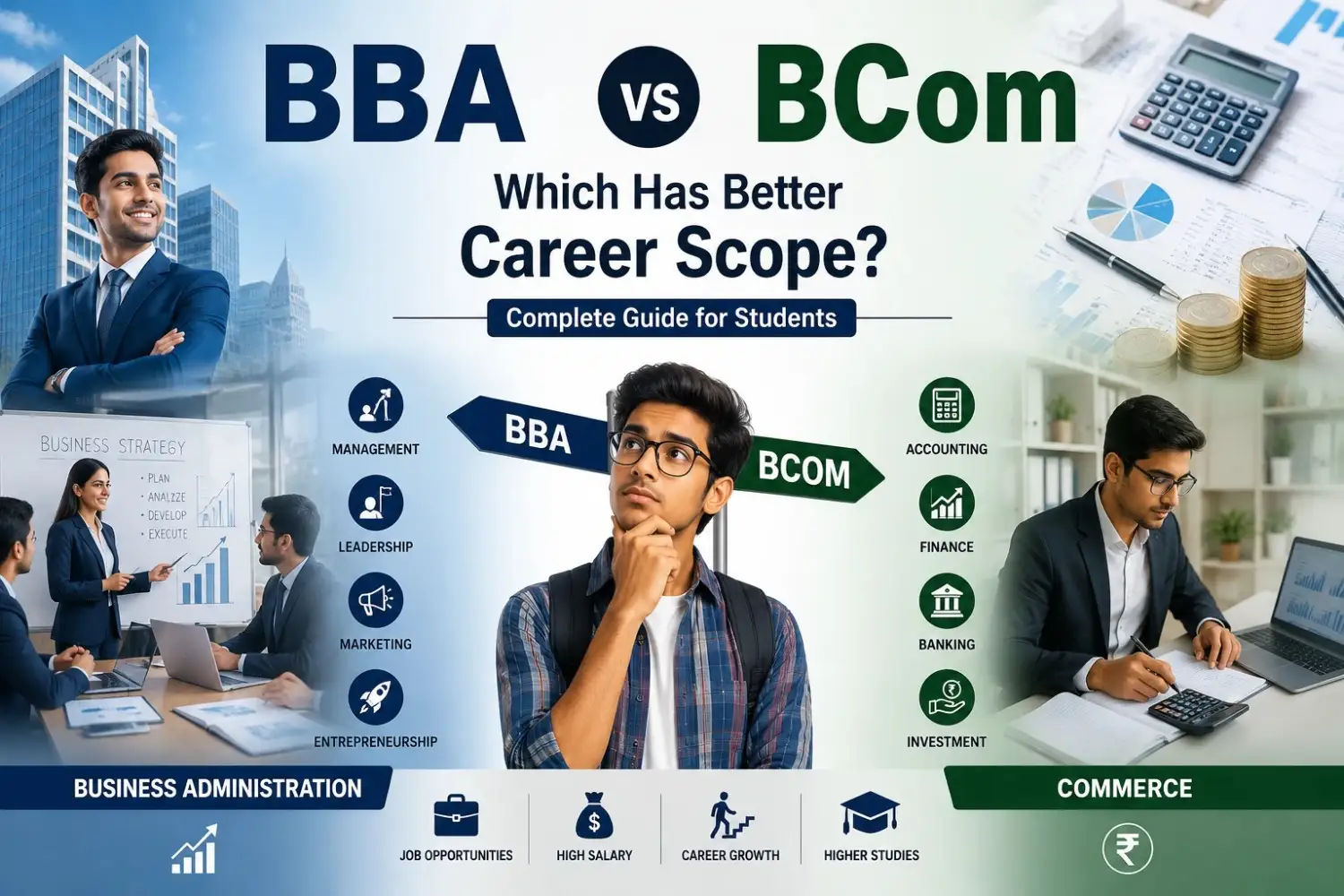
BBA vs BCom: Which Has Better Career Scope?
Choosing the right undergraduate course after Class 12 can significantly influence your career path. Among commerce and management aspirants, one question consistently arises: BBA vs BCom – which has better career scope?
Both programs are highly respected and open doors to rewarding careers. However, they differ in curriculum, skill development, career outcomes, and future opportunities.
If you are confused about whether to pursue a Bachelor of Business Administration (BBA) or a Bachelor of Commerce (BCom), this comprehensive guide will help you understand the differences and make an informed decision.
Students exploring admission options can also refer to the career guidance resources available on www.vidyaudbhav.com for additional insights into course selection and professional planning.
Quick Answer: BBA vs BCom
Featured Snippet
BBA is generally better for students interested in management, entrepreneurship, leadership, marketing, and corporate careers.
BCom is often preferred for students interested in accounting, finance, taxation, banking, auditing, and professional certifications such as CA, CMA, or CS.
The better option depends on your career goals, interests, and future plans.
Understanding BBA and BCom
What is BBA?
Bachelor of Business Administration (BBA) is a professional undergraduate degree focused on business management and administration.
The course develops practical business skills such as:
- Leadership
- Marketing
- Human Resource Management
- Business Analytics
- Entrepreneurship
- Corporate Communication
- Strategic Planning
Students are trained to understand how organizations operate and how business decisions are made.
What is BCom?
Bachelor of Commerce (BCom) is a commerce-focused degree emphasizing financial and business concepts.
The program typically covers:
- Accounting
- Economics
- Taxation
- Auditing
- Business Law
- Finance
- Banking
- Statistics
BCom builds a strong foundation for financial and accounting careers.
BBA vs BCom Comparison Table
| Full Form | Bachelor of Business Administration | Bachelor of Commerce |
| Focus Area | Business Management | Commerce & Finance |
| Duration | 3 Years | 3 Years |
| Industry Exposure | Higher | Moderate |
| Practical Learning | Extensive | Moderate |
| Management Skills | Strong | Limited |
| Finance Knowledge | Moderate | Strong |
| Entrepreneurship Scope | High | Moderate |
| MBA Preparation | Excellent | Good |
| CA/CMA/CS Preparation | Moderate | Excellent |
| Corporate Employability | High | High |
Search Intent: Who Should Choose BBA?
You might be wondering whether BBA is the right fit for you.
BBA is ideal if you:
- Enjoy leadership roles
- Want to work in corporate management.
- Dream of becoming an entrepreneur
- Like marketing and branding
- Want early exposure to business operations
- Plan to pursue an MBA
Many multinational companies prefer management graduates who possess strong communication and leadership skills.
Who Should Choose BCom?
BCom may be a better choice if you:
- Enjoy working with numbers.
- Have an interest in accounting.
- Want a career in finance.
- Plan to become a CA
- Want to enter banking.
- Like taxation and auditing
One thing many students overlook is that BCom provides an excellent foundation for professional certifications.
Career Scope After BBA
The demand for management professionals continues to grow globally.
Popular Jobs After BBA
Business Development Executive
Responsible for identifying business opportunities and generating revenue.
Marketing Executive
Works on branding, customer acquisition, and promotional campaigns.
Human Resource Executive
Handles recruitment, employee relations, and workforce management.
Operations Executive
Focuses on improving business efficiency and processes.
Sales Manager
Leads revenue-generation activities and customer engagement.
Emerging Career Opportunities After BBA
Modern industries now demand professionals in:
- Digital Marketing
- Business Analytics
- Product Management
- E-commerce Management
- Startup Management
- Customer Success
These fields offer significant growth potential.
Career Scope After BCom
Finance remains one of the strongest sectors worldwide.
Popular Jobs After BCom
Accountant
Maintains financial records and compliance.
Tax Consultant
Provides taxation guidance to businesses and individuals.
Financial Analyst
Evaluates investments and financial performance.
Banking Executive
Works in retail, corporate, or investment banking.
Auditor
Ensures financial transparency and compliance.
Emerging Opportunities After BCom
The finance industry is evolving rapidly.
New opportunities include:
- Financial Modeling
- FinTech
- Investment Research
- Risk Management
- Wealth Management
- Financial Consulting
Salary Comparison: BBA vs BCom
Salary varies based on skills, location, college reputation, and industry.
| Freshers | Moderate to High | Moderate |
| 3–5 Years Experience | High Growth | High Growth |
| MBA/Professional Qualification | Very High | Very High |
| Leadership Positions | Excellent | Good |
In many cases, long-term growth depends more on skills and specialization than on the degree itself.
Higher Education Options
After BBA
Students commonly pursue:
- MBA
- PGDM
- Business Analytics
- Marketing Management
- International Business
- Human Resource Management
MBA is often considered the natural progression after BBA.
After BCom
Students frequently choose:
- CA
- CMA
- CS
- MCom
- MBA
- CFA
- Financial Certifications
These qualifications can significantly increase earning potential.
BBA vs BCom for MBA Preparation
This is one of the most searched questions among students.
BBA Advantage
Students already understand:
- Business Fundamentals
- Management Principles
- Organizational Behavior
- Marketing Concepts
As a result, MBA coursework often becomes easier.
BCom Advantage
Students possess stronger analytical and financial knowledge, which is beneficial in finance-focused MBA specializations.
Real-Life Career Scenarios
Scenario 1
A student wants to launch a startup and lead teams.
Recommended Course: BBA
The curriculum develops management and entrepreneurial abilities.
Scenario 2
A student dreams of becoming a Chartered Accountant.
Recommended Course: BCom
The coursework aligns closely with CA preparation.
Scenario 3
A student wants a corporate management career and a future MBA.
Recommended Course: BBA
Scenario 4
A student is interested in finance, investments, and banking.
Recommended Course: BCom
Benefits of Choosing BBA
- Strong leadership development
- Better exposure to corporate environments
- Industry-oriented curriculum
- Entrepreneurship opportunities
- Strong MBA foundation
- Better communication skill development
Benefits of Choosing BCom
- Strong finance and accounting knowledge
- Excellent for professional certifications
- Affordable in many institutions
- Strong banking career prospects
- High demand in finance sectors
Common Mistakes Students Make
Choosing Based on Friends
Your interests should guide your decision, not your peer group.
Ignoring Career Goals
Always evaluate your long-term aspirations first.
Focusing Only on Starting Salary
Career growth matters more than first-job compensation.
Overlooking Skill Development
Employers increasingly hire based on skills, not just degrees.
Beginner Strategy for Choosing Between BBA and BCom
Follow this simple framework:
Choose BBA If:
- You enjoy business discussions.
- You like leadership activities.
- You want management roles.
- You plan for MBA.
Choose BCom If:
- You enjoy accounting.
- You like finance.
- You want CA, CMA, or CS.
- You prefer analytical careers.
Students can further explore educational planning resources and admission guidance through relevant sections of www.vidyaudbhav.com.
Advanced Strategy for Career Growth
Regardless of your degree:
Learn Digital Skills
- Excel
- Data Analytics
- AI Tools
- Presentation Skills
Build Industry Experience
- Internships
- Freelance Projects
- Live Business Projects
Develop Communication Skills
This becomes more important when competing for leadership roles.
Build Professional Networks
Networking often creates opportunities before job portals do.
Future Trends: BBA vs BCom
The future workplace is changing rapidly.
High-growth areas include:
- Artificial Intelligence in Business
- Business Analytics
- FinTech
- Digital Marketing
- Financial Technology
- Entrepreneurship
- E-commerce
Students who combine domain knowledge with technology skills will have the strongest career prospects.
Expert Tips
- Do not choose a degree solely based on popularity.
- Align your course with your personality and strengths.
- Focus on internships from the first year.
- Develop communication and analytical skills together.
- Pursue relevant certifications during graduation.
- Build a professional LinkedIn profile early.
- Stay updated with industry trends.
Final Verdict: Which Has Better Career Scope?
There is no universal winner between BBA and BCom.
Choose BBA if your goal is management, entrepreneurship, leadership, marketing, or corporate strategy.
Choose B.Com if your interest lies in finance, accounting, taxation, banking, auditing, or professional certifications like CA and CMA.
From a broader management perspective, BBA often provides stronger exposure to modern business environments. However, for finance-oriented careers, BCom remains one of the most valuable undergraduate degrees available.
The best choice is the one that aligns with your interests, skills, and long-term career objectives.
Frequently Asked Questions (FAQs)
1. Is BBA better than BCom?
BBA is better for management and business careers, while BCom is better for finance, accounting, and commerce-related professions.
2. Which course has higher salary potential?
Both offer excellent salary growth. Earnings depend more on specialization, experience, and skills than on the degree itself.
3. Can a BCom student pursue an MBA?
Yes. BCom graduates are fully eligible for MBA programs worldwide.
4. Is BBA useful without MBA?
Yes. BBA graduates can secure jobs in marketing, sales, HR, operations, and business development even without an MBA.
5. Which is better for becoming a CA?
BCom is generally considered the better option because its curriculum aligns closely with CA subjects.
6. Which course has more job opportunities?
Both courses offer strong opportunities. BBA dominates management careers, while BCom dominates finance and accounting careers.
7. Which course is best after 12th commerce?
The answer depends on your interests. Choose BBA for management and BCom for finance and accounting.