

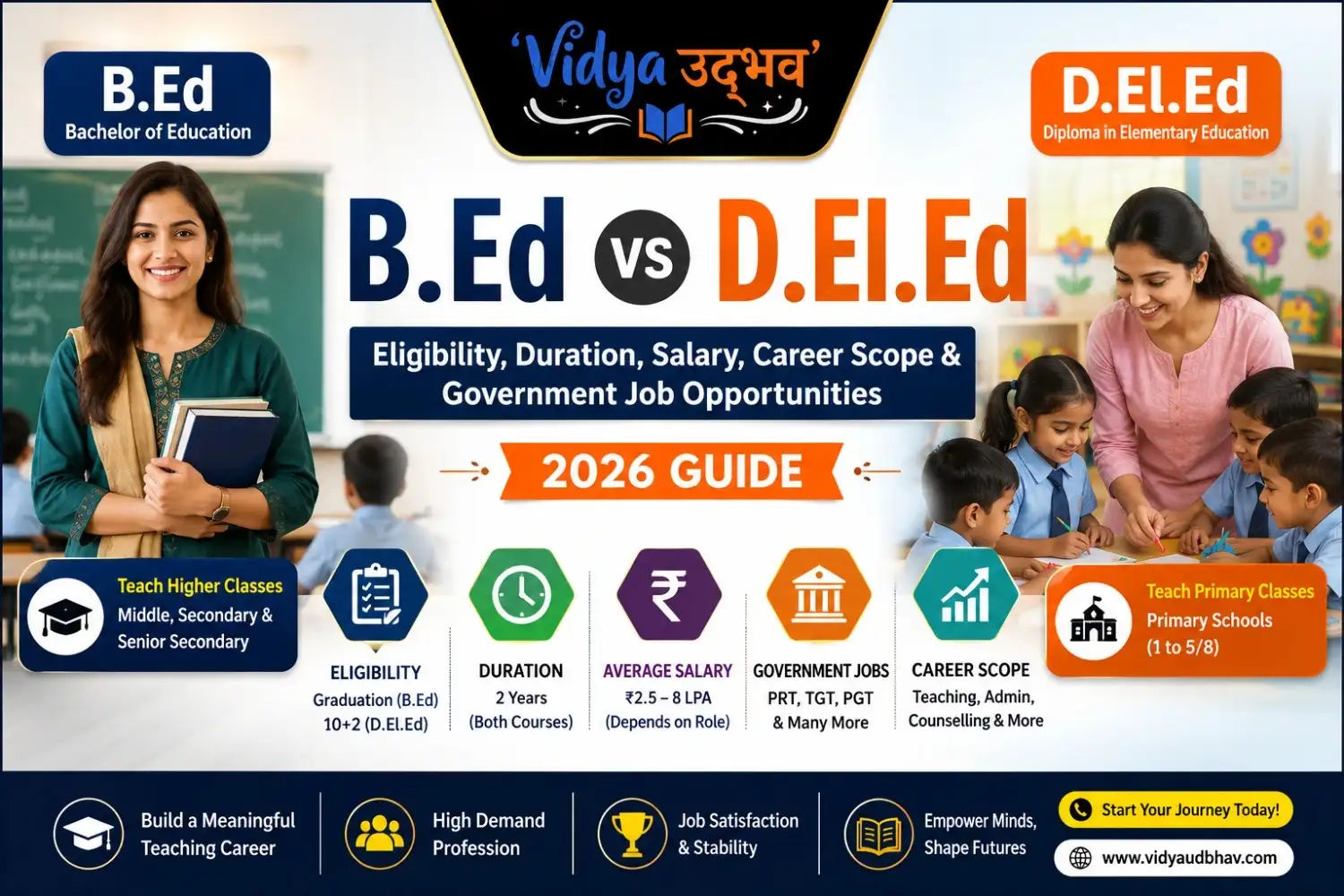
B.Ed vs D.El.Ed: Eligibility, Duration, Salary, Career Scope & Government Job Opportunities (2026 Guide)
Choosing the right teacher training course is one of the most important decisions for anyone planning a career in education. Two of the most popular options are Bachelor of Education (B.Ed) and Diploma in Elementary Education (D.El.Ed).
Although both courses prepare candidates for teaching careers, they differ significantly in eligibility, duration, career opportunities, salary potential, and the level of students you can teach.
If you're unsure which course is right for you, this comprehensive guide explains everything you need to know in simple terms.
If you're still exploring teaching careers, our career planning guide at www.vidyaudbhav.com can help you understand different education pathways before making your final decision.
Quick Answer: B.Ed vs D.El.Ed
| Course Type | Bachelor's Degree | Diploma |
| Eligibility | Graduation | 10+2 (varies by state) |
| Duration | 2 Years | 2 Years |
| Teaching Level | Secondary & Senior Secondary | Primary Schools |
| Government Jobs | TGT, PGT (with additional eligibility) | Primary Teacher (PRT) |
| Average Salary | ₹3–8 LPA | ₹2.5–5 LPA |
| Best For | Graduates | Students after Class 12 |
What is B.Ed?
Bachelor of Education (B.Ed) is a professional teaching degree designed for graduates who wish to become teachers in secondary and higher secondary schools.
The course focuses on educational psychology, classroom management, curriculum development, teaching methodologies, educational technology, and practical teaching experience.
Today, a B.Ed degree is considered essential for most secondary school teaching positions in India.
What is D.El.Ed?
Diploma in Elementary Education (D.El.Ed) is a teacher training diploma aimed at preparing candidates to teach children from Classes 1 to 8.
The course emphasizes child development, foundational literacy, inclusive education, activity-based learning, and classroom engagement techniques.
It is an excellent choice for students who want to start a teaching career immediately after completing Class 12.
Search Intent Snapshot
Primary Intent: Informational
Most readers searching for "B.Ed vs D.El.Ed" want to compare both courses before taking admission. They are looking for:
- Eligibility
- Duration
- Career opportunities
- Salary
- Government jobs
- Future scope
This guide answers each of these questions in detail.
Eligibility Criteria
B.Ed Eligibility
Generally, candidates should have:
- Bachelor's degree from a recognized university
- Minimum qualifying marks (varies by institution)
- Entrance examination (for many universities)
Some universities may also have subject-specific eligibility requirements.
D.El.Ed Eligibility
Most institutes require:
- Completion of Class 12
- Minimum percentage as prescribed
- State-level entrance examination (where applicable)
Eligibility rules may differ across states.
Course Duration
Both programs typically take 2 years to complete.
However, the academic structure differs.
B.Ed Includes
- Educational Psychology
- Teaching Methodology
- Internship
- School Observation
- Assessment Techniques
- Educational Technology
D.El.Ed Includes
- Child Development
- Primary Education Methods
- Language Teaching
- Mathematics Teaching
- Classroom Activities
- Teaching Practice
Which Students Can You Teach?
One of the biggest differences lies here.
After B.Ed
You can generally teach:
- Middle School
- Secondary School
- Senior Secondary School
Depending on eligibility tests and recruitment rules.
After D.El.Ed
You mainly teach:
- Primary Schools
- Elementary Education
- Classes 1–5
- Sometimes up to Class 8 (subject to state regulations)
B.Ed vs D.El.Ed Salary Comparison
| Primary Teacher | ₹2.5–5 LPA |
| Secondary Teacher | ₹3–7 LPA |
| Senior Secondary Teacher | ₹4–8 LPA |
| Private International Schools | ₹5–12 LPA |
Salary depends on:
- Experience
- School type
- Location
- Qualifications
- Government vs Private sector
Government schools usually offer higher long-term benefits due to allowances, pensions (where applicable), and job stability.
Government Job Opportunities
Both qualifications open doors to government teaching jobs, but the positions differ.
After D.El.Ed
Common roles include:
- Primary Teacher (PRT)
- Elementary School Teacher
- Government Primary Schools
- Rural Education Programs
After B.Ed
Popular career paths include:
- Trained Graduate Teacher (TGT)
- Post Graduate Teacher (PGT) (with additional qualifications)
- Kendriya Vidyalayas
- Navodaya Vidyalayas
- State Government Schools
- Private CBSE & ICSE Schools
Candidates generally need to qualify relevant teacher eligibility examinations as per national or state recruitment norms.
For complete preparation strategies, explore the placement preparation strategies section on www.vidyaudbhav.com.
Career Scope
Career Opportunities After B.Ed
A B.Ed degree offers diverse career options beyond classroom teaching.
Examples include:
- School Teacher
- Academic Coordinator
- Education Consultant
- Online Tutor
- Educational Content Developer
- Curriculum Designer
- Coaching Faculty
- School Administrator
Career Opportunities After D.El.Ed
Graduates commonly work as:
- Primary School Teacher
- Nursery Teacher
- Government School Teacher
- NGO Education Trainer
- Learning Support Instructor
- Early Childhood Educator
Benefits of Choosing B.Ed
- Better long-term career growth
- Higher salary potential
- Opportunities in secondary education
- Better promotion prospects
- Suitable for postgraduate teaching pathways
- Greater flexibility across education sectors
Benefits of Choosing D.El.Ed
- Start teaching earlier
- Affordable in many institutions
- Excellent for primary education
- Strong demand in elementary schools
- Ideal after Class 12
Step-by-Step: Which Course Should You Choose?
Choose B.Ed If You:
- Already have a bachelor's degree.
- Want to teach higher classes.
- Aim for better salary growth.
- Want leadership opportunities in schools.
Choose D.El.Ed If You:
- Have completed Class 12
- Love teaching young children
- Want to enter the teaching profession early.
- Plan to become a primary teacher.
One thing many beginners miss is that choosing the right course depends more on your career goals than on salary alone.
Real-Life Example
Imagine two aspiring teachers.
Riya completed her graduation and dreams of teaching high school science. A B.Ed helps her qualify for secondary teaching roles and prepares her for competitive teacher recruitment exams.
Arjun, on the other hand, completed Class 12 and enjoys working with young children. D.El.Ed allows him to begin his teaching journey earlier while focusing on foundational education.
Both have rewarding careers—but their educational paths are different because their goals are different.
Beginner Strategy
If you're just starting your career planning:
- Identify the age group you want to teach.
- Check your current educational qualification.
- Research admission requirements.
- Compare government recruitment rules in your state.
- Plan your long-term teaching goals.
Advanced Strategy
Experienced educators often recommend combining qualifications with additional skills such as:
- Digital teaching
- Smart classroom tools
- Classroom management
- Educational psychology
- Communication skills
- Subject specialization
These skills improve employability in both government and private schools.
Common Mistakes to Avoid
Many students make avoidable mistakes during course selection.
Avoid these:
- Choosing only based on salary.
- Ignoring eligibility requirements
- Not checking state recruitment rules.
- Overlooking internship quality
- Selecting colleges without proper recognition
- Assuming both courses offer identical career opportunities
Best Practices for Success
To build a successful teaching career:
- Focus on communication skills.
- Gain practical classroom experience.
- Stay updated with education policies.
- Prepare consistently for teacher eligibility exams.
- Build digital teaching skills.
- Continue professional development through workshops and certifications.
Future Trends in Teaching (2026 and Beyond)
Education is evolving rapidly.
Emerging trends include:
- AI-assisted learning
- Smart classrooms
- Hybrid teaching models
- Personalized learning
- Digital assessments
- Inclusive education
- Skill-based curriculum
Teachers who adapt to these trends will have stronger career prospects in the coming years.
Final Advice
Both B.Ed and D.El.Ed are respected teacher training qualifications, but they serve different purposes.
If your goal is to teach young learners immediately after Class 12, D.El.Ed is a practical starting point.
If you already hold a bachelor's degree and aspire to teach secondary or senior secondary students with broader career growth, B.Ed is the better choice.
Before making a decision, assess your educational background, preferred teaching level, and long-term career goals. You can also explore the career counselling resources and education guidance articles available on www.vidyaudbhav.com to make a more informed choice.
Frequently Asked Questions (FAQs)
1. Which is better, B.Ed or D.El.Ed?
Neither is universally better. B.Ed is ideal for graduates aiming to teach secondary or senior secondary classes, while D.El.Ed is suited for those who want to teach at the primary level after Class 12.
2. Can I pursue B.Ed after D.El.Ed?
Yes. After completing the required graduation degree, you can pursue a B.Ed to expand your teaching opportunities.
3. Is D.El.Ed enough for government teaching jobs?
Yes, D.El.Ed qualifies candidates for many primary teacher positions, subject to meeting state-specific eligibility and teacher recruitment requirements.
4. What is the average salary after B.Ed?
Salaries vary by employer and experience, but many teachers earn between ₹3 lakh and ₹8 lakh per year, with higher potential in experienced or specialized roles.
5. Which course has better future scope?
B.Ed generally offers broader long-term career progression because it opens opportunities in secondary education, administration, and advanced academic roles.