

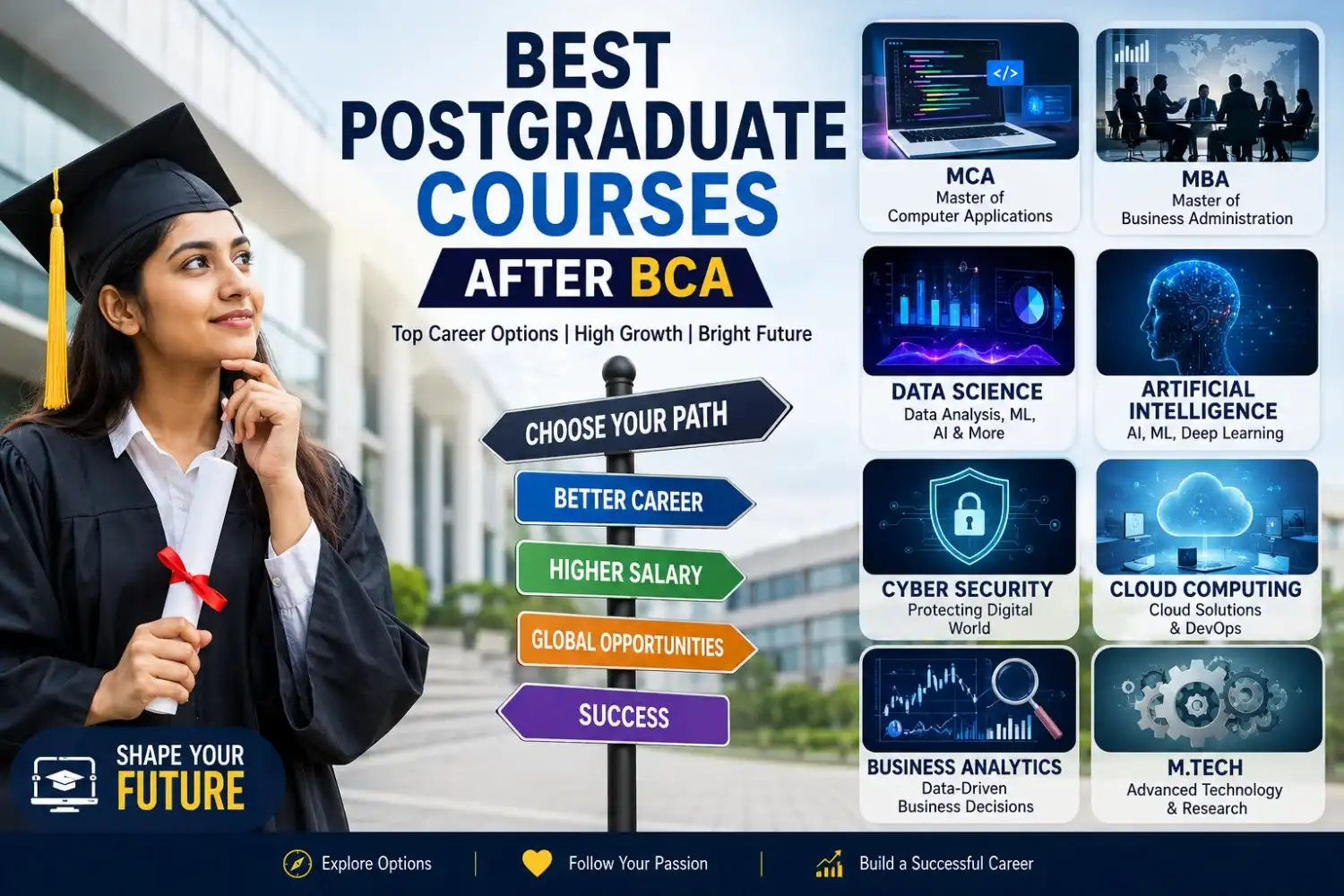
Best Postgraduate Courses After BCA: Complete Career Guide for Students
Choosing the best postgraduate courses after BCA is one of the most important decisions that can shape your career in technology, management, data science, or emerging digital industries.
A Bachelor of Computer Applications (BCA) provides a strong foundation in programming, databases, networking, software development, and computer applications. However, many students reach their final semester and begin asking a common question:
What should I do after BCA?
The answer depends on your career goals, interests, industry demand, and future earning potential.
Some graduates want to become software developers. Others dream of entering management roles, working in artificial intelligence, cybersecurity, cloud computing, or even launching their own startups.
In this detailed guide, we will explore the top postgraduate courses after BCA, their eligibility, career scope, salary potential, and how to choose the right path for long-term success.
For students planning their academic journey, exploring the career guidance resources available on Vidya Udbhav can help build a structured roadmap toward professional success.
Quick Answer: What Are the Best Postgraduate Courses After BCA?
The most popular postgraduate options include:
| MCA | 2 Years | Software Development, IT |
| MBA | 2 Years | Management, Business Leadership |
| MSc Computer Science | 2 Years | Advanced Computing |
| MSc Data Science | 2 Years | Analytics, AI |
| PG Diploma in AI & ML | 6-12 Months | Artificial Intelligence |
| PG Diploma in Cyber Security | 6-12 Months | Security & Ethical Hacking |
| MTech (For Eligible Candidates) | 2 Years | Engineering & Research |
| MSc Information Technology | 2 Years | IT Infrastructure |
| Cloud Computing Programs | 6-18 Months | Cloud Engineering |
| Business Analytics Programs | 1-2 Years | Data-Driven Business Decisions |
Understanding Your Options After BCA
Before choosing a postgraduate course, understand that there is no universal "best" option.
The right course depends on:
- Career interests
- Technical skills
- Salary expectations
- Industry demand
- Long-term goals
- Global job opportunities
One thing many beginners miss is that choosing a course based only on popularity can lead to dissatisfaction later.
Instead, align your course with your desired career path.
Why Pursue Higher Education After BCA?
A postgraduate qualification can help you:
- Gain specialization
- Improve employability
- Increase salary potential
- Access leadership roles
- Build advanced technical skills.
- Expand global career opportunities.
- Enhance professional credibility
Many multinational companies prefer candidates with specialized expertise rather than general technical knowledge.
MCA (Master of Computer Applications)
Why MCA Remains a Top Choice
MCA is often considered the most natural progression after BCA.
It builds on the concepts learned at graduation and delves deeper into advanced computing technologies.
What You Study
- Data Structures
- Advanced Programming
- Artificial Intelligence
- Cloud Computing
- Software Engineering
- Database Management
- Machine Learning
Career Opportunities
- Software Developer
- Full Stack Developer
- System Analyst
- Software Architect
- Technical Consultant
- Application Developer
Benefits
- Strong technical foundation
- High demand worldwide
- Excellent growth opportunities
- Suitable for software careers
Average Salary Potential
Entry-level salaries vary significantly based on skills, internships, and location, but generally improve considerably after an MCA compared to a BCA alone.
MBA After BCA
For Students Interested in Business and Management
Many BCA graduates move into management rather than purely technical roles.
An MBA combines business knowledge with technological understanding, creating a powerful career combination.
Popular MBA Specializations
- Information Technology
- Business Analytics
- Marketing
- Finance
- Human Resources
- Operations Management
Career Opportunities
- IT Manager
- Product Manager
- Business Analyst
- Project Manager
- Operations Manager
- Technology Consultant
Why Choose an MBA?
You might be wondering why a technology graduate should pursue management.
Modern organizations need professionals who understand both technology and business.
This combination often leads to leadership roles faster.
MSc Computer Science
Advanced Technical Expertise
An MSc in Computer Science is ideal for students who enjoy theoretical and technical computing concepts.
Key Subjects
- Algorithms
- Computational Theory
- Advanced Programming
- Data Science
- Software Systems
Career Roles
- Research Associate
- Software Engineer
- Data Analyst
- Academic Professional
- Computer Scientist
Best For
Students interested in research, development, and advanced computing.
MSc Data Science
One of the Fastest-Growing Career Fields
Data has become one of the world's most valuable assets.
Organizations rely heavily on data-driven decisions.
Core Topics
- Statistics
- Machine Learning
- Data Visualization
- Predictive Analytics
- Big Data Technologies
Career Opportunities
- Data Scientist
- Data Analyst
- Business Intelligence Analyst
- Machine Learning Engineer
Why It Matters
Companies across healthcare, finance, retail, education, and technology actively seek data professionals.
Artificial Intelligence and Machine Learning Programs
Future-Focused Career Path
AI and Machine Learning continue to transform industries worldwide.
Skills Covered
- Neural Networks
- Deep Learning
- Natural Language Processing
- Computer Vision
- Predictive Modeling
Career Roles
- AI Engineer
- ML Engineer
- AI Researcher
- Data Scientist
Advantages
- High global demand
- Excellent salary potential
- Strong future relevance
Cyber Security Courses
Protecting the Digital World
As cyber threats continue increasing, cyber security professionals remain in demand globally.
Topics Covered
- Network Security
- Ethical Hacking
- Security Operations
- Digital Forensics
- Threat Intelligence
Career Opportunities
- Security Analyst
- Ethical Hacker
- Cyber Security Consultant
- Security Engineer
Industry Demand
Governments, banks, healthcare institutions, and technology companies continuously hire cybersecurity experts.
Cloud Computing Programs
A Growing Global Opportunity
Businesses increasingly move operations to cloud platforms.
As a result, cloud professionals are among the most sought-after technology specialists.
Areas of Study
- Cloud Architecture
- Virtualization
- DevOps
- Cloud Security
- Infrastructure Management
Career Options
- Cloud Engineer
- DevOps Engineer
- Solutions Architect
- Infrastructure Specialist
Business Analytics Programs
Bridging Technology and Business
Business Analytics helps organizations make informed decisions using data.
Skills Developed
- Data Analysis
- Visualization
- Reporting
- Business Intelligence
- Strategic Planning
Career Roles
- Business Analyst
- Data Consultant
- Analytics Specialist
- Strategy Analyst
Can You Do MTech After BCA?
This is one of the most frequently asked questions among students.
The Short Answer
Yes, but eligibility depends on:
- University regulations
- Entrance requirements
- Additional qualifications
- Integrated programs
Some institutions require a relevant postgraduate qualification before admission.
Always verify eligibility criteria before applying.
Students can explore educational planning resources on Vidya Udbhav to understand admission pathways more effectively.
Step-by-Step Guide to Choosing the Right Postgraduate Course
Step 1: Identify Your Interests
Ask yourself:
- Do I enjoy coding?
- Do I enjoy management?
- Do I like research?
- Am I interested in data analysis?
Step 2: Define Career Goals
Choose between:
- Technical careers
- Management careers
- Research careers
- Entrepreneurial careers
Step 3: Evaluate Industry Demand
Focus on high-growth fields such as:
- AI
- Data Science
- Cloud Computing
- Cyber Security
Step 4: Assess Financial Investment
Compare:
- Tuition costs
- Return on investment
- Placement opportunities
Step 5: Review Future Growth
Think beyond your first job.
Choose a course that remains relevant for the next decade.
Common Mistakes Students Make After BCA
Here is where many people make mistakes.
Choosing Based on Friends
Your friend's ideal course may not be right for you.
Ignoring Industry Trends
Technology evolves rapidly.
Always evaluate future demand.
Focusing Only on Salary
High salaries often require advanced skills and consistent learning.
Avoiding Skill Development
A degree alone is rarely enough today.
Practical skills matter equally.
Not Building a Portfolio
Projects, internships, and certifications significantly improve employability.
Real-Life Career Scenarios
Scenario 1: Future Software Developer
Rahul enjoys programming and software projects.
Best option:
- MCA
- Cloud Computing Certifications
- Software Development Projects
Scenario 2: Future Manager
Ananya enjoys leadership and communication.
Best option:
- MBA in IT
- Business Analytics
Scenario 3: Future Data Scientist
David loves numbers and analytics.
Best option:
- MSc Data Science
- Machine Learning Programs
Scenario 4: Security Enthusiast
Sophia enjoys ethical hacking and network security.
Best option:
- Cyber Security Programs
- Security Certifications
Best Tools for Skill Development After BCA
Beginner-Friendly Tools
- GitHub
- VS Code
- Canva
- Notion
Data Science Tools
- Python
- R
- Tableau
- Power BI
Cloud Platforms
- AWS
- Microsoft Azure
- Google Cloud
Cyber Security Learning Tools
- Kali Linux
- Wireshark
- Burp Suite
Beginner Strategy for Career Growth
If you are still unsure, follow this roadmap:
Year 1
- Choose specialization
- Build foundational skills
- Complete certifications
Year 2
- Create projects
- Participate in internships
- Build professional networking
Year 3
- Apply for specialized roles.
- Strengthen portfolio
- Pursue advanced certifications
Students can complement this approach using the student success resources and career planning guides available on Vidya Udbhav.
Advanced Strategy for Competitive Careers
Professionals aiming for top-tier opportunities should:
- Develop niche expertise
- Build personal projects
- Contribute to open-source communities.
- Publish technical content
- Participate in hackathons
- Earn industry-recognized certifications
This becomes more important when competing for global technology roles.
Best Practices for Long-Term Success
- Continue learning regularly
- Stay updated with technology trends.
- Focus on practical experience.
- Develop communication skills
- Build professional networks
- Maintain a strong online portfolio.
The most successful professionals combine technical expertise with problem-solving and business understanding.
Future Trends After BCA
Several emerging technologies will continue creating opportunities:
Artificial Intelligence
Automation and intelligent systems are expanding rapidly.
Generative AI
Organizations increasingly integrate AI-powered solutions.
Cyber Security
Security concerns continue to grow worldwide.
Data Analytics
Data-driven decision-making remains essential.
Cloud Infrastructure
Cloud adoption is accelerating across industries.
Automation and DevOps
Organizations seek faster software delivery and deployment.
Students preparing for future-ready careers should continuously monitor these evolving sectors.
Expert Tips for Choosing the Best Postgraduate Course After BCA
- Align education with career goals.
- Prioritize skills over degree names.
- Evaluate placement outcomes.
- Research industry demand.
- Build projects throughout your studies.
- Gain internship experience early.
- Stay adaptable to changing technology trends.
- Focus on continuous learning.
Actionable Final Advice
If your goal is software development, MCA remains one of the strongest choices.
If leadership interests you, an MBA offers excellent opportunities.
If you enjoy working with data, Data Science and Business Analytics are highly rewarding.
If you are passionate about emerging technologies, AI, Machine Learning, Cyber Security, and Cloud Computing provide strong future prospects.
The best course is not necessarily the most popular one—it is the one that aligns with your strengths, interests, and long-term career vision.
Conclusion
Choosing the best postgraduate courses after BCA requires thoughtful planning and a clear understanding of your career aspirations.
Whether you select MCA, MBA, Data Science, Cyber Security, Artificial Intelligence, Cloud Computing, or Business Analytics, success ultimately depends on how effectively you combine education with practical skills and industry exposure.
The technology landscape continues evolving rapidly, creating exciting opportunities for skilled professionals worldwide. By choosing the right specialization, building real-world expertise, and staying committed to continuous learning, you can create a successful and future-ready career after BCA.
For additional educational insights, career planning guidance, and student-focused resources, explore relevant sections of www.vidyaudbhav.com to strengthen your academic and professional journey.
Frequently Asked Questions (FAQs)
1. Which is the best postgraduate course after BCA?
MCA is often considered the best option for students pursuing software and IT careers. However, MBA, Data Science, AI, Cyber Security, and Cloud Computing are also excellent choices depending on career goals.
2. Can I do an MBA after BCA?
Yes. BCA graduates are eligible for MBA programs and can specialize in areas such as IT Management, Business Analytics, Marketing, Finance, and Operations.
3. Is MCA better than MBA after BCA?
MCA is generally better for technical careers, while MBA is more suitable for management and leadership roles.
4. Can I pursue Data Science after BCA?
Yes. Data Science is one of the most promising career paths for BCA graduates, offering opportunities in analytics, machine learning, and business intelligence.
5. Is Cyber Security a good career after BCA?
Yes. Cybersecurity professionals are in high demand globally, and the field offers strong career growth and job stability.
6. What is the highest-paying course after BCA?
Courses related to Artificial Intelligence, Data Science, Machine Learning, Cloud Computing, Cyber Security, and MBA from reputed institutions often lead to high-paying opportunities.
7. Can I do MTech after BCA?
Eligibility varies by institution. Some universities may require additional qualifications or postgraduate studies before admission.