

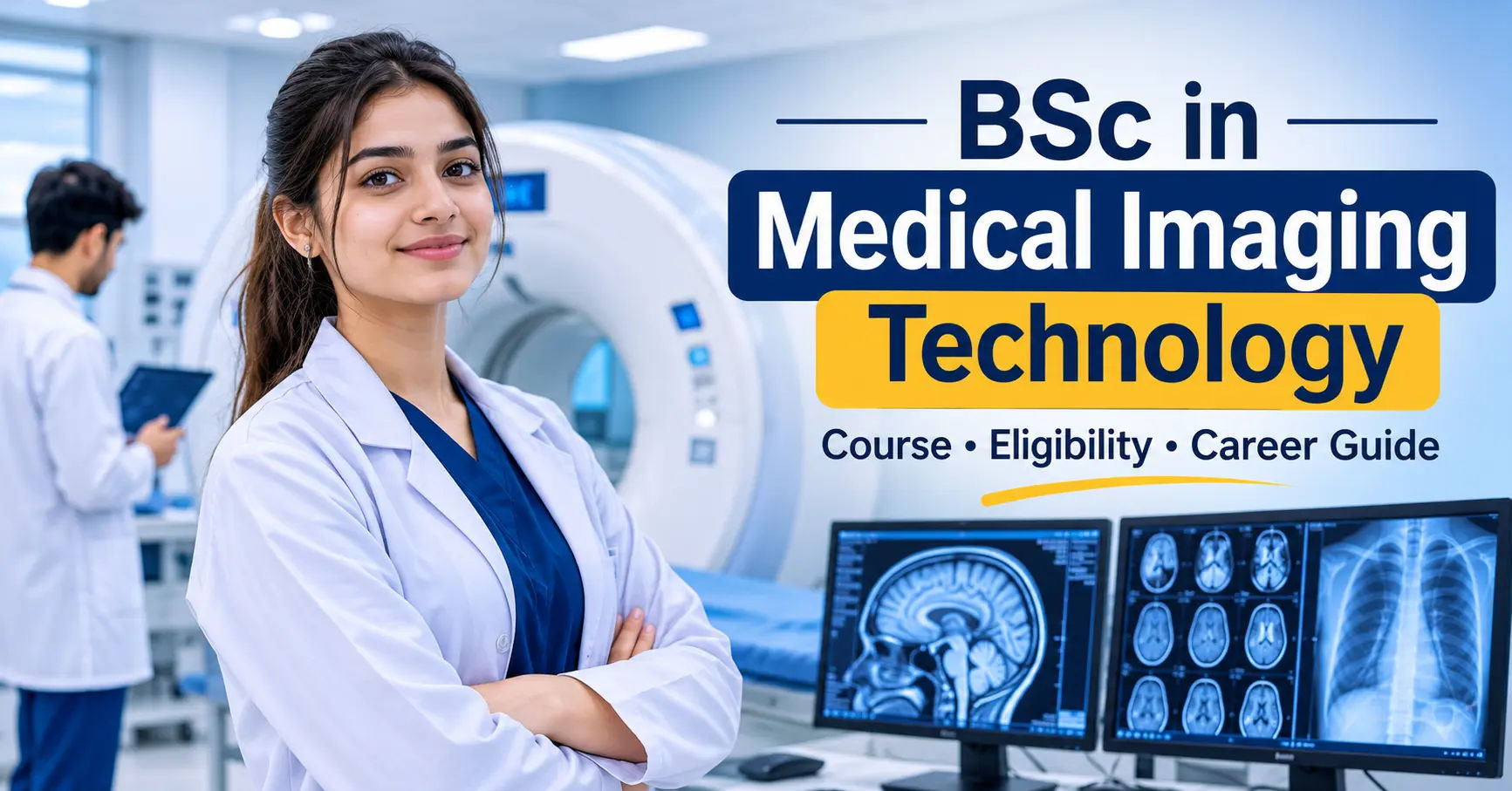
BSc in Medical Imaging Technology: Course, Eligibility, Syllabus, Career Opportunities and Future Scope
Medical imaging has become an essential part of modern healthcare. From identifying bone fractures to detecting internal organ abnormalities, imaging technologies help doctors understand what is happening inside the human body without relying entirely on invasive procedures.
For students interested in healthcare, science and advanced technology, a BSc in Medical Imaging Technology can be an interesting career option. This undergraduate programme combines medical sciences, imaging equipment, patient care and practical clinical training.
But what exactly does this course involve? What qualifications are required, how long does it take, and what career opportunities can graduates explore?
Let's understand everything you need to know before choosing this degree.
What Is BSc in Medical Imaging Technology?
BSc in Medical Imaging Technology is an undergraduate healthcare programme that prepares students to work with diagnostic imaging equipment used in hospitals, clinics and diagnostic centres.
Medical imaging professionals help produce high-quality images of internal body structures using technologies such as X-rays, computed tomography (CT), magnetic resonance imaging (MRI) and other imaging systems.
Their responsibilities include preparing patients, positioning them correctly, operating equipment within their professional scope, maintaining image quality and following patient safety procedures.
An important distinction: medical imaging technologists are not the same as radiologists. Radiologists are medical doctors who interpret diagnostic images and provide medical reports. Imaging technologists are trained to perform imaging procedures and support the diagnostic process.
Why Choose a Career in Medical Imaging Technology?
Healthcare increasingly depends on accurate diagnostic information. Imaging technology supports the detection, monitoring and management of various medical conditions.
Here are some reasons students consider this field:
- Technology-based profession: Work with advanced diagnostic equipment and digital imaging systems.
- Healthcare contribution: Support doctors in identifying and monitoring medical conditions.
- Different specialisations: Explore areas such as CT, MRI, mammography and conventional radiography.
- Multiple workplaces: Opportunities may exist in hospitals, diagnostic centres, speciality clinics and research facilities.
- Further education: Graduates can explore postgraduate studies and specialised professional training.
However, students should understand that this profession requires technical accuracy, patient interaction, discipline and continuous learning.
BSc Medical Imaging Technology: Course Overview
The course name and structure may differ between universities and countries. Some institutions offer it as BSc Medical Imaging Technology, while others use names such as Medical Radiology and Imaging Technology or Radiography and Imaging Technology.
| Degree | Bachelor of Science |
| Field | Allied Healthcare Sciences |
| Duration | Commonly 3–4 years |
| Eligibility | Usually 10+2 with relevant science subjects |
| Study Mode | Generally full-time |
| Learning Method | Classroom, laboratory and clinical training |
| Specialisations | X-ray, CT, MRI and other imaging areas |
| Career Sector | Hospitals and diagnostic facilities |
Always check the exact programme structure and recognition status with the institution before applying.
Eligibility Criteria for BSc in Medical Imaging Technology
Most universities expect applicants to complete higher secondary education or an equivalent qualification.
Common eligibility requirements include:
- Completion of Class 12 or equivalent education.
- Physics and Chemistry as relevant subjects.
- Biology is commonly required, although some institutions may accept alternative subject combinations.
- Minimum qualifying marks as specified by the university.
- English language proficiency where applicable.
Can students from a non-science background apply?
Usually, this course is designed for students with a science background. However, eligibility requirements differ, so applicants should check the admission guidelines of individual institutions.
International applicants may also need an academic equivalence certificate and additional documentation.
Subjects Covered in the Course
The curriculum combines theoretical knowledge with practical experience. Students first develop an understanding of the human body before progressing to imaging techniques and equipment operation.
Important subjects generally include:
- Human Anatomy and Physiology
- Pathology and Medical Terminology
- Radiation Physics
- Radiographic Positioning and Techniques
- Medical Imaging Equipment
- Radiation Protection and Safety
- CT and MRI Principles
- Patient Care and Medical Ethics
- Digital Image Processing
- Quality Assurance in Medical Imaging
Understanding Major Imaging Technologies
1. X-ray Imaging
X-ray technology uses ionising radiation to create images of internal structures, particularly bones and certain chest conditions.
2. Computed Tomography (CT)
CT scanners combine multiple X-ray measurements to create detailed cross-sectional images of the body.
3. Magnetic Resonance Imaging (MRI)
MRI uses strong magnetic fields and radiofrequency signals to produce detailed images of organs, soft tissues and other body structures.
4. Ultrasound Imaging
Ultrasound uses high-frequency sound waves to produce real-time images without ionising radiation.
5. Mammography
Mammography is specialised breast imaging used in breast health assessment and screening.
Practical Training and Internship
Practical experience is one of the most important parts of medical imaging education.
Students need more than textbook knowledge to become competent professionals. They must understand equipment handling, patient positioning, imaging protocols, communication and safety procedures.
Depending on the university, clinical training may involve:
- Observing experienced imaging professionals.
- Learning patient preparation and positioning.
- Understanding equipment controls and operating procedures.
- Practising image quality assessment.
- Participating in supervised clinical rotations.
- Completing an internship where required.
For example, a student may receive exposure to X-ray departments before moving into CT and MRI units during advanced clinical training.
Career Opportunities After BSc Medical Imaging Technology
Graduates can explore different professional pathways depending on their qualifications, practical experience, local regulations and employer requirements.
| Radiologic Technologist | Performing diagnostic radiography |
| CT Technologist | Supporting CT imaging procedures |
| MRI Technologist | Working with MRI equipment |
| Mammography Technologist | Performing specialised breast imaging |
| Imaging Department Assistant | Supporting imaging department operations |
| Medical Imaging Research Assistant | Supporting imaging-related research |
| Quality Assurance Assistant | Supporting equipment and image quality processes |
Where Can Graduates Work?
Potential workplaces include:
- Multispeciality hospitals
- Diagnostic imaging centres
- Cancer treatment facilities
- Speciality healthcare clinics
- Medical research organisations
- Academic and training institutions
International employment is also possible, but a degree alone may not provide automatic permission to practise in another country. Local registration, licensing, credential evaluation or additional examinations may be necessary.
Skills Required to Become a Successful Imaging Professional
Academic qualifications are important, but employers also value practical and interpersonal skills.
Students should develop:
- Technical equipment-handling abilities
- Attention to detail
- Communication and teamwork
- Patient care and empathy
- Basic computer and digital imaging knowledge
- Problem-solving skills
- Understanding of radiation protection
- Time management and professional discipline
One thing many students overlook is patient communication. A technically correct procedure can still become difficult if the patient is uncomfortable, anxious or unable to follow instructions.
Benefits and Challenges of This Career
Benefits
- Opportunity to work in a specialised healthcare profession.
- Exposure to advanced medical technologies.
- Different imaging specialisation pathways.
- Opportunities for further education and professional development.
- Meaningful contribution to patient diagnosis and care.
Challenges
- Shift-based duties may be required.
- Some procedures involve exposure to ionising radiation.
- Continuous attention to safety protocols is essential.
- Working with patients can sometimes be emotionally demanding.
- Professional licensing requirements can vary internationally.
How Can Students Overcome These Challenges?
Focus on practical training, learn radiation safety thoroughly, develop communication skills and stay updated with technological developments. Choose an institution with structured clinical exposure rather than relying only on classroom teaching.
How to Choose the Right Medical Imaging College
Selecting the right institution can influence your learning experience and career preparation.
Before applying, evaluate these factors:
- Recognition: Verify university affiliation and applicable regulatory approval.
- Clinical exposure: Check whether students receive supervised hospital training.
- Equipment availability: Ask about access to X-ray, CT and MRI facilities.
- Internship structure: Understand the duration and quality of clinical placements.
- Faculty experience: Review the qualifications of teaching and clinical staff.
- Career support: Check internship assistance, placement support and alumni outcomes.
Students should also compare tuition fees, additional charges, accommodation and admission requirements before making a decision.
For personalised educational guidance, students can explore the Vidya Udbhav student counselling platform to understand available academic guidance and course-selection support.
Future Scope of Medical Imaging Technology
Medical imaging continues to evolve through digital systems, advanced scanning techniques, image processing and artificial intelligence.
AI-assisted imaging tools are increasingly being explored to support image analysis, workflow efficiency and clinical decision-making. However, these technologies do not remove the need for trained professionals who understand patient care, equipment safety and clinical procedures.
Future professionals may benefit from developing additional knowledge in:
- AI-assisted medical imaging
- Advanced CT and MRI techniques
- Digital imaging systems
- Image management and PACS
- Quality assurance
- Research and healthcare technology
The most valuable approach is to combine a recognised qualification with strong clinical experience and continuous professional development.
Common Mistakes to Avoid Before Taking Admission
Here are some mistakes students should avoid:
- Selecting a college without checking recognition.
- Assuming every university follows the same course duration.
- Choosing a programme without adequate clinical training.
- Confusing imaging technologists with radiologists.
- Relying entirely on placement advertisements.
- Ignoring licensing requirements for international employment.
- Comparing colleges only on the basis of tuition fees.
Conclusion
A BSc in Medical Imaging Technology can provide a pathway into the growing field of diagnostic healthcare. It combines scientific knowledge, advanced imaging equipment, patient interaction and practical clinical experience.
However, choosing the right programme requires careful research. Students should compare eligibility requirements, university recognition, practical training, internship opportunities and future professional registration requirements.
If you enjoy science, technology and working in a healthcare environment, this degree may be worth exploring. Start by understanding your interests, evaluating recognised institutions and selecting a programme that supports your long-term career goals.
Frequently Asked Questions (FAQs)
1. What is the duration of BSc Medical Imaging Technology?
The programme commonly takes three to four years, depending on the university and country. Some institutions include an additional compulsory internship.
2. Can I pursue BSc Medical Imaging Technology after Class 12?
Yes. Students who have completed Class 12 with the required science subjects can generally apply, subject to the institution's eligibility criteria.
3. Is Medical Imaging Technology a good career option?
It can be a suitable career for students interested in healthcare, diagnostic equipment and patient care. Career opportunities depend on qualifications, experience and local professional requirements.
4. What subjects are taught in Medical Imaging Technology?
Common subjects include Anatomy, Physiology, Pathology, Radiation Physics, Radiographic Techniques, CT, MRI, Patient Care and Radiation Safety.
5. Can I work abroad after completing this degree?
Yes, international opportunities may be available. However, each country has its own qualification assessment, registration, licensing and certification requirements.
6. What is the difference between a radiologist and an imaging technologist?
A radiologist is a medical doctor trained to interpret medical images and diagnose conditions. An imaging technologist performs imaging procedures and operates diagnostic equipment within their authorised professional scope.
7. Does BSc Medical Imaging Technology include practical training?
Yes. Practical laboratory sessions and supervised clinical training are important components of the programme. The exact duration and structure depend on the institution.
8. Can I pursue higher studies after BSc Medical Imaging Technology?
Yes. Depending on eligibility and local regulations, graduates may explore postgraduate programmes in medical imaging, radiology-related technology, healthcare sciences and specialised clinical fields.