

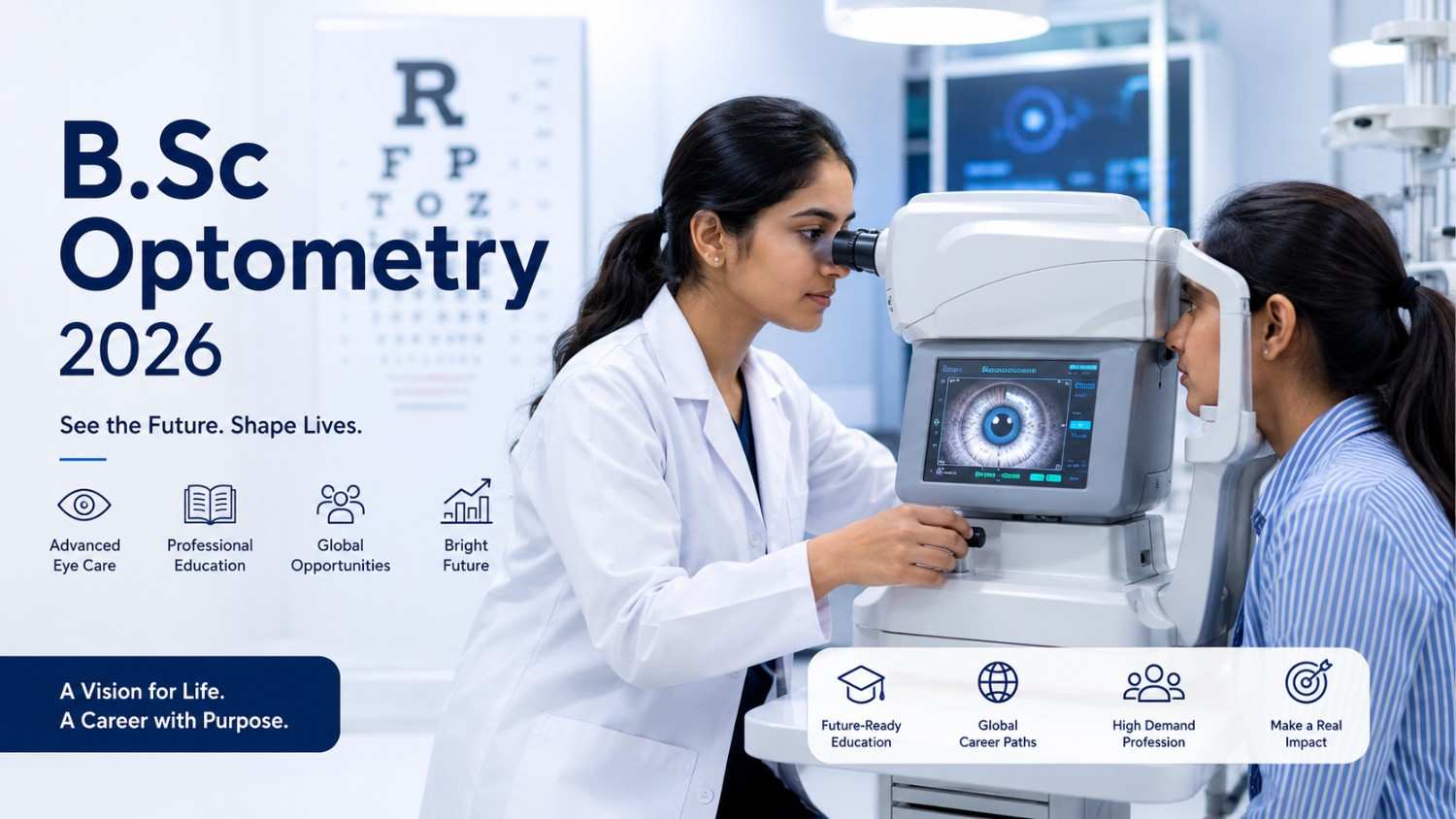
B.Sc Optometry 2026 – Course & Career Guide
The healthcare industry continues to evolve rapidly, and vision care has become one of the most important specialized fields worldwide. As screen time increases and eye-related disorders become more common, the demand for qualified optometrists is growing across hospitals, eye clinics, research institutions, and healthcare organizations.
If you are a student interested in healthcare but do not necessarily want to become a doctor through an MBBS program, a B.Sc. Optometry can be an excellent alternative. It offers a rewarding career, strong employment opportunities, and the chance to make a meaningful impact on people's lives.
This comprehensive guide explains everything you need to know about B.Sc Optometry 2026, including eligibility, admission process, syllabus, career opportunities, salary expectations, future scope, and expert strategies for success.
Students exploring healthcare careers may also benefit from career planning resources available through Vidya Udbhav, including educational guidance, admission counseling, and professional development support.
Quick Answer: What is B.Sc Optometry?
B.Sc Optometry is a 3 to 4-year undergraduate healthcare program focused on eye care, vision science, visual systems, eye disorders, diagnostic techniques, and corrective vision management.
Graduates are trained to:
- Conduct eye examinations
- Diagnose vision problems
- Prescribe corrective lenses
- Detect eye diseases
- Assist ophthalmologists
- Manage vision rehabilitation
- Operate advanced diagnostic equipment.
An optometrist serves as a primary eye care professional and plays a critical role in preventive vision healthcare.
B.Sc Optometry Course Overview
| Course Name | Bachelor of Science in Optometry |
| Course Level | Undergraduate |
| Duration | 3–4 Years (including internship in many institutions) |
| Eligibility | 10+2 with Science Stream |
| Admission Mode | Merit-Based or Entrance Exam |
| Career Field | Healthcare & Vision Sciences |
| Average Starting Salary | ₹3 LPA – ₹6 LPA |
| Higher Studies | M.Sc Optometry, MPH, MBA Healthcare, PhD |
| Global Opportunities | High |
Why Choose B.Sc Optometry in 2026?
Healthcare careers are becoming increasingly specialized. Vision care is among the fastest-growing sectors because of several global trends:
- Increased digital screen usage
- Growing aging population
- Rising awareness of eye health
- Expansion of eye care facilities
- Technological advancements in diagnostics
- Demand for preventive healthcare
This creates strong opportunities for qualified optometrists worldwide.
One thing many students miss is that optometry combines medical knowledge, patient interaction, technology, and healthcare management, making it a versatile career path.
Eligibility Criteria for B.Sc Optometry 2026
Most institutions require students to meet the following criteria:
Academic Qualification
Candidates should have completed:
- 10+2 or equivalent
- Science stream preferred
- Physics, Chemistry, Biology and/or Mathematics
Minimum Marks
Requirements vary by institution but generally range from:
- 45%–60% aggregate marks
Age Requirement
Most colleges require candidates to be at least 17 years old at the time of admission.
Students uncertain about healthcare career options can explore educational counseling and career assessment resources through relevant student guidance sections on Vidya Udbhav.
Admission Process for B.Sc Optometry 2026
The admission process generally involves the following steps:
Step 1: Research Colleges
Identify institutions offering recognized optometry programs.
Step 2: Check Eligibility
Review academic requirements and admission criteria.
Step 3: Submit Application
Complete online or offline applications within deadlines.
Step 4: Entrance Examination (If Applicable)
Some institutions conduct:
- University entrance tests
- Healthcare aptitude tests
- Allied health admission exams
Step 5: Counseling and Seat Allocation
Qualified candidates participate in counseling rounds.
Step 6: Document Verification
Required documents typically include:
- Academic certificates
- Identity proof
- Passport-size photographs
- Category certificates (if applicable)
B.Sc Optometry Syllabus and Subjects
The curriculum combines theoretical knowledge with clinical training.
First-Year Subjects
- Human Anatomy
- Human Physiology
- Biochemistry
- Geometrical Optics
- Ocular Anatomy
- Basic Optometry
Second-Year Subjects
- Visual Optics
- Ocular Diseases
- Contact Lens Practice
- Optometric Instruments
- Clinical Optometry
- Pharmacology
Third-Year Subjects
- Low Vision Care
- Binocular Vision
- Community Optometry
- Pediatric Optometry
- Advanced Diagnostic Techniques
- Research Methodology
Internship Training
Many programs include practical hospital-based internships where students gain hands-on experience.
Skills Required to Become a Successful Optometrist
Academic knowledge alone is not enough.
Top optometrists typically develop:
Technical Skills
- Eye examination techniques
- Diagnostic testing
- Instrument handling
- Vision assessment
Soft Skills
- Communication
- Patient counseling
- Problem-solving
- Attention to detail
Digital Skills
Modern eye care increasingly relies on:
- Electronic medical records
- Diagnostic software
- Telehealth platforms
- Vision analysis systems
Career Opportunities After B.Sc Optometry
One of the biggest advantages of this degree is the variety of career paths available.
Clinical Optometrist
Work directly with patients in hospitals and eye clinics.
Contact Lens Specialist
Specialize in fitting and managing contact lenses.
Pediatric Optometrist
Focus on children's vision care.
Vision Therapist
Help patients improve visual performance through therapy programs.
Low Vision Specialist
Assist individuals with significant visual impairments.
Research Associate
Participate in vision science and healthcare research projects.
Academic Professional
Teach future optometry students in educational institutions.
Healthcare Administrator
Manage eye care facilities and healthcare operations.
Top Industries Hiring Optometrists
Qualified professionals may find opportunities in:
- Hospitals
- Eye Care Centers
- Vision Clinics
- Optical Chains
- Research Institutions
- Medical Device Companies
- Educational Institutions
- Public Health Organizations
- Rehabilitation Centers
Salary After B.Sc Optometry
Salary varies based on location, experience, specialization, and employer.
| Fresh Graduate | ₹3–6 LPA |
| 2–5 Years | ₹5–10 LPA |
| Senior Professional | ₹10–18 LPA |
| Specialist Roles | ₹15 LPA+ |
International opportunities often offer significantly higher compensation.
Global Scope of Optometry
You might be wondering whether optometry has international career potential.
The answer is yes.
Countries actively seeking eye care professionals include:
- United States
- Canada
- Australia
- United Kingdom
- New Zealand
- Singapore
Many professionals pursue licensing pathways and advanced qualifications to work internationally.
Benefits of Pursuing B.Sc Optometry
Growing Demand
Eye care services are expanding globally.
Patient Impact
Professionals help improve the quality of life through better vision.
Diverse Career Options
Clinical, academic, research, and corporate opportunities exist.
Technology Exposure
Work with advanced diagnostic equipment and healthcare technologies.
Stable Career Growth
Healthcare remains one of the most resilient employment sectors.
Challenges Students Should Know
Every career has challenges.
Continuous Learning
Eye care technologies evolve rapidly.
Licensing Requirements
Some countries require additional certifications.
Patient Responsibility
Accurate diagnosis is critical.
Competition
Top positions often require advanced specialization.
Understanding these challenges early helps students prepare effectively.
Higher Education Options After B.Sc Optometry
Students interested in specialization can pursue:
M.Sc Optometry
Advanced clinical and research-focused education.
Master of Public Health (MPH)
Ideal for community healthcare leadership.
MBA in Healthcare Management
Useful for administrative and management roles.
Fellowship Programs
Specialized training in advanced eye care fields.
PhD in Vision Sciences
Suitable for research and academic careers.
Real-Life Career Example
Consider a student who completes B.Sc Optometry and joins a vision clinic as a junior optometrist.
Within two years, they gain expertise in diagnostic testing and contact lens management.
After pursuing an M.Sc specialization, they transition into a senior clinical role, eventually leading a team of eye care professionals.
This progression demonstrates how skill development and specialization can significantly enhance career growth.
Tools and Technologies Used in Modern Optometry
Modern optometrists frequently work with:
| Auto Refractors | Vision Testing |
| Retinal Cameras | Eye Imaging |
| OCT Systems | Retina Analysis |
| Keratometers | Corneal Measurement |
| Visual Field Analyzers | Vision Assessment |
| Digital Eye Testing Systems | Diagnosis |
Understanding these technologies can improve employability and clinical effectiveness.
Beginner Strategy for Success in Optometry
If you are just starting your journey, focus on:
- Building strong science fundamentals.
- Improving communication skills.
- Learning basic clinical concepts.
- Participating in healthcare internships.
- Staying updated on industry developments.
Students can complement their preparation through career development resources, admission guidance, and student success roadmaps available on Vidya Udbhav.
Advanced Career Growth Strategy
After graduation:
Build Clinical Expertise
Hands-on experience is invaluable.
Pursue Certifications
Specialized certifications improve career prospects.
Develop Research Skills
Research experience increases academic and professional opportunities.
Learn Healthcare Technology
Digital healthcare knowledge is increasingly valuable.
Network Professionally
Industry conferences and professional associations can accelerate growth.
Common Mistakes to Avoid
Here is where many students make mistakes.
Choosing a Course Without Research
Understand the curriculum and career outcomes first.
Ignoring Clinical Exposure
Practical experience is essential.
Weak Communication Skills
Patient interaction is a major part of the profession.
Avoiding Specialization
Specialized expertise often leads to better career opportunities.
Neglecting Industry Trends
The healthcare sector evolves continuously.
Best Practices for Future Optometrists
- Prioritize patient-centered care.
- Maintain professional ethics.
- Stay updated on new technologies.
- Focus on lifelong learning.
- Build interdisciplinary healthcare knowledge.
- Develop leadership and management skills.
These practices help professionals remain competitive in a changing healthcare landscape.
Future Trends in Optometry Beyond 2026
The future of optometry looks highly promising.
Emerging trends include:
Tele-Optometry
Remote eye consultations are expanding.
AI-Assisted Diagnostics
Artificial intelligence is improving disease detection.
Digital Vision Care
Growing demand due to increased screen exposure.
Personalized Eye Care
Customized treatment approaches are becoming common.
Preventive Vision Healthcare
Early detection and prevention will play larger roles.
Professionals who adapt to these trends will have a significant advantage.
Actionable Final Advice for Students
If you enjoy science, healthcare, patient interaction, and technology, B.Sc Optometry can be an excellent career choice.
Before applying:
- Research institutions carefully.
- Compare curriculum structures.
- Understand internship opportunities.
- Explore higher education pathways.
- Build long-term career goals.
A well-planned educational journey often leads to stronger career outcomes and greater professional satisfaction.
Conclusion
B.Sc Optometry 2026 offers an exciting blend of healthcare, technology, and patient care. With increasing awareness of eye health, growing global demand for vision professionals, and expanding career opportunities, optometry remains one of the most promising allied healthcare careers available today.
Whether your goal is clinical practice, research, education, healthcare management, or international opportunities, this degree provides a strong foundation for long-term professional success.
Students seeking structured educational planning, admission guidance, and career preparation support can explore relevant resources and career planning guides available through Vidya Udbhav to make informed academic decisions.
Frequently Asked Questions (FAQs)
1. Is B.Sc Optometry a good career in 2026?
Yes. Increasing eye care needs, technological advancements, and rising healthcare demand make optometry a strong career choice in 2026 and beyond.
2. What is the duration of B.Sc Optometry?
Most programs last 3 to 4 years, depending on the institution and internship requirements.
3. Can I pursue B.Sc Optometry after 12th Science?
Yes. Students who complete 10+2 with science subjects are generally eligible.
4. What is the average salary after B.Sc Optometry?
Fresh graduates typically earn between ₹3 lakh and ₹6 lakh annually, with higher earnings possible through specialization and experience.
5. Can optometrists work abroad?
Yes. Many countries offer opportunities for qualified optometrists, though licensing requirements may vary.
6. Is NEET required for B.Sc Optometry?
In many institutions, NEET is not mandatory. Admission may be based on merit or institution-specific entrance examinations.
7. What are the best higher study options after B.Sc Optometry?
Popular options include M.Sc Optometry, MPH, MBA Healthcare Management, fellowship programs, and PhD studies.