

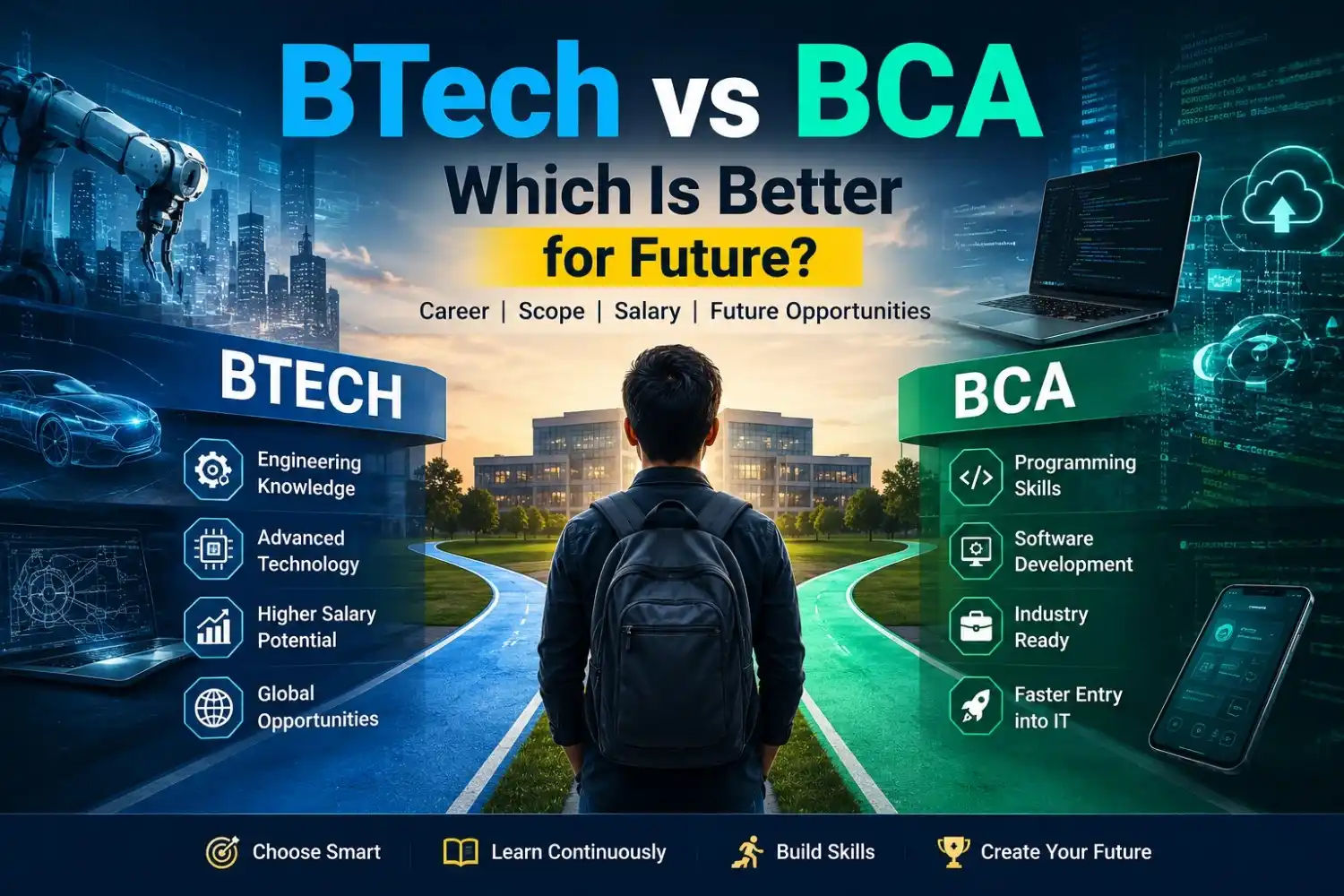
BTech vs BCA: Which Is Better for the Future?
Choosing the right career path after 12th grade has become more confusing than ever. Technology is evolving rapidly, artificial intelligence is changing industries, and students want courses that offer long-term career security, global opportunities, and strong salary growth.
Among the most popular options in the tech field, two courses dominate the conversation: B.Tech. and BCA.
But here comes the big question:
BTech vs BCA, which is better for the future?
The answer is not as simple as choosing one over the other. Both degrees can lead to successful careers in technology, software development, cybersecurity, cloud computing, AI, data science, and IT management. However, the better option depends on your goals, budget, learning style, career expectations, and long-term vision.
Some students want faster entry into the IT industry. Others want deeper technical expertise and engineering-level opportunities. Many also wonder which degree performs better globally, especially with the rise of remote jobs and AI-driven careers.
This detailed guide will help you understand every major difference between BTech and BCA in practical terms.
If you are planning your career journey, you should also explore career planning resources and educational guidance available on www.vidyaudbhav.com for better course selection and future preparation.
Quick Comparison: B.Tech. vs. BCA
| Full Form | Bachelor of Technology | Bachelor of Computer Applications |
| Duration | 4 Years | 3 Years |
| Focus | Engineering & Technical Depth | Software & Application Development |
| Eligibility | PCM in 12th | Any Stream in many colleges |
| Coding Level | Advanced | Moderate to Advanced |
| Fees | Higher | Lower |
| Entrance Exams | Often Required | Usually Merit-Based |
| Career Scope | Broad Engineering Roles | IT & Software Roles |
| Average Starting Salary | Higher Initially | Moderate Initially |
| Higher Study Options | MTech, MBA, MS | MCA, MBA, MS |
| Global Recognition | Very High | Growing Rapidly |
| Best For | Technical & Engineering Careers | Software & IT Careers |
Understanding BTech
What Is BTech?
BTech, or Bachelor of Technology, is a professional engineering degree focused on technical knowledge, engineering concepts, programming, problem-solving, and system development.
Students usually specialize in areas such as:
- Computer Science Engineering
- Artificial Intelligence
- Data Science
- Cybersecurity
- Mechanical Engineering
- Electronics
- Civil Engineering
When people compare BTech and BCA, most comparisons focus specifically on BTech in Computer Science or IT-related branches.
Understanding BCA
What Is BCA?
BCA, or Bachelor of Computer Applications, is a professional undergraduate program focused on computer applications, programming, software development, databases, networking, and web technologies.
Unlike B.Tech., BCA is more application-oriented rather than engineering-oriented.
Students typically study:
- Programming languages
- Web development
- Mobile app development
- Database management
- Cloud basics
- Networking fundamentals
- Software tools
BCA has become extremely popular among students who want to enter the IT industry without pursuing engineering.
Search Intent Analysis: Why Students Compare BTech and BCA
Students searching for “BTech vs BCA, which is better for the future” usually want answers related to:
- Salary comparison
- Future job security
- AI and automation impact
- Global opportunities
- Course difficulty
- Coding careers
- Software developer jobs
- Higher studies
- ROI and affordability
This becomes more important when students come from middle-income families and want maximum career return with minimum risk.
BTech vs BCA: Core Differences Explained
1. Course Structure
BTech
BTech focuses heavily on:
- Engineering mathematics
- Algorithms
- Operating systems
- Data structures
- Networking
- Hardware concepts
- Software engineering
- System architecture
The curriculum is usually more technical and intensive.
BCA
BCA focuses more on:
- Software applications
- Coding fundamentals
- Website development
- Database handling
- Practical software tools
- IT applications
The learning curve is comparatively easier for beginners.
2. Eligibility Criteria
BTech Eligibility
Most universities require:
- Physics
- Chemistry
- Mathematics (PCM)
Many colleges also require entrance exams.
BCA Eligibility
BCA is more flexible.
Many universities allow:
- Commerce students
- Arts students
- Biology students
- PCM students
This is one reason BCA attracts a wider range of students globally.
Which Course Is Better for Coding?
This is one of the biggest misconceptions.
Many students assume that only BTech students become successful software developers.
That is no longer true.
Today, companies care more about:
- Skills
- Projects
- Problem-solving ability
- Portfolio
- Internships
- Real-world coding experience
A highly skilled BCA student can outperform an average BTech student.
However, BTech usually provides:
- Stronger computer science fundamentals
- Better exposure to algorithms
- Deeper system knowledge
Meanwhile, BCA often helps students become job-ready faster in practical software development.
BTech vs BCA Salary Comparison
Starting Salary Comparison
| Software Developer | Higher | Moderate |
| Web Developer | Similar | Similar |
| Data Analyst | Higher | Moderate |
| IT Support | Similar | Similar |
| Cybersecurity | Higher | Moderate |
| App Developer | Similar | Similar |
Important Reality
Initial salary differences exist.
But after 3–5 years, skills matter far more than degree names.
One thing many beginners miss is this:
The tech industry rewards expertise, not just qualifications.
A BCA graduate with strong coding skills, certifications, internships, and projects can earn more than many engineering graduates.
Which Has Better Future Scope?
Future Scope of BTech
BTech offers strong opportunities in:
- Artificial Intelligence
- Robotics
- Machine Learning
- Semiconductor industries
- Core engineering
- Software architecture
- Research & Development
BTech is particularly valuable for students aiming for:
- Product-based companies
- High-level technical roles
- Engineering leadership positions
Future Scope of BCA
BCA is growing rapidly because the world needs:
- Software developers
- Web developers
- App developers
- Cloud professionals
- Digital transformation experts
- IT support specialists
With the rise of remote work and freelancing, BCA graduates now have more global opportunities than ever before.
Which Degree Is Better for AI and Future Technology?
Artificial intelligence is changing the job market globally.
You might be wondering whether BTech or BCA is safer in the AI era.
Here is what actually works:
AI will replace repetitive work, not skilled professionals.
Students who continuously upgrade skills will remain valuable regardless of their degree.
BTech Advantage in AI
BTech provides:
- Strong mathematics
- Advanced algorithms
- Machine learning foundations
- Engineering-level AI understanding
BCA Advantage in AI
BCA students can still enter AI careers by learning:
- Python
- Data analytics
- AI tools
- Cloud platforms
- Automation systems
Today, many AI developers come from non-engineering backgrounds.
Career Opportunities After BTech
Popular Careers
- Software Engineer
- AI Engineer
- Cloud Engineer
- DevOps Engineer
- Data Scientist
- System Architect
- Cybersecurity Analyst
- Game Developer
- Robotics Engineer
- Full Stack Developer
Career Opportunities After BCA
Popular Careers
- Web Developer
- Software Developer
- UI/UX Developer
- Database Administrator
- Mobile App Developer
- Technical Support Engineer
- IT Analyst
- Digital Product Executive
- Cloud Support Associate
- Freelance Developer
BTech vs BCA: Which Is More Difficult?
BTech Difficulty Level
BTech is generally tougher because it includes:
- Advanced mathematics
- Engineering subjects
- Technical theory
- Hardware concepts
- Complex programming structures
Students need consistent discipline.
BCA Difficulty Level
BCA is relatively easier for beginners.
The curriculum is often more practical and software-focused.
This makes BCA attractive for students who want a smoother entry into IT careers.
Cost Comparison: BTech vs BCA
| Tuition Fees | High | Moderate |
| Hostel Expenses | Often High | Lower in many colleges |
| Coaching Costs | Common | Usually Lower |
| Duration Cost | 4 Years | 3 Years |
| ROI Speed | Slower Initially | Faster for many students |
For students looking for affordable technology education, BCA often offers better financial flexibility.
BTech vs BCA for Abroad Opportunities
BTech Abroad Scope
BTech is widely recognized globally and preferred for:
- Engineering jobs
- Research roles
- Technical specialization
- Higher studies abroad
BCA Abroad Scope
BCA graduates also get opportunities globally, especially in:
- Software development
- IT support
- Cloud computing
- Web technologies
- Digital services
Many students strengthen their BCA careers with MCA or international certifications.
Higher Studies Options
After BTech
Students can pursue:
- MTech
- MBA
- MS Abroad
- Data Science Specialization
- AI Programs
After BCA
Students commonly choose:
- MCA
- MBA
- MSc IT
- Cybersecurity Courses
- Cloud Certifications
Interestingly, many recruiters consider BCA + MCA equivalent to engineering-level expertise for software roles.
Skills That Matter More Than a Degree
This is where many students make mistakes.
They focus only on the degree title.
But companies increasingly value:
- Coding ability
- GitHub projects
- Communication skills
- Internship experience
- Problem-solving
- Portfolio quality
- Real-world exposure
A weak BTech profile struggles.
A strong BCA profile succeeds.
Real-Life Career Scenarios
Scenario 1: Engineering-Oriented Student
A student interested in:
- Advanced computing
- AI research
- System design
- Robotics
will likely benefit more from BTech.
Scenario 2: Fast IT Career Entry
A student wants:
- Faster graduation
- Lower fees
- Early employment
- Freelancing opportunities
may find BCA more practical.
Scenario 3: Startup & Freelancing Career
Many successful freelancers and startup founders come from BCA backgrounds because they focus heavily on practical development skills.
Best Skills to Learn Alongside BTech or BCA
Regardless of degree, students should learn:
- Python
- JavaScript
- SQL
- Cloud computing
- Git & GitHub
- AI tools
- Data analytics
- UI/UX basics
- Communication skills
You can also improve career readiness through educational guidance and student preparation resources available at www.vidyaudbhav.com.
Best Tools and Platforms for Students
Beginner-Friendly Tools
- Canva
- GitHub
- VS Code
- Figma
- Notion
Coding Platforms
- LeetCode
- HackerRank
- CodeChef
Cloud & AI Platforms
- AWS
- Google Cloud
- Azure
Learning Platforms
- Coursera
- Udemy
- edX
Mistakes Students Should Avoid
1. Choosing Based Only on Salary
Initial salary should not be the only factor.
Long-term growth matters more.
2. Ignoring Skill Development
Degrees alone are no longer enough.
Continuous learning is essential.
3. Following Peer Pressure
Many students choose BTech simply because their friends are doing it.
Career decisions should match personal strengths.
4. Ignoring Financial Reality
Education loans and high fees can create pressure.
Students should evaluate ROI carefully.
5. Not Building Projects
Projects matter massively in the IT industry.
A strong portfolio can outperform academic scores.
Expert Tips for Choosing Between BTech and BCA
Choose BTech If:
- You enjoy mathematics
- You want engineering depth.
- You aim for AI/research roles.
- You want broader technical exposure.
- You can manage a longer and tougher curriculum.
Choose BCA If:
- You want faster IT entry.
- You prefer practical software learning.
- You want affordable education.
- You enjoy coding more than engineering theory.
- You plan to build strong technical skills independently.
Beginner Strategy for Long-Term Success
No matter which degree you choose:
Step 1: Master One Programming Language
Start with:
- Python
- Java
- JavaScript
Step 2: Build Projects
Examples:
- Portfolio website
- Chat application
- AI chatbot
- Expense tracker
Step 3: Gain Internship Experience
Practical experience changes career outcomes significantly.
Step 4: Create LinkedIn & GitHub Presence
Global recruiters increasingly check online portfolios.
Step 5: Learn AI Tools
AI productivity skills will become essential across industries.
Advanced Career Strategy
Students aiming for top-tier careers should focus on:
- Open-source contributions
- Hackathons
- Competitive coding
- AI integration skills
- Cloud certifications
- Remote international internships
This combination often matters more than degree labels.
Future Trends in Technology Careers
The future IT industry will heavily demand:
- AI engineers
- Automation specialists
- Cybersecurity experts
- Cloud architects
- Full-stack developers
- Data professionals
Both BTech and BCA graduates can succeed in these industries.
However, adaptability will decide long-term success.
BTech vs BCA: Final Comparison Summary
| Engineering Depth | BTech |
| Faster Graduation | BCA |
| Lower Cost | BCA |
| Technical Foundations | BTech |
| Practical Software Skills | BCA |
| Higher Initial Salary | BTech |
| Flexible Entry | BCA |
| Research Opportunities | BTech |
| Freelancing Potential | BCA |
| Long-Term Growth | Depends on Skills |
So, Which Is Better for the future?
There is no universal winner.
The better course depends on your:
- Career goals
- Financial situation
- Learning preference
- Technical interest
- Long-term vision
Choose BTech if you want deep engineering expertise and advanced technical roles.
Choose BCA if you want practical IT skills, affordability, and faster entry into the software industry.
The most successful professionals in technology are not always the ones with the most prestigious degrees.
They are the ones who continuously learn, adapt, and build valuable skills.
For students planning careers in technology, software, or global IT industries, career guidance platforms like www.vidyaudbhav.com can help simplify educational decisions and future planning strategies.
Frequently Asked Questions (FAQs)
1. Is BCA better than BTech for software development?
BCA can be excellent for software development if students focus on coding skills, projects, and internships. BTech usually provides stronger theoretical foundations.
2. Which has a higher salary: B.Tech. or BCA?
BTech graduates often get higher starting salaries, but long-term salary depends more on skills, experience, and specialization.
3. Can BCA students work in AI and data science?
Yes. BCA students can enter AI and data science by learning Python, machine learning, cloud computing, and analytics tools.
4. Is B.Tech. harder than BCA?
Generally yes. BTech includes advanced engineering mathematics and technical theory, making it more academically demanding.
5. Can BCA students get jobs abroad?
Absolutely. Skilled BCA graduates can work globally in software development, cloud computing, cybersecurity, and IT support roles.
6. Which course is more affordable?
BCA is usually more affordable than BTech in terms of tuition fees and total education cost.
7. Is MCA necessary after BCA?
Not always. Many BCA graduates get jobs directly. However, MCA can improve career growth and advanced opportunities.
Final Thoughts
The debate around “BTech vs BCA, which is better for the future” will continue because both degrees offer strong opportunities in the digital economy.
Technology careers no longer depend only on degrees.
They depend on:
- Skills
- Adaptability
- Continuous learning
- Problem-solving
- Real-world experience
If you focus on building expertise, practical exposure, and future-ready skills, both BTech and BCA can lead to highly successful careers globally.