

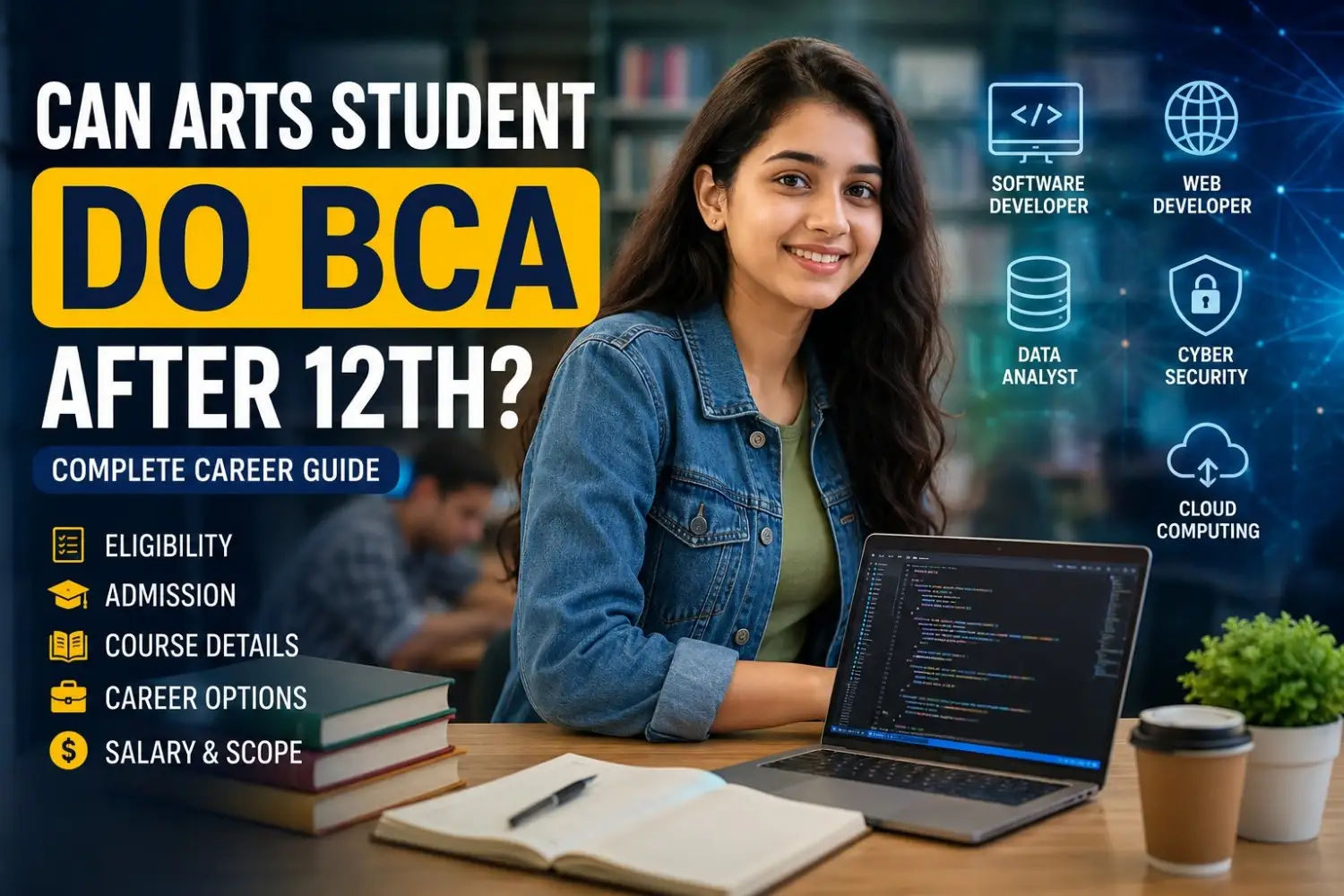
Introduction
One of the most common questions students ask after completing Class 12 is: Can an arts student do a BCA after 12th?
The simple answer is yes.
Today, many universities and colleges allow Arts students to pursue a Bachelor of Computer Applications (BCA) even if they did not study Science or Mathematics in school.
As technology continues to transform industries worldwide, BCA has become one of the most popular undergraduate programs for students interested in computers, software, programming, and information technology.
If you are an Arts student wondering whether BCA is the right choice, this guide will help you understand the eligibility, admission requirements, career opportunities, salary expectations, required skills, and future growth prospects.
Students exploring career options after Class 12 can also benefit from the career planning resources available on Vidya Udbhav, including educational guidance, professional development, and student success roadmaps.
Quick Answer: Can an Arts Student Do BCA After 12th?
Yes, Arts Students Can Pursue BCA
Most universities and colleges now accept Arts students for BCA admissions.
However, eligibility requirements vary depending on the institution.
Some colleges:
- Accept students from any stream.
- Require minimum qualifying marks.
- Prefer a Mathematics or Computer Science background.
- Conduct entrance examinations
Fortunately, a large number of institutions worldwide welcome Arts students into BCA programs.
What Is BCA?
Definition
Bachelor of Computer Applications (BCA) is a three-year undergraduate degree focused on computer science, software development, programming, databases, networking, and IT applications.
The course prepares students for careers in:
- Software Development
- Web Development
- Data Analytics
- Cybersecurity
- Cloud Computing
- Artificial Intelligence
- IT Support
- Mobile App Development
Why Arts Students Are Choosing BCA
Technology is no longer limited to Science students.
Modern industries need professionals who can combine:
- Technical skills
- Communication abilities
- Creativity
- Problem-solving
- Analytical thinking
Arts students often possess strong communication and creative skills, making them valuable contributors in the IT sector.
Eligibility Criteria for BCA After 12th Arts
The exact eligibility depends on the university.
Common Eligibility Requirements
| Education | 12th Pass |
| Stream | Arts, Commerce, Science |
| Minimum Marks | 45%–60% |
| Entrance Exam | In Some Colleges |
| Mathematics Requirement | Varies by Institution |
Many universities now offer admissions without requiring Mathematics in Class 12.
Can Arts Students Do BCA Without Mathematics?
Yes.
This is one of the biggest concerns among students.
Many colleges allow Arts students to pursue BCA even if they did not study Mathematics.
However:
Some Universities Require Mathematics
These institutions may ask for:
- Mathematics in Class 12
- Mathematics in Class 10
- Bridge courses during the program
Some Universities Do Not Require Mathematics
These institutions focus more on:
- Overall academic performance
- Entrance test scores
- Interview performance
Always verify admission criteria before applying.
Subjects Taught in BCA
Many students assume BCA is entirely about coding.
In reality, the curriculum is designed for beginners.
Core Subjects
Programming Languages
- C
- C++
- Java
- Python
Database Management
- SQL
- Database Design
- Data Storage
Computer Networks
- Internet Technologies
- Networking Concepts
Software Engineering
- Software Development Process
- Project Management
Operating Systems
- Windows
- Linux
- System Management
Web Technologies
- HTML
- CSS
- JavaScript
Data Structures
- Algorithms
- Problem Solving
Is BCA Difficult for Arts Students?
The Honest Answer
Not necessarily.
Initially, Arts students may face a learning curve because technical concepts are new.
However, thousands of Arts students successfully complete the BCA every year.
What Helps Students Succeed
- Consistent learning
- Practice coding regularly
- Use online resources
- Participate in projects
- Develop logical thinking
One thing many beginners miss is that programming is a skill, not a talent.
With practice, most students become comfortable with coding.
Benefits of Doing BCA After 12th Arts
1. Enter the IT Industry
BCA provides direct access to technology careers.
2. Strong Career Growth
Technology remains one of the fastest-growing sectors globally.
3. Multiple Specialization Options
Students can specialize in:
- Data Science
- Artificial Intelligence
- Cybersecurity
- Cloud Computing
- Software Development
4. Global Opportunities
IT professionals are in demand across countries and industries.
5. Higher Education Pathways
After BCA, students can pursue:
- MCA
- MBA
- MSc IT
- Data Science Programs
- Cybersecurity Certifications
Students interested in long-term career growth can also explore educational planning and higher-study guidance available through Vidya Udbhav.
Skills Arts Students Should Develop Before Joining BCA
Technical Skills
- Basic computer knowledge
- Internet usage
- Typing proficiency
- Familiarity with software applications
Soft Skills
- Communication
- Teamwork
- Presentation skills
- Critical thinking
Analytical Skills
- Logical reasoning
- Problem-solving
- Pattern recognition
These skills significantly improve academic performance during BCA.
Step-by-Step Guide to Pursuing BCA After 12th Arts
Step 1: Research Universities
Check:
- Eligibility requirements
- Curriculum
- Placement records
- Industry partnerships
Step 2: Understand Admission Criteria
Some institutions offer:
- Merit-based admission
- Entrance-based admission
Step 3: Prepare Required Documents
Typically:
- Class 10 Marksheet
- Class 12 Marksheet
- Identity Proof
- Passport-size Photographs
Step 4: Apply to Multiple Institutions
Applying to several colleges increases admission opportunities.
Step 5: Build Basic Computer Knowledge
Before classes begin, learn:
- Computer fundamentals
- MS Office
- Internet concepts
- Basic programming
Career Opportunities After BCA
One of the strongest reasons students choose BCA is the wide range of career opportunities.
Software Developer
Develop software applications and systems.
Web Developer
Create and maintain websites.
Mobile App Developer
Build applications for smartphones and tablets.
Data Analyst
Analyze business and customer data.
System Administrator
Manage computer networks and infrastructure.
Cybersecurity Analyst
Protect systems from security threats.
Cloud Support Associate
Work with cloud-based technologies.
Technical Support Engineer
Provide technical solutions to users and businesses.
Salary After BCA
Salary depends on:
- Country
- Skills
- Experience
- Certifications
- Employer
Typical Career Progression
| Experience Level | Salary Potential |
| Fresher | Entry-Level |
| 2–5 Years | Mid-Level Growth |
| 5–10 Years | Senior Positions |
| 10+ Years | Leadership Roles |
Students who continuously upgrade their skills often achieve significantly higher earning potential.
Real-Life Example
From Arts Student to Software Professional
Consider a student who completed Class 12 in Arts and had no prior coding experience.
During BCA, the student:
- Learned Python
- Built small projects
- Completed internships
- Earned certifications
Within three years, the student secured a position as a junior software developer.
This demonstrates that prior stream selection does not determine future success in technology.
Common Challenges Arts Students Face
Challenge 1: Fear of Programming
Solution
Start with beginner-friendly languages such as Python.
Challenge 2: Lack of Mathematics Background
Solution
Focus on logical reasoning and basic mathematical concepts.
Challenge 3: Technical Terminology
Solution
Learn gradually through practical projects.
Challenge 4: Confidence Issues
Solution
Join coding communities and participate in workshops.
Beginner Strategy for Success in BCA
If you are starting from an Arts background:
First Year
Focus on:
- Computer fundamentals
- Programming basics
- Communication skills
Second Year
Focus on:
- Projects
- Internships
- Skill development
Third Year
Focus on:
- Placements
- Portfolio building
- Advanced certifications
This structured approach helps students become industry-ready.
Advanced Strategy for Career Growth
Students aiming for higher-paying opportunities should learn:
Programming
- Python
- Java
- JavaScript
Cloud Computing
- AWS
- Azure
- Google Cloud
Data Analytics
- Power BI
- SQL
- Excel
Artificial Intelligence
- Machine Learning
- Data Science
Cybersecurity
- Ethical Hacking
- Network Security
Combining BCA with specialized certifications often accelerates career growth.
Best Tools for BCA Students
Beginner-Friendly Tools
- Visual Studio Code
- Notepad++
- GitHub
Free Learning Platforms
- FreeCodeCamp
- Codecademy
- Coursera
Premium Learning Platforms
- Udemy
- Pluralsight
- LinkedIn Learning
These tools help students gain practical experience beyond classroom learning.
Mistakes to Avoid
Here is where many people make mistakes.
Ignoring Practical Skills
Theory alone is not enough.
Avoiding Coding Practice
Programming improves through consistent practice.
Waiting Until Final Year
Start building projects from the first year.
Ignoring Communication Skills
Technical skills and communication skills work together.
Not Creating a Portfolio
A portfolio showcases your capabilities to employers.
Expert Tips for Arts Students Entering BCA
Learn One Programming Language Well
Depth matters more than quantity.
Build Projects Early
Projects strengthen understanding.
Join Tech Communities
Networking creates opportunities.
Complete Internships
Practical exposure increases employability.
Stay Updated
Technology changes rapidly.
Continuous learning is essential.
Future Scope of BCA
The future looks highly promising.
Growing fields include:
- Artificial Intelligence
- Machine Learning
- Cloud Computing
- Data Science
- Cybersecurity
- Automation
- Software Development
As digital transformation expands globally, skilled BCA graduates will continue to find opportunities across industries.
Comparison: BCA vs Other Popular Courses for Arts Students
| Course | Technology Focus | Career Opportunities | Industry Demand |
| BCA | High | Very High | Very High |
| BA | Low | Moderate | Moderate |
| BBA | Medium | High | High |
| BJMC | Low | Medium | Moderate |
| B.Com | Medium | High | High |
For students interested in technology and digital careers, BCA often provides broader opportunities.
Actionable Final Advice
If you are an Arts student wondering whether BCA is the right choice, focus on the following:
- Verify eligibility requirements.
- Learn basic computer skills.
- Practice logical reasoning.
- Start coding early.
- Build real projects.
- Complete internships.
- Develop communication skills.
- Continue learning emerging technologies.
Following these steps can significantly improve your chances of academic and career success.
Conclusion
So, can an arts student do BCA after 12th?
Absolutely.
Arts students can successfully pursue BCA, build technical expertise, and establish rewarding careers in the IT industry.
Your academic stream does not define your future potential. What matters most is your willingness to learn, adapt, and consistently improve your skills.
With the growing demand for technology professionals worldwide, BCA remains one of the strongest career options available for Arts students seeking future-ready opportunities.
Students looking for additional educational guidance, career planning resources, placement preparation strategies, and student success roadmaps can explore related content available on Vidya Udbhav.
Frequently Asked Questions (FAQs)
1. Can an Arts student apply for BCA after Class 12?
Yes. Most colleges and universities allow Arts students to apply for BCA programs.
2. Is Mathematics compulsory for BCA?
Not always. Many institutions admit students without Mathematics, although some may require it.
3. Can Arts students become software developers after BCA?
Yes. BCA provides the knowledge and skills needed to become a software developer.
4. Is BCA a good career option for Arts students?
Yes. BCA offers strong career opportunities in IT, software development, data analytics, and other technology fields.
5. What is the duration of BCA?
The standard duration of a BCA program is three years.
6. Can I pursue MCA after BCA?
Yes. MCA is one of the most popular higher education options after completing BCA.
7. What skills should Arts students learn before BCA?
Basic computer knowledge, logical reasoning, communication skills, and introductory programming concepts are beneficial.