

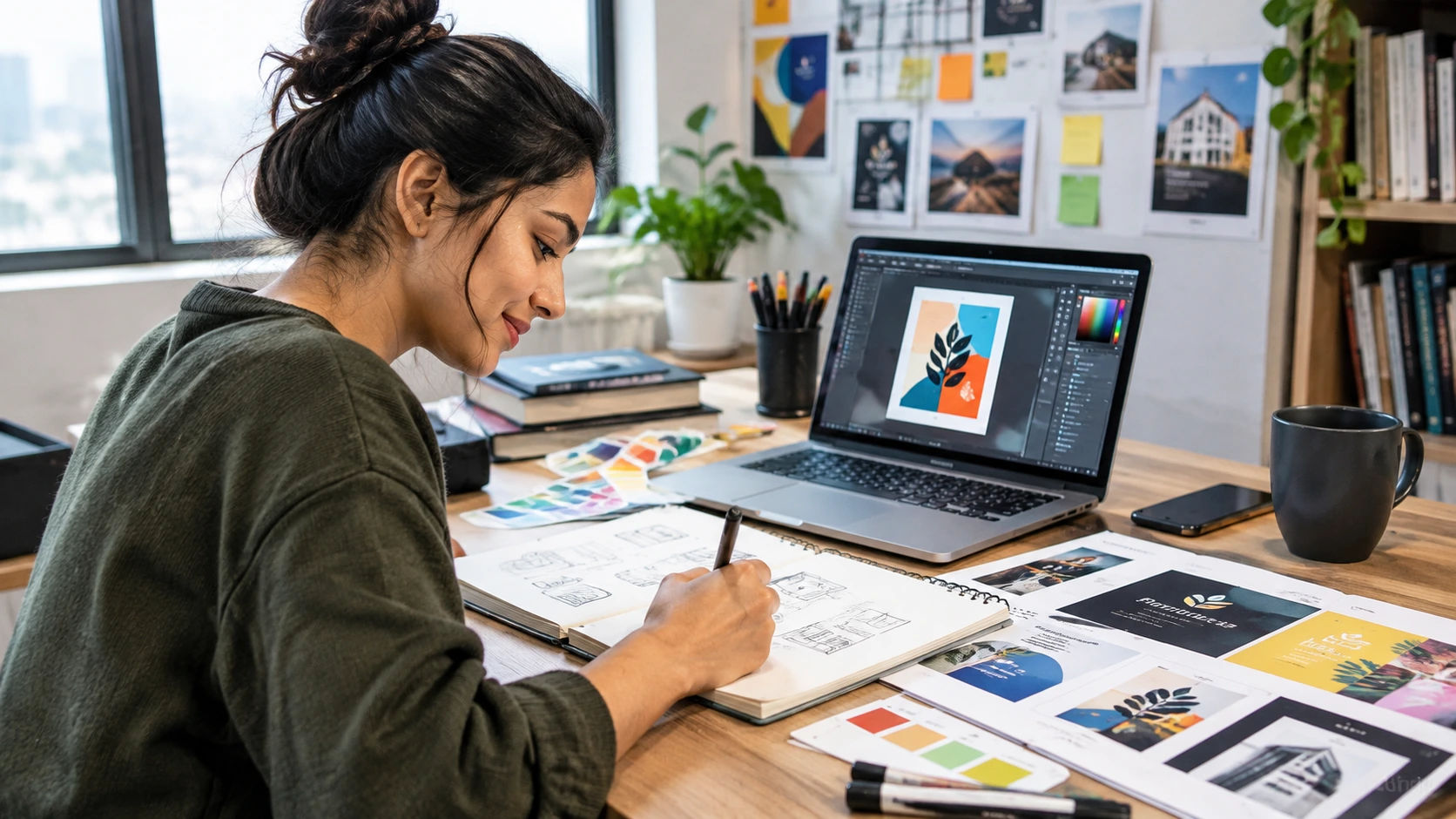
Yes, you can become a graphic designer without a degree. A formal qualification can be useful for structured learning and certain job applications. Still, graphic design is also a skill-driven field where your portfolio, design ability, software knowledge, creativity, and practical experience can play a major role.
For beginners, the real question is not simply whether you have a degree. It is whether you can create effective visual communication and demonstrate your ability through actual work.
If you are currently confused about which creative career suits your interests and strengths, this career guidance guide can help you evaluate your options.
Quick Answer: Can You Become a Graphic Designer Without a Degree?
Yes. You can start a graphic design career without a formal graphic design degree by:
- Learning fundamental design principles.
- Practising with design software.
- Creating real and self-initiated projects.
- Building a professional portfolio.
- Getting freelance, internship, or project experience.
- Learning how to communicate with clients.
- Continuously improving your skills.
However, requirements vary between employers, countries, industries, and individual job postings. Some organisations may still prefer or require formal qualifications, while other opportunities focus more heavily on demonstrated skills and experience. Indeed's 2026 career guidance notes that many graphic design roles do not have specific education requirements.
What Does a Graphic Designer Actually Do?
A graphic designer uses visual elements to communicate an idea, message, product, or brand.
Typical work can include:
- Social media graphics
- Posters and flyers
- Logos and brand identities
- Advertisements
- Presentations
- Brochures
- Packaging
- Website graphics
- Infographics
- Digital marketing creatives
- YouTube thumbnails
- Marketing materials
Modern designers may work across print, digital marketing, websites, mobile interfaces, video content, and branding.
The important point is that graphic design is not simply about making something "look attractive." A good design has a purpose. It guides attention, communicates information, supports a brand, and makes content easier to understand.
Degree vs Skills: What Matters More?
A degree can provide structured education, feedback, theory, networking, and access to formal academic environments.
But a degree alone does not automatically make someone a good designer.
Consider two candidates:
| Degree | Design degree | No design degree |
| Portfolio | Basic | Strong and varied |
| Software skills | Intermediate | Advanced |
| Real projects | Limited | Several |
| Design fundamentals | Good | Strong |
| Client experience | None | Freelance experience |
For some employers, Candidate A's qualification may matter. For many practical design opportunities, Candidate B's demonstrated ability may be highly relevant.
That is why beginners should focus on building both knowledge and evidence of skill.
What Skills Do You Need to Become a Graphic Designer?
You do not need to master everything on day one.
Start with these foundations.
1. Typography
Learn how fonts work together, how hierarchy is created, and how text can remain readable across different screen sizes.
2. Colour Theory
Understand colour combinations, contrast, visual mood, accessibility, and brand consistency.
3. Layout and Composition
Learn how to arrange text, images, shapes, and space so the viewer naturally understands the design.
4. Visual Hierarchy
A viewer should quickly understand what is most important.
For example, a promotional flyer might need this hierarchy:
Main offer → Product/service → Supporting information → Call to action
5. Branding
Learn how colours, fonts, logos, imagery, and design style work together to create a consistent identity.
6. Communication
A designer often works with people who cannot explain design terminology. You need to understand their objective and translate it into a visual solution.
Which Tools Should Beginners Learn?
You do not need ten different applications.
Start with one beginner-friendly tool and gradually add professional software.
Beginner-Friendly Options
- Canva
- Adobe Express
- Figma
Professional Design Tools
- Adobe Photoshop
- Adobe Illustrator
- Adobe InDesign
Adobe describes Illustrator as a vector design tool suitable for logos, icons, typography, illustrations, and scalable graphics, while Photoshop is widely used for image editing, compositing, and graphic design.
The tool is only part of the process. Knowing where to click is not the same as knowing why a particular layout, font, image, or colour should be used.
How to Become a Graphic Designer Without a Degree: Step-by-Step
Step 1: Learn Design Fundamentals
Before worrying about getting clients, understand typography, colour, spacing, alignment, contrast, composition, and hierarchy.
Study good designs and ask yourself why they work.
Step 2: Choose One Design Niche
Do not try to become an expert in everything immediately.
You could start with:
- Social media design
- Branding
- Logo design
- Marketing flyers
- Presentation design
- UI design
- YouTube thumbnails
- Print design
Choosing a starting niche makes practice more focused.
Step 3: Practise With Realistic Projects
This is where many beginners make mistakes.
Instead of creating random designs endlessly, give yourself realistic briefs.
For example:
Project: Create a promotional campaign for a fictional coffee brand.
Create:
- Instagram post
- Story
- Flyer
- Menu
- Promotional banner
You now have a small campaign rather than five unrelated designs.
Step 4: Build a Portfolio
Your portfolio is your evidence.
Include your strongest work rather than uploading everything you have ever created.
A beginner portfolio could contain:
- 3 social media campaigns
- 2 branding projects
- 2 promotional flyers
- 1 presentation project
- 1 personal branding project
Explain the objective behind each project when possible.
Step 5: Gain Practical Experience
You can gain experience through:
- Freelancing
- Internships
- Volunteer projects
- Personal projects
- Student organizations
- Small businesses
- Content creators
- Startup projects
The goal is to understand real requirements, deadlines, revisions, feedback, and communication.
Step 6: Start Applying for Opportunities
Search for roles such as:
- Junior Graphic Designer
- Visual Designer
- Social Media Designer
- Creative Designer
- Marketing Designer
- Freelance Graphic Designer
Read each job description carefully because qualification requirements differ between employers.
Benefits of Becoming a Graphic Designer Without a Degree
There are several potential advantages to a self-taught route.
Lower Initial Education Cost
You can learn through books, tutorials, practice projects, courses, and software without necessarily committing to a multi-year design degree.
Flexible Learning
You can learn around school, college, employment, or other responsibilities.
Faster Portfolio Development
Instead of waiting until graduation to create professional-style projects, you can start building a portfolio immediately.
Practical Skill Development
Self-directed learning encourages you to solve actual design problems rather than only study theory.
Global Opportunities
Graphic design can be delivered digitally, which can create opportunities to work with clients or companies in different locations.
Still, global competition also means your portfolio needs to communicate your capabilities clearly.
Challenges of Becoming a Designer Without a Degree
The non-degree route has challenges too.
Lack of Structured Learning
You have to decide what to learn and in what order.
No Built-In Network
A formal program may provide classmates, instructors, alumni, and career connections.
Portfolio Quality Takes Time
Watching tutorials is much easier than developing professional-level design judgment.
Some Jobs Have Qualification Requirements
Certain employers may list formal education as a requirement or preference.
Self-Doubt
Beginners often compare their first projects with designers who have years of experience.
The practical solution is simple: measure your progress against your previous work.
What Is More Important: Certificate, Degree, or Portfolio?
They serve different purposes.
| Degree | Structured education and academic qualification | Takes more time and money |
| Certificate | Shows completion of specific learning | Does not automatically demonstrate design ability |
| Portfolio | Demonstrates actual work | Requires significant practice |
| Experience | Shows real-world application | Can take time to build |
For a practical design career, these elements can complement one another rather than being mutually exclusive.
Real-Life Example
Imagine a student who has completed Class 12 and enjoys creating Instagram posts.
Instead of immediately worrying about having no degree, the student could spend the next six months learning design fundamentals, practising with Canva or Adobe tools, recreating selected design styles for practice, developing original projects, and building a portfolio.
After that, the student could approach local businesses, creators, agencies, or freelance platforms with a focused portfolio.
This approach creates something valuable: proof of ability.
For students still deciding between creative, technical, business, and other career options, exploring career opportunities based on skills and interests can help before committing to a particular direction.
Beginner Strategy: A Simple 90-Day Roadmap
Month 1: Learn
Focus on:
- Typography
- Colour
- Layout
- Composition
- Basic branding
- One design application
Month 2: Practise
Create at least 10–15 meaningful projects.
Do not simply copy templates. Understand the design decisions and then create your own solutions.
Month 3: Build
Create a portfolio with your strongest work.
Then start:
- Applying for internships
- Contacting potential clients
- Taking small freelance projects
- Asking for feedback
- Improving weak portfolio pieces
Consistency matters more than trying to become an expert overnight.
Advanced Strategy: Combine Graphic Design With Another Skill
One thing many beginners miss is that design becomes more valuable when combined with another professional skill.
For example:
Graphic Design + Digital Marketing
You can create advertisements and understand how visual content supports campaigns.
Graphic Design + Video Editing
You can create thumbnails, social posts, reels, motion graphics, and promotional content.
Graphic Design + UI/UX
You can move toward digital interfaces and product design.
Graphic Design + Branding
You can specialise in visual identity systems rather than individual graphics.
This kind of skill combination can make your professional profile more distinctive.
Common Mistakes To Avoid
Copying Templates Without Learning Design
Templates are useful learning tools, but simply changing text and images does not develop strong design judgement.
Learning Too Many Tools
Mastering five applications poorly is less useful than becoming genuinely capable with one or two.
Ignoring Typography
A visually attractive design can still fail because the text is difficult to read.
Building a Huge but Weak Portfolio
Ten excellent projects can communicate more than fifty average ones.
Forgetting the Brief
Design should solve a communication problem, not just demonstrate creativity.
Never Asking for Feedback
External feedback can reveal problems that you no longer notice yourself.
Expert Tips for Beginners
Here is what actually works:
- Study professional designs regularly.
- Recreate practice designs, then create your own versions.
- Learn design principles before chasing trends.
- Keep your portfolio focused.
- Save editable project files.
- Learn basic client communication.
- Understand social media dimensions and formats.
- Learn how branding works.
- Develop presentation skills.
- Keep updating your portfolio.
If you are building your broader professional roadmap, this career planning resource can also help you connect skill development with longer-term career planning.
Future Trends in Graphic Design
Graphic design is changing as AI-assisted tools, automation, digital content, short-form video, and interactive experiences become more common.
This does not mean designers simply need to learn more software.
The more important shift is toward creative problem-solving.
Designers increasingly need to understand:
- Brand communication
- User behaviour
- Digital marketing
- AI-assisted workflows
- Content strategy
- Accessibility
- Motion and video
- Cross-platform design
AI can speed up certain tasks, but human judgement remains important when deciding what a design should communicate, who it is for, and whether it actually works.
Best Practices for Building a Design Career
A sustainable approach is to follow this cycle:
Learn → Practise → Create → Get Feedback → Improve → Publish → Repeat
Do not wait until you feel completely ready.
Your first portfolio will not be your final portfolio. Your skills should improve as you gain experience.
For students and professionals exploring future-focused career options, understanding how different skills connect with changing job markets is equally important. Vidya Udbhav's guide to courses for future jobs and international careers provides a broader perspective.
Frequently Asked Questions
Can I become a graphic designer without a degree?
Yes. Many graphic design opportunities focus on demonstrated skills, portfolio quality, and experience, although some employers may still require or prefer formal qualifications.
Is a graphic design certificate necessary?
No. A certificate can demonstrate that you completed training, but it is not a substitute for practical design ability and a strong portfolio.
Can I learn graphic design at home?
Yes. You can learn design principles, practise software, complete projects, and build a portfolio from home.
How long does it take to learn graphic design?
The basic tools can be learned relatively quickly, but becoming professionally capable takes consistent practice. Your progress depends on the amount and quality of practice, feedback, and real project experience.
Can I get freelance graphic design work without a degree?
Yes. Freelance clients generally evaluate the services you provide, your portfolio, communication, reliability, and ability to deliver according to their requirements.
Which software should a beginner learn first?
Canva or Adobe Express can provide an accessible starting point, while Photoshop, Illustrator, and InDesign offer more advanced professional capabilities. Adobe also provides beginner-oriented tutorials for Photoshop and other design tools.
Can graphic design become a full-time career?
Yes. Potential career paths include graphic designer, visual designer, branding designer, social media designer, marketing designer, UI designer, and freelance designer. The exact opportunities depend on your skills, specialization, location, experience, and portfolio.
Actionable Final Advice
If you want to become a graphic designer without a degree, do not spend too much time worrying about the qualification you do not have.
Instead, build the qualification that matters in practical situations: the ability to create good design and prove it through your work.
Start with design fundamentals. Learn one tool. Create realistic projects. Build a focused portfolio. Get feedback. Take small opportunities. Then gradually move toward more complex work.
A degree can be one route into graphic design, but it is not the only route.
Your career path should ultimately depend on your interests, strengths, learning goals, practical circumstances, and the opportunities available to you.
Conclusion
So, can you become a graphic designer without a degree? Absolutely, in many career paths.
The journey is less about collecting credentials and more about developing genuine design skills, creating meaningful work, gaining experience, and continuously improving.
If you are considering graphic design as a career, start experimenting today. One well-designed project can teach you more about your strengths and interests than hours of simply thinking about whether you are qualified.
The goal is not to prove that degrees do not matter. The goal is to understand that there are multiple ways to develop a career—and practical skills, experience, and a strong portfolio can be an important part of that journey.
Read Previous Blog:
https://vidyaudbhav.com/blogs/how-to-become-an-icu-nurse-in-india
https://vidyaudbhav.com/blogs/non-clinical-career-options-after-nursing