

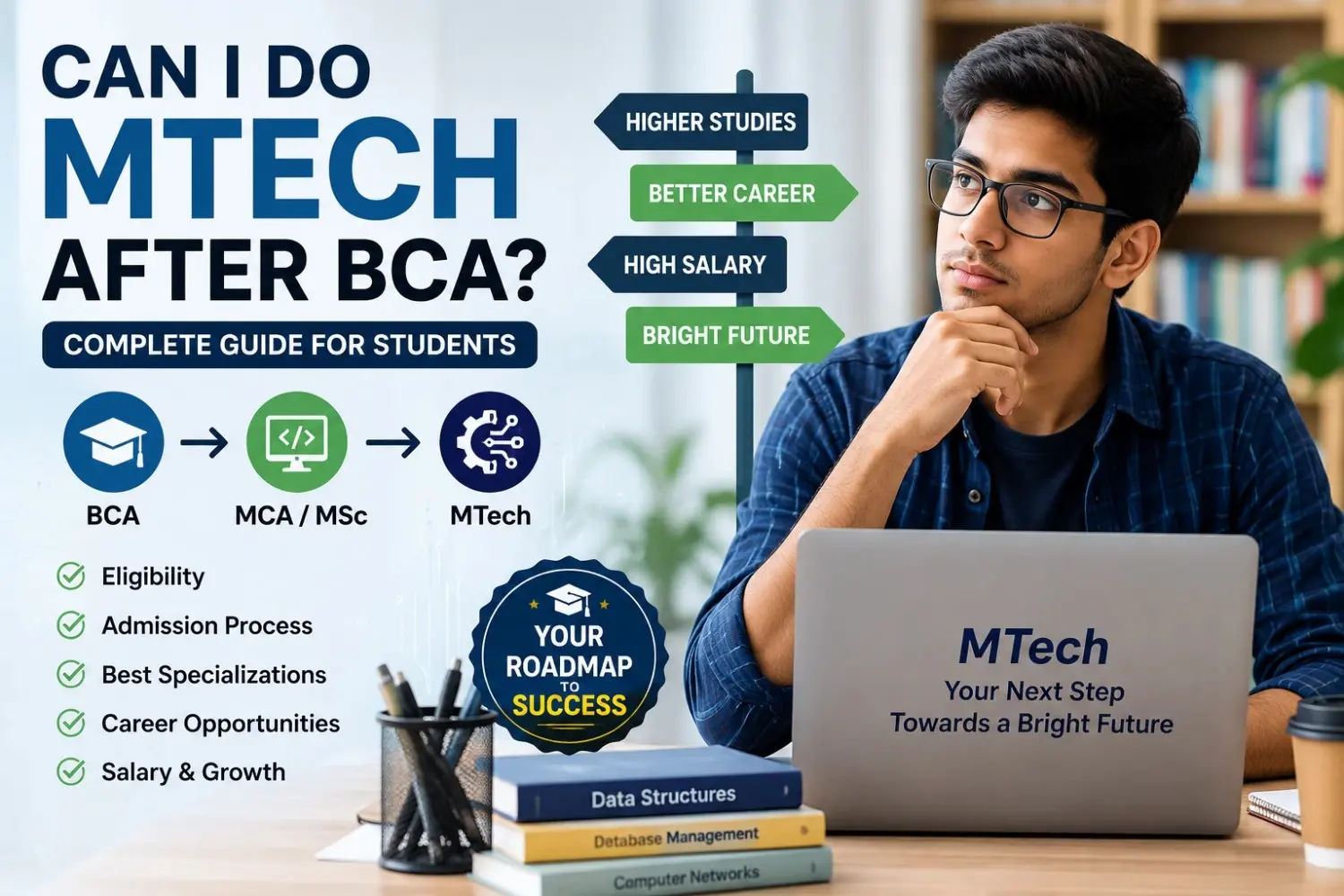
Can I Do MTech After BCA? Complete Career Roadmap for Students
Choosing the right career path after graduation can feel overwhelming, especially for students from a computer applications background. One of the most frequently asked questions is: Can I do MTech after BCA?
The short answer is yes, but not directly in most cases.
Many students complete a Bachelor of Computer Applications (BCA) and later develop an interest in advanced technology fields such as Artificial Intelligence, Data Science, Cybersecurity, Software Engineering, Cloud Computing, or Machine Learning. Naturally, they begin exploring whether an MTech degree can help them achieve their career goals.
In this detailed guide, you will learn everything about pursuing MTech after BCA, including eligibility requirements, alternative pathways, admission processes, career opportunities, salary prospects, and expert recommendations.
If you are planning your future after BCA, you may also find value in related career planning resources available on Vidya Udbhav, including student success roadmaps, technology career guidance, and higher education planning resources.
Quick Answer: Can I Do MTech After BCA?
Yes, but usually not directly.
Most universities require candidates applying for MTech programs to possess:
- BTech degree
- BE degree
- Equivalent engineering qualification
Since BCA is not considered an engineering degree, direct admission into MTech programs is often restricted.
However, several alternative pathways exist:
- BCA → MCA → MTech
- BCA → MSc Computer Science → MTech
- Integrated MCA-MTech Programs
- University-specific admission routes
- International postgraduate pathways
The exact eligibility depends on the university and country.
Understanding BCA and MTech
Before discussing eligibility, it is important to understand the difference between these two degrees.
| Full Form | Bachelor of Computer Applications | Master of Technology |
| Level | Undergraduate | Postgraduate |
| Duration | 3 Years | 2 Years |
| Focus | Software and Applications | Advanced Engineering and Technology |
| Eligibility | 12th Pass | Engineering or Equivalent Degree |
| Career Path | Developer, Analyst | Engineer, Researcher, Architect |
While BCA focuses on computer applications and software fundamentals, MTech emphasizes advanced technical and engineering concepts.
Why Students Want to Pursue MTech After BCA
Many BCA graduates eventually become interested in specialized technical domains.
Common reasons include:
- Better salary opportunities
- Research-oriented careers
- Advanced technical expertise
- Higher-level industry positions
- Teaching and academic careers
- Specialization in emerging technologies
You might be wondering whether MTech is the only route toward these goals.
The reality is that several postgraduate options can lead to equally successful careers.
Eligibility for MTech After BCA
Standard Eligibility Criteria
Most universities require:
- BE degree
- BTech degree
- Minimum qualifying percentage
- Entrance examination score
Popular entrance exams include:
- GATE
- University-specific entrance tests
- National postgraduate admission exams
Because BCA does not fall under traditional engineering qualifications, direct admission is usually unavailable.
Can Some Universities Allow MTech After BCA?
Yes.
Certain universities may offer:
- Bridge programs
- MCA-to-MTech transitions
- Special integrated programs
- Lateral postgraduate pathways
Admission policies change periodically.
Students should always verify current university regulations before applying.
Best Pathway: BCA → MCA → MTech
This is widely considered the most practical route.
Step 1: Complete BCA
Build strong foundations in:
- Programming
- Database Management
- Networking
- Operating Systems
- Software Development
Step 2: Pursue MCA
MCA provides:
- Advanced programming knowledge
- Software engineering skills
- Research exposure
- Technical specialization
Many universities recognize MCA as equivalent to a professional postgraduate technology qualification.
Step 3: Apply for MTech
After MCA, eligibility for MTech improves significantly in many institutions.
Alternative Route: BCA to MSc to MTech
Another option involves pursuing:
BCA → MSc Computer Science → MTech
This route works particularly well for students interested in:
- Research
- Data Science
- AI
- Academic careers
- Scientific computing
Some universities consider MSc graduates eligible for selected MTech specializations.
Step-by-Step Guide to Pursuing MTech After BCA
Step 1: Evaluate Career Goals
Ask yourself:
- Do I want a research career?
- Am I interested in an engineering specialization?
- Do I want to enter academia?
- Am I targeting leadership roles in technology?
Your answers will determine whether MTech is the right choice.
Step 2: Strengthen Technical Skills
Focus on:
- Python
- Java
- Data Structures
- Algorithms
- Database Systems
- Cloud Platforms
One thing many beginners miss is that practical skills often matter as much as degrees in technology careers.
Step 3: Select the Right Postgraduate Route
Possible options include:
- MCA
- MSc Computer Science
- MSc Data Science
- MSc Artificial Intelligence
Choose based on your long-term objectives.
Step 4: Prepare for Entrance Exams
Depending on your chosen path:
- GATE
- University entrance exams
- Aptitude tests
- Technical interviews
Preparation should begin at least six months before application deadlines.
Step 5: Build a Professional Portfolio
Create:
- Coding projects
- GitHub repositories
- Research papers
- Internships
- Industry certifications
This significantly improves future opportunities.
Benefits of Doing MTech After BCA
1. Higher Technical Expertise
MTech develops an advanced understanding of:
- AI
- Cybersecurity
- Cloud Computing
- Machine Learning
- Software Architecture
2. Better Career Opportunities
MTech graduates often qualify for:
- Technology Architect
- Research Engineer
- System Designer
- Technical Consultant
3. Increased Salary Potential
Advanced qualifications can improve earning potential, especially when combined with practical experience.
4. Academic and Research Careers
MTech opens pathways toward:
- Teaching
- Research
- PhD Programs
- Innovation Labs
5. Leadership Positions
Many senior technology positions prefer candidates with postgraduate qualifications.
Challenges of Pursuing MTech After BCA
Eligibility Restrictions
The biggest challenge is that many institutions do not offer direct admission.
Additional Years of Study
Students may need:
- MCA
- MSc
- Bridge Programs
before becoming eligible.
Entrance Exam Preparation
Competitive examinations require substantial preparation.
Financial Investment
Higher education involves:
- Tuition fees
- Study materials
- Living expenses
Proper planning becomes important.
Practical Solutions for BCA Graduates
If direct MTech admission is unavailable:
Option 1
Pursue MCA
Option 2
Pursue MSc Computer Science
Option 3
Gain Industry Experience
Option 4
Earn Technical Certifications
Option 5
Apply for International Programs
Here is what actually works in many cases: combining postgraduate education with hands-on technical projects.
Real-Life Career Scenarios
Scenario 1: Software Developer
A BCA graduate works as a developer for two years, completes MCA, and later specializes in AI through MTech.
Result:
- Higher salary
- Specialized expertise
- Leadership opportunities
Scenario 2: Cybersecurity Professional
A student completes:
BCA → MSc Cybersecurity → MTech Security Systems
Result:
- Security analyst roles
- Research opportunities
- Consulting careers
Top Specializations to Consider
Popular MTech specializations include:
- Artificial Intelligence
- Machine Learning
- Data Science
- Cybersecurity
- Cloud Computing
- Software Engineering
- Information Security
- Robotics
- Internet of Things
- Blockchain Technology
Future demand for these domains continues to grow globally.
Tools and Platforms for Skill Development
Beginner-Friendly Tools
- Visual Studio Code
- GitHub
- Replit
- Canva
Intermediate Tools
- Docker
- PostgreSQL
- MongoDB
- Jenkins
Advanced Tools
- Kubernetes
- TensorFlow
- Apache Spark
- AWS
These tools help students build industry-relevant expertise before postgraduate admissions.
Beginner Strategy
If you recently completed BCA:
- Learn programming deeply.
- Build projects.
- Complete internships.
- Decide between MCA and MSc.
- Explore specialization interests.
Avoid rushing into a postgraduate program without a clear objective.
Advanced Strategy
For experienced professionals:
- Gain industry exposure.
- Identify specialization areas.
- Build a strong portfolio.
- Publish technical work.
- Pursue postgraduate education strategically.
This approach often produces stronger career outcomes.
Common Mistakes to Avoid
Choosing a Degree Without a Goal
Always align education with career objectives.
Ignoring Skill Development
Degrees alone are rarely enough.
Not Researching Eligibility
University requirements differ significantly.
Avoiding Internships
Practical experience strengthens your profile.
Following Trends Blindly
Choose fields that genuinely match your interests and strengths.
Expert Tips for Success
- Focus on fundamentals.
- Learn one programming language thoroughly.
- Build real-world projects.
- Participate in hackathons.
- Maintain a professional portfolio.
- Stay updated with industry trends.
Successful technology careers are built through continuous learning.
Best Practices for BCA Graduates
- Keep improving technical skills.
- Network with professionals.
- Pursue certifications.
- Participate in open-source projects.
- Develop communication skills.
These habits create long-term career advantages.
Future Trends
Technology education is evolving rapidly.
High-growth areas include:
- Generative AI
- Quantum Computing
- Cybersecurity
- Cloud Engineering
- Data Analytics
- Robotics
- Edge Computing
Students planning long-term careers should monitor these emerging sectors.
Actionable Final Advice
If your goal is to pursue MTech after BCA:
- Verify university eligibility requirements.
- Consider MCA as the most practical route.
- Build strong technical foundations.
- Gain project experience.
- Select a specialization carefully.
- Focus on long-term career outcomes rather than degree titles alone.
Students who combine education, skills, and practical experience consistently achieve the strongest results.
Conclusion
So, can I do MTech after BCA?
Yes, but direct admission is not always available. In most cases, students follow pathways such as BCA → MCA → MTech or BCA → MSc → MTech.
The best route depends on your career goals, preferred specialization, and university requirements.
Rather than focusing only on eligibility, concentrate on building strong technical skills, gaining practical experience, and choosing a specialization aligned with future industry demand.
For additional career planning insights, higher education guidance, and student development resources, explore relevant sections on Vidya udbhav as part of your long-term academic journey.
Frequently Asked Questions (FAQs)
1. Can I directly do MTech after BCA?
In most universities, direct admission is not available because BCA is not considered an engineering degree. Alternative routes such as MCA or MSc are commonly required.
2. Is MCA better before MTech?
For many BCA graduates, MCA is the most accepted pathway toward MTech eligibility and advanced technology careers.
3. Which specialization is best for MTech after BCA?
Popular choices include Artificial Intelligence, Data Science, Cybersecurity, Cloud Computing, and Software Engineering.
4. Can MCA students apply for MTech?
Yes. Many institutions allow MCA graduates to apply for selected MTech programs.
5. Is GATE required for MTech admission?
Many universities use GATE scores for admission, although some conduct their own entrance examinations.
6. What is the fastest route from BCA to MTech?
The most commonly accepted pathway is:
BCA → MCA → MTech
However, eligibility varies by institution.
7. Is MTech worth it after BCA?
For students interested in advanced technology, research, teaching, or specialized engineering roles, MTech can provide significant career advantages.