

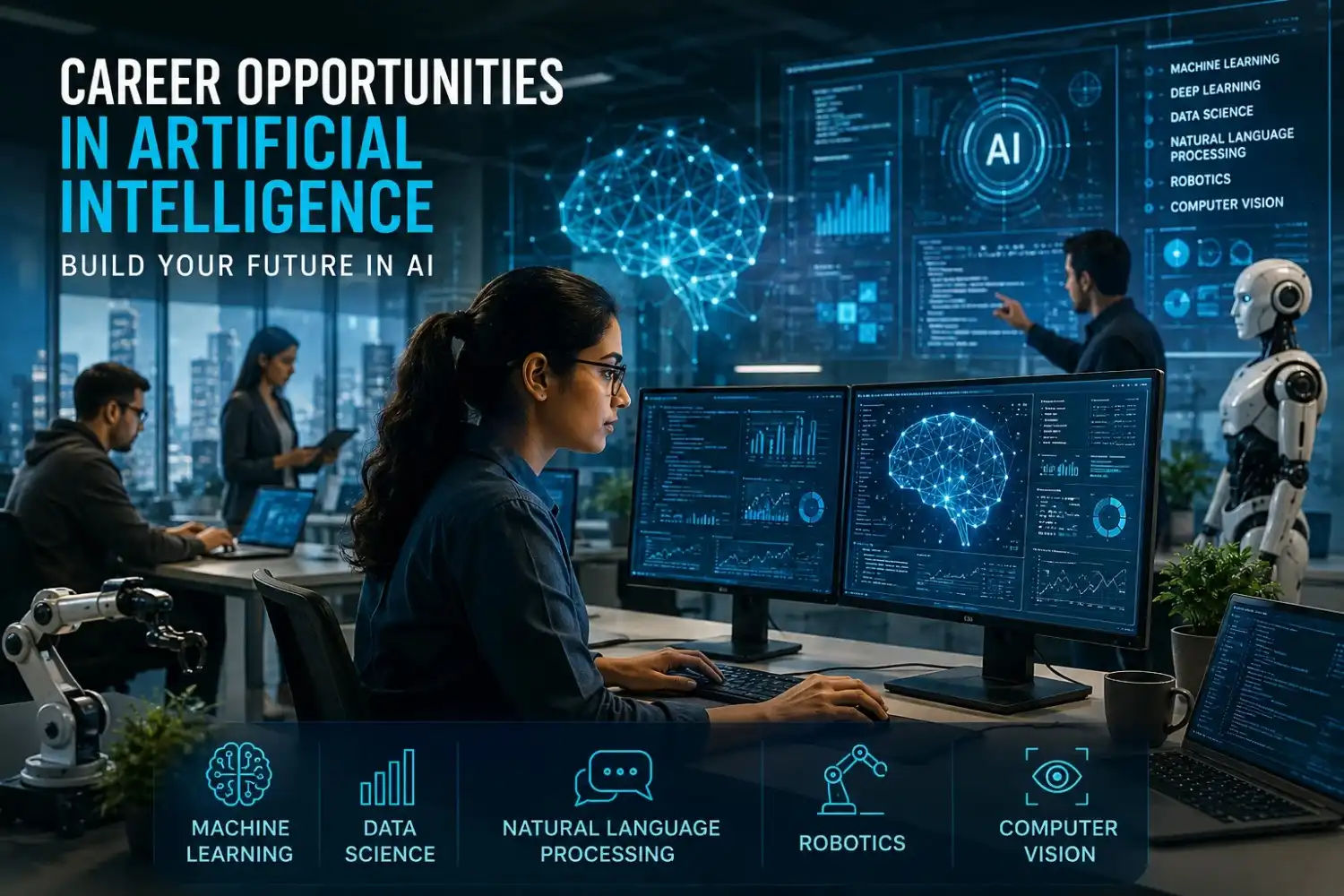
Career Opportunities in Artificial Intelligence
Artificial Intelligence is no longer a futuristic concept. It is already transforming industries, creating new business models, automating operations, and changing how people work globally. From healthcare and education to finance and entertainment, AI is becoming one of the most influential technologies of this generation.
Because of this rapid transformation, career opportunities in artificial intelligence are growing faster than many traditional professions. Companies worldwide are searching for AI professionals who can build intelligent systems, analyze data, automate processes, and solve complex business problems.
You might be wondering whether AI careers are only for programmers or tech experts. The reality is very different. Today, AI offers opportunities for students, beginners, engineers, business professionals, designers, researchers, and even non-technical individuals willing to learn modern digital skills.
If you are planning your future career path, exploring technology fields, or searching for a high-growth industry with global demand, artificial intelligence could become one of the smartest career choices you make.
For students exploring future-focused education pathways, career planning strategies available on www.vidyaudbhav.com can help build a stronger roadmap for long-term success.
What Is Artificial Intelligence?
Artificial Intelligence, commonly called AI, refers to computer systems designed to perform tasks that usually require human intelligence.
These tasks include:
- Learning from data
- Understanding language
- Recognizing images
- Making decisions
- Solving problems
- Predicting outcomes
- Automating repetitive work
AI systems use technologies such as:
- Machine Learning
- Deep Learning
- Natural Language Processing
- Robotics
- Computer Vision
- Neural Networks
Today, AI powers:
- Virtual assistants
- Recommendation systems
- Self-driving technology
- Fraud detection systems
- Medical diagnosis tools
- Chatbots
- Smart search engines
This widespread adoption is exactly why career opportunities in artificial intelligence continue expanding globally.
Why Artificial Intelligence Careers Are Growing So Fast
The global demand for AI professionals is increasing because businesses are under pressure to become faster, smarter, and more efficient.
Here is what is driving AI career growth:
| Business automation | Increased hiring of AI specialists |
| Big data explosion | Demand for data analysts and scientists |
| Digital transformation | AI integration across industries |
| Cybersecurity needs | Intelligent threat detection systems |
| Healthcare innovation | AI-powered diagnosis and research |
| E-commerce expansion | Personalized recommendation systems |
| Smart manufacturing | Robotics and predictive maintenance |
One thing many beginners miss is that AI is not replacing every job. Instead, it is creating entirely new categories of careers that never existed before.
Types of Career Opportunities in Artificial Intelligence
AI is a broad field with multiple specialized career paths. Let us understand the most popular and high-demand roles.
1. Machine Learning Engineer
Machine Learning Engineers design algorithms that allow systems to learn from data and improve over time.
Responsibilities
- Building ML models
- Data processing
- Training AI systems
- Model optimization
- Performance testing
Skills Required
- Python
- TensorFlow
- PyTorch
- Mathematics
- Statistics
Industries Hiring
- Healthcare
- Finance
- E-commerce
- Automotive
- Technology
2. Data Scientist
Data Scientists analyze large datasets to identify patterns, trends, and business insights.
Main Tasks
- Data analysis
- Predictive modeling
- Visualization
- Business forecasting
Important Tools
- Python
- R
- SQL
- Tableau
- Power BI
This role remains one of the highest-paying career opportunities in artificial intelligence worldwide.
3. AI Research Scientist
Research Scientists focus on developing advanced AI systems and discovering new innovations.
Common Work Areas
- Deep learning
- Neural networks
- Robotics
- Language models
- Computer vision
Ideal For
- Researchers
- PhD students
- Innovation-focused professionals
4. AI Software Developer
AI Developers create applications powered by artificial intelligence.
Responsibilities
- Developing AI apps
- Integrating AI APIs
- Building automation tools
- Improving software intelligence
This role is becoming increasingly important for startups and enterprise software companies.
5. Robotics Engineer
Robotics Engineers combine AI with mechanical systems to build intelligent machines.
Industries Using Robotics
- Manufacturing
- Healthcare
- Logistics
- Defense
- Agriculture
Robotics is one of the fastest-growing AI sectors globally.
6. Natural Language Processing Engineer
NLP Engineers help machines understand human language.
Examples
- Chatbots
- Translation software
- Voice assistants
- AI writing tools
With the rise of conversational AI systems, this career path is becoming highly valuable.
7. Computer Vision Engineer
Computer Vision focuses on enabling machines to interpret images and videos.
Applications
- Facial recognition
- Autonomous vehicles
- Medical imaging
- Security systems
This becomes more important when industries rely heavily on visual automation.
Top Industries Hiring AI Professionals
Artificial Intelligence is no longer limited to technology companies.
Here are the major industries actively hiring AI talent:
Healthcare
AI helps with:
- Disease detection
- Medical imaging
- Drug research
- Patient monitoring
Finance
AI powers:
- Fraud detection
- Risk management
- Automated trading
- Credit scoring
Education
AI improves:
- Personalized learning
- Student analytics
- Virtual tutoring
Students interested in future-ready education and skill development can explore career guidance resources on www.vidyaudbhav.com.
E-commerce
AI supports:
- Product recommendations
- Customer support
- Demand forecasting
Cybersecurity
AI identifies:
- Threat patterns
- Malware detection
- Network anomalies
Entertainment
AI helps with:
- Content recommendation
- Video analysis
- Audience prediction
Skills Required for a Successful AI Career
Many people think AI careers require only coding skills. In reality, successful AI professionals combine technical knowledge with problem-solving abilities.
Technical Skills
Programming Languages
- Python
- Java
- R
- C++
Mathematics
- Linear algebra
- Probability
- Statistics
- Calculus
AI Frameworks
- TensorFlow
- PyTorch
- Scikit-learn
Data Handling
- SQL
- Data visualization
- Data cleaning
Soft Skills
Critical Thinking
AI professionals solve complex business challenges.
Communication
Explaining technical concepts clearly is extremely important.
Creativity
AI innovation requires original problem-solving.
Adaptability
Technology changes rapidly.
Here is where many people make mistakes. They focus only on coding while ignoring communication and practical business understanding.
Step-by-Step Guide to Start a Career in Artificial Intelligence
Starting an AI career can feel overwhelming in the beginning. However, breaking the process into steps makes it manageable.
Step 1: Learn the Basics
Start with:
- Programming fundamentals
- Basic mathematics
- Data analysis concepts
Python is usually the best beginner-friendly programming language for AI.
Step 2: Understand Machine Learning
Focus on:
- Supervised learning
- Unsupervised learning
- Model training
- Evaluation methods
Step 3: Work on Projects
Projects help build real-world skills.
Examples include:
- Chatbots
- Recommendation systems
- Image classifiers
- Predictive models
Employers value practical experience more than theory alone.
Step 4: Build a Portfolio
Your portfolio should include:
- AI projects
- GitHub repositories
- Research work
- Certifications
Step 5: Gain Industry Exposure
Try:
- Internships
- Freelance work
- Open-source contributions
- Research collaborations
Career preparation resources and student development strategies on www.vidyaudbhav.com can help students improve employability and career readiness.
Best Educational Paths for AI Careers
There is no single route into AI.
Traditional Degrees
- Computer Science
- Artificial Intelligence
- Data Science
- Mathematics
- Information Technology
Online Certifications
Popular learning areas include:
- Machine learning
- Data analytics
- Deep learning
- AI engineering
Bootcamps
Bootcamps offer:
- Faster learning
- Practical projects
- Career-focused training
Self-Learning
Many professionals successfully enter AI through self-study combined with consistent project building.
One thing that actually works is combining structured learning with hands-on implementation.
AI Career Opportunities for Non-Technical Professionals
This surprises many people, but AI is creating opportunities beyond programming.
AI Product Manager
Bridges business goals and AI development teams.
AI Ethics Specialist
Focuses on responsible AI practices.
AI Business Consultant
Helps companies implement AI strategies.
AI Content Strategist
Works with AI-powered content systems.
AI Sales Specialist
Explains AI solutions to businesses.
This is why artificial intelligence is becoming a multidisciplinary career ecosystem.
Salary Potential in Artificial Intelligence
AI remains one of the highest-paying career sectors globally.
| AI Role | Average Global Salary Potential |
| Machine Learning Engineer | High |
| Data Scientist | High |
| AI Researcher | Very High |
| Robotics Engineer | High |
| NLP Engineer | High |
| AI Product Manager | Very High |
Actual salaries depend on:
- Experience
- Country
- Industry
- Technical expertise
- Portfolio quality
Countries with strong AI job markets include:
- United States
- Canada
- Germany
- United Kingdom
- Singapore
- Australia
- India
Benefits of Choosing an AI Career
High Demand
AI professionals are needed globally.
Excellent Salary Growth
The industry offers strong long-term earning potential.
Innovation Opportunities
You can work on cutting-edge technologies.
Remote Work Possibilities
Many AI roles support remote careers.
Cross-Industry Flexibility
AI skills apply to multiple industries.
Continuous Learning
The field constantly evolves, making work intellectually engaging.
Challenges in Artificial Intelligence Careers
AI careers are exciting, but they also come with challenges.
Rapid Technology Changes
Tools and frameworks evolve quickly.
Competitive Industry
The demand is high, but skilled talent competition is also growing.
Complex Learning Curve
Mathematics and programming can initially feel difficult.
Ethical Concerns
AI systems raise privacy and fairness questions.
Now, let us understand how successful professionals overcome these challenges.
Practical Solutions for AI Career Growth
Focus on Fundamentals
Strong basics remain valuable even when technologies change.
Build Real Projects
Practical implementation matters more than memorization.
Stay Updated
Follow industry trends and research developments.
Learn Problem Solving
Businesses hire people who solve real problems.
Develop Communication Skills
Technical professionals with communication abilities stand out significantly.
Students building long-term career plans can also explore educational development content on www.vidyaudbhav.com.
Real-Life AI Career Examples
Example 1: Healthcare AI Specialist
A healthcare AI engineer develops systems that detect diseases through medical imaging. These tools help doctors identify conditions earlier and improve treatment accuracy.
Example 2: E-commerce Recommendation Engineer
AI specialists create recommendation systems that suggest products based on customer behavior.
This directly improves:
- Sales
- Customer experience
- Retention rates
Example 3: Financial Fraud Analyst
Banks use AI professionals to develop fraud detection systems that identify suspicious transactions instantly.
Beginner Strategy for Entering AI
If you are completely new, do not try learning everything at once.
Recommended Beginner Path
- Learn Python
- Study basic statistics
- Understand machine learning concepts.
- Build small projects
- Practice consistently
- Join AI communities
- Create a portfolio
Consistency matters far more than speed.
Advanced Strategy for AI Professionals
Experienced professionals can accelerate growth by focusing on specialization.
High-Value Specializations
- Generative AI
- AI cybersecurity
- Robotics
- AI healthcare systems
- Autonomous systems
- AI infrastructure engineering
Advanced professionals should also focus on:
- Research publications
- Open-source contributions
- Leadership skills
- Scalable AI architecture
Common Mistakes to Avoid in AI Careers
Learning Without Projects
Theory alone is not enough.
Ignoring Mathematics
Strong mathematical understanding improves AI performance significantly.
Chasing Every New Trend
Focus on core skills first.
Weak Portfolio Development
Employers want proof of practical abilities.
Lack of Industry Understanding
AI solutions should solve business problems.
Here is where many people struggle. They learn tools but fail to understand real-world applications.
Best Tools for Artificial Intelligence Learning
Beginner-Friendly Tools
- Google Colab
- Scikit-learn
- Jupyter Notebook
Intermediate Tools
- TensorFlow
- PyTorch
- Keras
Advanced Platforms
- AWS AI services
- Azure AI
- NVIDIA AI ecosystem
Free tools are excellent for beginners, while enterprise platforms help professionals scale larger projects.
Future Trends in Artificial Intelligence Careers
AI careers will continue expanding over the next decade.
Generative AI Expansion
Content generation and automation tools will grow rapidly.
AI in Healthcare
Medical AI systems will become more advanced.
Autonomous Technology
Self-driving systems and robotics will expand.
AI Regulation Careers
Governments and businesses will need AI policy experts.
Human-AI Collaboration
Future workplaces will combine human creativity with AI efficiency.
One thing many beginners underestimate is how deeply AI will integrate into nearly every profession.
How Students Can Prepare Early for AI Careers
Students can gain a major advantage by starting early.
Focus Areas for Students
- Coding basics
- Logical reasoning
- Mathematics
- Data interpretation
- Communication skills
Practical Activities
- Participate in hackathons
- Build mini projects
- Join coding communities
- Practice problem-solving
Career-focused educational planning available on www.vidyaudbhav.com can help students align their learning with future technology industries.
AI Careers vs Traditional Technology Careers
| Factor | AI Careers | Traditional IT Careers |
| Growth Rate | Extremely High | Moderate |
| Innovation Level | Very High | High |
| Salary Potential | High | Moderate to High |
| Automation Exposure | Core Industry | Supporting Industry |
| Future Demand | Rapidly Increasing | Stable |
AI is increasingly becoming one of the most future-proof career sectors.
Expert Tips for Building a Strong AI Career
Build Depth, Not Just Breadth
Master one specialization before expanding.
Practice Daily
Small, consistent learning sessions work better than random intensive study.
Follow Industry Trends
Stay informed about emerging technologies.
Solve Real Problems
Businesses value impact-driven professionals.
Develop Professional Networks
Networking often creates hidden career opportunities.
Actionable Final Advice
If you are serious about building a successful future in technology, artificial intelligence offers one of the strongest long-term career opportunities available today.
The best approach is simple:
- Start with fundamentals
- Learn consistently
- Build projects
- Develop practical experience
- Stay adaptable
You do not need to become an expert overnight.
What matters most is starting early, practicing regularly, and focusing on real-world skills that solve meaningful problems.
Conclusion
Career opportunities in artificial intelligence are transforming the global job market faster than almost any other industry. From healthcare and robotics to finance and education, AI professionals are shaping the future of technology and innovation.
Whether you are a student, beginner, working professional, or career changer, AI offers exciting possibilities with strong salary potential, global demand, and long-term growth.
The field may seem challenging at first, but with the right learning strategy, consistent practice, and project-based experience, building a successful AI career is absolutely achievable.
As industries continue embracing automation and intelligent systems, professionals with AI skills will remain among the most valuable talents in the modern workforce.
For students planning future-ready careers, educational growth resources and career preparation guidance available on www.vidyaudbhav.com can support long-term success in evolving industries.
Frequently Asked Questions (FAQs)
1. What are the best career opportunities in artificial intelligence?
Some of the best AI careers include:
- Machine Learning Engineer
- Data Scientist
- AI Research Scientist
- Robotics Engineer
- NLP Engineer
- Computer Vision Engineer
2. Is artificial intelligence a good career for the future?
Yes. AI is considered one of the fastest-growing and highest-demand career fields globally due to increasing automation and digital transformation.
3. Can beginners start a career in AI?
Absolutely. Beginners can start by learning Python, mathematics, and machine learning basics, and working on small projects consistently.
4. Do AI careers require advanced mathematics?
Mathematics is important, especially statistics and linear algebra, but beginners can gradually build these skills over time.
5. Which industries hire AI professionals?
Industries hiring AI professionals include:
- Healthcare
- Finance
- Education
- E-commerce
- Cybersecurity
- Manufacturing
- Entertainment
6. What programming language is best for AI?
Python is widely considered the best programming language for artificial intelligence because of its simplicity and powerful AI libraries.
7. Are AI jobs high-paying?
Yes. Many AI-related jobs offer strong salary potential due to high demand and specialized expertise requirements.