

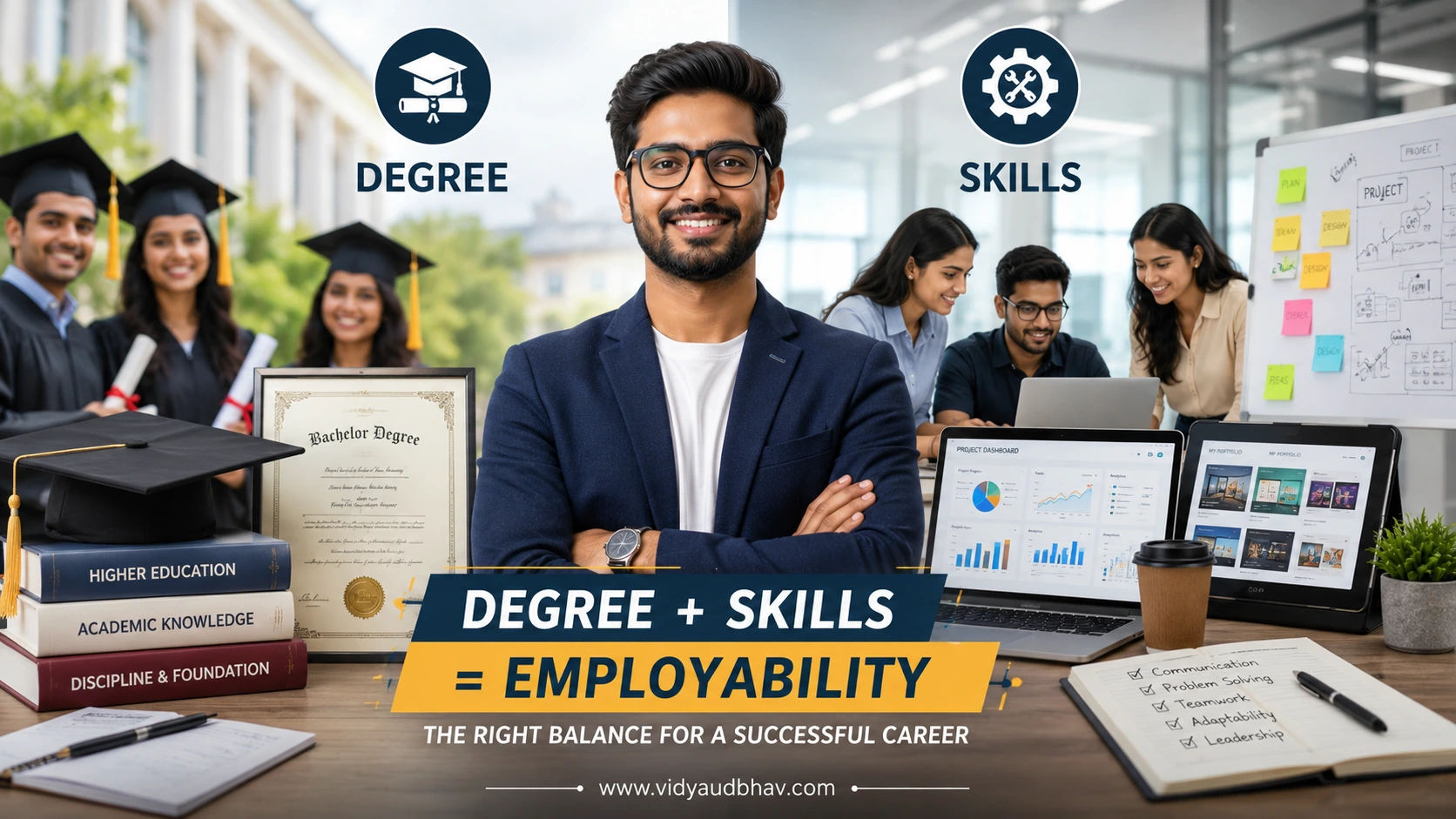
The job market has changed. A college degree can still open doors, but employers increasingly want evidence that you can actually do the work.
So, degree vs skills—which matters more for getting a job?
The most accurate answer is: it depends on the career, but for many modern jobs, skills and practical experience can make the difference after a degree gets you through the first screening.
Recent hiring research supports this shift. NACE’s 2025 Job Outlook found that almost two-thirds of surveyed employers use skills-based hiring for entry-level recruitment. Research into AI and green jobs has also found growing emphasis on specific skills alongside a decline in degree requirements in some emerging roles.
https://vidyaudbhav.com/blogs/which-skills-should-i-learn-for-a-successful-career
https://vidyaudbhav.com/blogs/best-editing-tool-for-beginners-2026
That does not mean degrees are becoming useless. Instead, the winning approach is increasingly degree + relevant skills + practical proof.
If you are choosing a course, preparing for your first job, or considering a career change, understanding this distinction can save you years of confusion.
Degree vs Skills: What Is the Difference?
A degree is a formal academic qualification that demonstrates structured education in a particular subject.
Skills are the practical abilities you can use to complete tasks, solve problems, communicate effectively, operate tools, or produce results.
For example, a B.Tech degree shows that a student has completed formal engineering education. But an employer hiring a software developer may also want to see programming ability, projects, problem-solving skills, Git knowledge, and the ability to work with a development team.
In simple terms:
- Degree: Shows what you studied.
- Skills: Show what you can do.
- Experience: Shows where you have applied those abilities.
- Portfolio: Provides evidence of your work.
- Communication: Shows how effectively you can work with others.
This is why employers increasingly look at the complete candidate rather than relying on one qualification.
Why Skills Are Becoming More Important
One thing many beginners miss is that companies do not hire people simply because they have certificates. They hire people to solve business problems.
A digital marketing agency needs someone who can create campaigns, analyse performance, understand audiences, and communicate results.
A software company needs developers who can build and troubleshoot applications.
A design agency needs designers who can create useful, attractive visual solutions.
In each case, demonstrable ability matters.
A 2025 study of employers and job seekers in the US and UK found that more than half of surveyed employers had removed degree requirements, although the importance of degrees remains mixed.
The trend is especially visible in fast-changing fields. Research analysing approximately 11 million UK job vacancies found that demand for AI roles increased while references to university education requirements declined for those roles.
When Does a Degree Matter More Than Skills?
A degree remains extremely important—and sometimes mandatory—in many careers.
1. Licensed professions
Fields such as medicine, law, teaching, engineering in regulated contexts, and certain healthcare professions can require recognised academic qualifications or professional licensing.
2. Careers requiring specialised academic knowledge
Research, medicine, advanced science, and some technical professions require years of structured learning.
3. Graduate recruitment
Large organisations may use educational qualifications as an initial screening criterion, particularly for entry-level programmes.
4. Immigration and international opportunities
For some international education, employment, or visa pathways, formal qualifications can become important eligibility factors.
5. Long-term academic careers
If you want to become a researcher, professor, or pursue advanced academic work, degrees are usually foundational.
So, abandoning education simply because “skills are more important” can be a serious mistake.
When Can Skills Matter More?
Skills can carry greater weight in careers where work can be demonstrated directly.
Examples include:
- Graphic design
- Video editing
- Digital marketing
- Web development
- UI/UX design
- Content creation
- Sales
- Social media management
- Data analytics
- Some software development roles
- Freelancing
Imagine two junior graphic designers.
Candidate A has a relevant degree but no portfolio.
Candidate B has a different academic background but has created ten strong branding projects, social media campaigns, and UI designs.
For a portfolio-driven employer, Candidate B may have a stronger case because the employer can directly evaluate the work.
That is the real power of skills: they can be demonstrated.
Degree vs Skills: A Practical Comparison
| Formal recognition | High | Varies |
| Required for regulated careers | Often | Usually not sufficient alone |
| Demonstrates practical ability | Limited | Stronger |
| Helps pass academic eligibility filters | Strong | Limited |
| Portfolio potential | Indirect | Direct |
| Career flexibility | Depends on field | Often high |
| Long-term learning foundation | Strong | Depends on learning path |
| Employer verification | Qualification-based | Work/test/project-based |
The strongest candidate often combines both.
How to Become More Employable: A Step-by-Step Guide
Step 1: Choose a career direction
Do not start by collecting random certifications.
First decide what type of work interests you.
For example:
Technology → software development, AI, cybersecurity, data
Business → management, sales, finance, operations
Creative → design, video, content, UI/UX
Healthcare → nursing, healthcare management, medical sciences
If you are still confused, a structured career planning guide can help you evaluate interests, strengths, and career possibilities.
Step 2: Identify the skills required
Look at actual job descriptions for your target role.
Create three lists:
- Technical skills
- Soft skills
- Tools or platforms
For example, a digital marketing role may require SEO, social media marketing, analytics, content strategy, communication, and campaign management.
Step 3: Learn through practice
Do not spend months watching tutorials without creating anything.
Learn a concept, then immediately apply it.
If you are learning web development, build a website.
If you are learning design, create posters and brand identities.
If you are learning data analysis, work with datasets and create dashboards.
Step 4: Build a portfolio
Your portfolio is your evidence.
A good portfolio can include:
- Academic projects
- Personal projects
- Internship work
- Freelance work
- Case studies
- Campaigns
- Research
- Before-and-after improvements
For students, practical experience can be particularly valuable. Vidya Udbhav's guide on building a successful career from college also highlights internships, networking, digital skills, and portfolios as important parts of career preparation.
Step 5: Gain real-world experience
Internships, volunteering, freelance assignments, competitions, college projects, and apprenticeships can all help.
You do not need your first job before gaining experience.
Create experience wherever possible.
Step 6: Improve communication
A technically capable candidate can still struggle if they cannot explain their work.
Practice:
- Interview answers
- Presentations
- Email writing
- Professional conversations
- Problem explanation
- Team communication
Communication is not a “soft extra.” In many workplaces, it directly affects performance.
Real-Life Career Example
Consider a student who completes a B.Com degree.
After graduation, the student has two possible approaches.
Approach A: Apply for jobs using only the degree.
Approach B: Complete the degree while learning Excel, data analytics, digital marketing, communication, and basic business tools, then complete internships and build project evidence.
The second candidate has created a clearer professional identity.
The degree provides the academic foundation.
The additional skills provide employability evidence.
That combination is much stronger than relying on either one alone.
What Employers Are Actually Looking For
Here is what actually works: think like a hiring manager.
Before applying, ask:
“If I were hiring for this position, what evidence would convince me that this person can perform the job?”
The answer could include:
- Relevant education
- Technical skills
- Practical projects
- Internship experience
- Communication
- Problem-solving
- Adaptability
- Industry knowledge
- Portfolio
- Interview performance
NACE's 2025 findings show that skills-based hiring is being used particularly during screening and interviews, including competency-based job descriptions and assessment tools.
Beginner Strategy: The 70/30 Approach
If you are starting from zero, consider dividing your career preparation roughly like this:
30% — Formal education
Focus on your degree, academic fundamentals, and subject knowledge.
70% — Practical development
Focus on:
- Skills
- Projects
- Internships
- Portfolio
- Communication
- Networking
- Interview preparation
This is not a universal mathematical rule. It is a practical mindset: do not let your academic qualification become the only evidence of your ability.
Advanced Strategy: Build a T-Shaped Skill Profile
Professionals can go one step further by developing a T-shaped profile.
The vertical part represents deep expertise in one area.
The horizontal part represents supporting skills.
For example, a digital marketer might specialise deeply in SEO while also understanding content, analytics, social media, paid advertising, and AI tools.
This makes the professional more adaptable without becoming a beginner in everything.
Common Mistakes to Avoid
Mistake 1: Collecting certificates without practice
Ten certificates cannot replace the ability to perform a task.
Mistake 2: Choosing a degree only because it is popular
A popular course is not automatically the right course for you.
Mistake 3: Ignoring internships
Real-world exposure can reveal gaps that classrooms do not.
Mistake 4: Learning too many unrelated skills
Depth matters. Choose a career direction first.
Mistake 5: Waiting until graduation
Career preparation should start before your final semester.
Mistake 6: Ignoring soft skills
Communication, teamwork, leadership, adaptability, and problem-solving remain valuable across industries.
Best Practices for Students and Job Seekers
A strong career-building system looks like this:
Education → Skills → Projects → Experience → Portfolio → Networking → Interviews → Continuous Learning
Students can also explore career planning tips for school and college students to create a more structured roadmap.
If you are choosing your course right now, do not ask only, “Which degree has the highest salary?”
Ask:
- What skills will I learn?
- Will I get practical exposure?
- Are internships available?
- What career paths can this qualification support?
- Can I build a portfolio?
- What is the demand for these skills?
- Does the course match my strengths?
Future Trends: Degree or Skills?
The future is unlikely to be completely degree-free.
Instead, hiring is moving toward a more skills-aware model where education, demonstrated ability, experience, and adaptability are considered together.
AI is accelerating this change because new tools and roles are appearing faster than traditional curricula can always adapt.
That makes continuous learning essential.
Research into AI and green jobs already provides evidence of employers placing greater emphasis on specific skills in emerging occupations.
For students, this means your first qualification should not be viewed as the end of education. It should be the foundation for continuous skill development.
Expert Tips: What Should You Do Today?
If you already have a degree, do not assume you are behind.
Pick one marketable skill related to your target career and become genuinely good at it.
If you are currently in college, start building projects before graduation.
If you have no degree, research your target profession carefully. Some careers are accessible through portfolios, certifications, apprenticeships, or experience, while others have strict educational requirements.
And if you are choosing a course after school, compare career outcomes, curriculum, practical exposure, internships, and skills—not just the course name.
For students comparing educational pathways, Vidya Udbhav's guide to choosing the right career path is a useful starting point.
FAQ
Is a degree or skill more important for getting a job?
For many modern jobs, practical skills can strongly influence hiring decisions, but a degree may still be required for eligibility or initial screening. The strongest combination is usually a relevant degree supported by job-ready skills.
Can I get a job without a degree?
Yes, in some fields. Design, freelancing, sales, digital marketing, content, and certain technology roles may place greater emphasis on demonstrated skills and experience. However, some professions legally or professionally require formal qualifications.
Do employers still care about degrees?
Yes. Degrees remain important in many industries and are particularly relevant for regulated professions, graduate programmes, specialised careers, and certain organisations. The trend is not “degrees don't matter”; it is that skills are increasingly being evaluated alongside them.
How can students prove their skills?
Build projects, complete internships, participate in competitions, create a portfolio, contribute to practical work, and be prepared to demonstrate your abilities during interviews or assessments.
Are certifications better than degrees?
Not generally. They serve different purposes. A degree provides broader formal education, while certifications can demonstrate specific knowledge or skills. Their value depends on the career and employer.
What skills should students learn for future jobs?
The right skills depend on the career. However, digital literacy, communication, problem-solving, adaptability, analytical thinking, and role-specific technical skills are broadly useful.
Should I focus on my degree or internships?
Do both when possible. Your degree builds formal knowledge and eligibility, while internships provide practical experience and workplace exposure.
Conclusion
The degree vs skills debate is not really about choosing one and rejecting the other.
A degree can provide knowledge, credibility, eligibility, and access to opportunities. Skills can help you demonstrate that you can turn knowledge into results.
Think of your degree as the foundation and your skills as the working structure built on it.
If you are a student, do not wait until graduation to become employable. Start developing practical skills, complete projects, gain experience, improve communication, and build a portfolio while studying.
If you are a graduate, identify the gap between your current abilities and the jobs you want—and work systematically to close it.
The future belongs less to people who simply possess qualifications and more to people who can learn, adapt, demonstrate their abilities, and create value.
Your degree can open the door. Your skills can help you walk through it—and keep moving forward.