

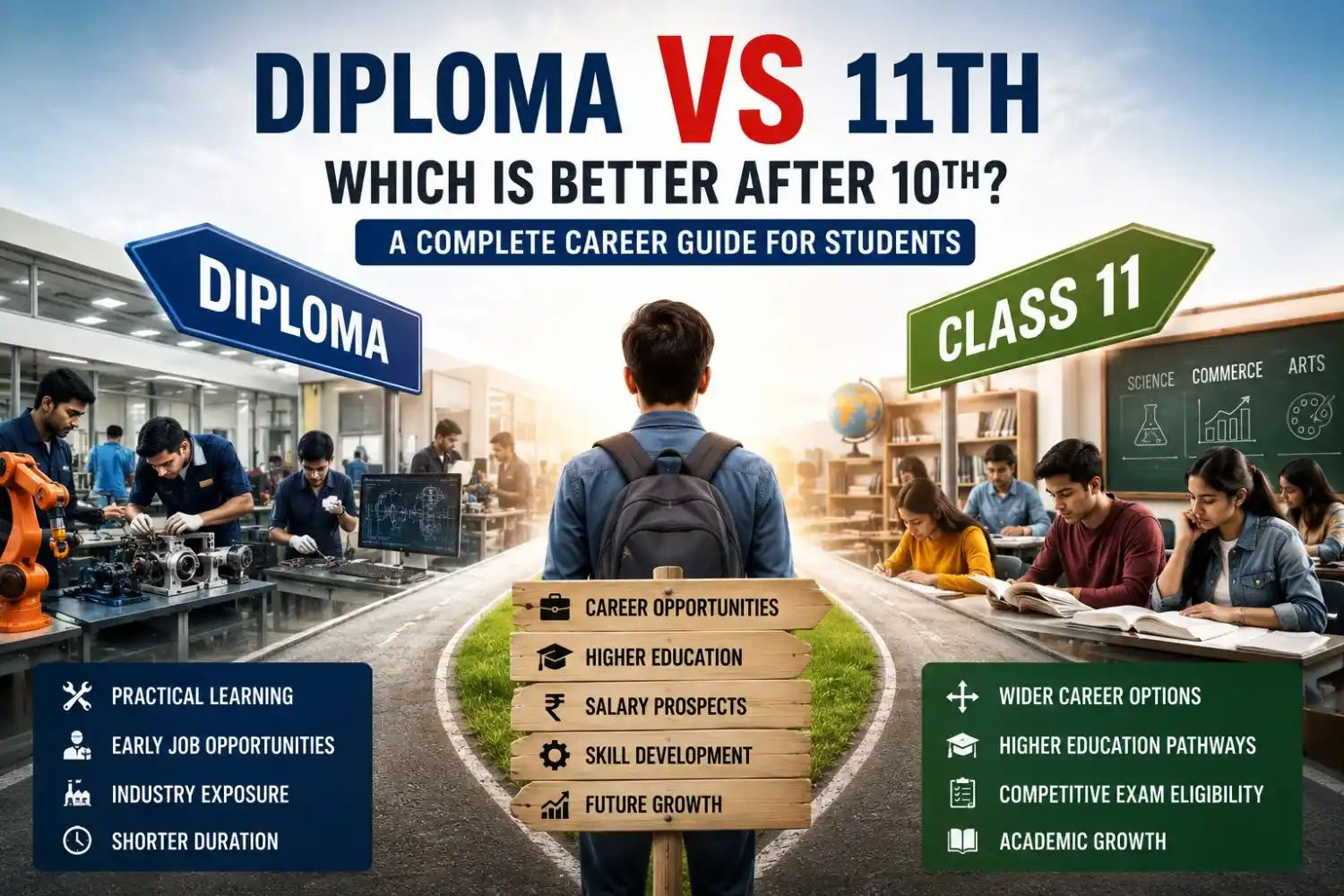
Diploma vs 11th: Which Is Better After 10th?
Choosing between a diploma course and Class 11 is one of the most important decisions students make after completing their 10th grade. Many students and parents find themselves confused because both options offer valuable opportunities, but they lead to different career paths.
The answer is not the same for everyone.
For some students, pursuing Class 11 and 12 is the best route toward professional degrees such as engineering, medicine, law, management, or civil services. For others, a diploma course provides early industry exposure, practical skills, and faster employment opportunities.
This guide will help you understand the key differences between a diploma and Class 11, compare their advantages and disadvantages, explore career opportunities, and identify which option is best suited to your goals.
Students planning their future can also explore educational guidance and career planning resources available at VidyaUdbhav to make informed academic decisions.
Quick Answer: Diploma vs 11th After 10th
A diploma is Better If:
- You want practical technical skills.
- You wish to start earning earlier.
- You prefer hands-on learning.
- You are interested in engineering, technology, healthcare, design, or vocational careers.
- You want direct industry exposure.
Class 11 is Better If:
- You plan to pursue graduation through traditional academic routes.
- You aim for engineering, medical, law, CA, management, or government careers.
- You want broader, higher education options.
- You are preparing for competitive examinations.
Understanding the Two Options
What Is Class 11?
Class 11 is the first year of higher secondary education. Students generally choose among:
- Science
- Commerce
- Arts/Humanities
After completing Class 12, students become eligible for undergraduate degree programs and various competitive examinations.
Common Academic Routes
| Science | Engineering, Medicine, Research |
| Commerce | CA, Finance, Business, Banking |
| Arts | Law, Journalism, Civil Services |
What Is a Diploma Course?
A diploma is a specialized skill-based program that focuses on practical training and industry requirements.
Most diploma programs after 10th grade range from 2 to 3 years.
Popular Diploma Courses
- Polytechnic Engineering
- Computer Science
- Mechanical Engineering
- Civil Engineering
- Electrical Engineering
- Hotel Management
- Fashion Design
- Graphic Design
- Medical Laboratory Technology
- Pharmacy Assistance
These programs prepare students directly for specific industries.
Diploma vs 11th: Detailed Comparison
Comparison Table
| Factor | Diploma | Class 11 & 12 |
| Duration | 2–3 Years | 2 Years |
| Learning Style | Practical | Academic |
| Industry Exposure | High | Limited |
| Employment Opportunity | Earlier | After Higher Studies |
| Skill Development | Specialized | General |
| Competitive Exam Preparation | Limited | Strong |
| Higher Education Options | Good | Extensive |
| Cost | Moderate | Generally Lower |
| Technical Knowledge | Strong | Basic Foundation |
| Flexibility | Specific Career Path | Multiple Career Paths |
Search Intent Analysis: What Students Really Want to Know
Most students searching "Diploma vs 11th, which is better after 10th" are looking for:
- Better career opportunities
- Faster job prospects
- Higher salary potential
- Easier study path
- Future growth
- Industry demand
The right answer depends on your long-term goals rather than immediate benefits.
Benefits of Choosing a Diploma After 10th
1. Early Skill Development
Diploma programs focus heavily on practical learning.
Students spend significant time in:
- Workshops
- Laboratories
- Industry projects
- Internships
This creates job-ready skills much earlier.
2. Faster Entry into the Workforce
Many diploma graduates start working at the age of 18–20.
This can provide:
- Financial independence
- Industry experience
- Career exposure
while peers may still be pursuing academic education.
3. Industry-Oriented Learning
One thing many beginners miss is that employers increasingly value practical skills.
Diploma programs often include:
- Real-world projects
- Industrial training
- Technical certifications
which improves employability.
4. Direct Entry into Engineering Degrees
Many countries and institutions allow diploma holders to enter the second year of engineering degree programs through lateral entry.
This can save both time and resources.
5. Better for Practical Learners
Students who struggle with theory-heavy education often excel in diploma environments because learning is application-focused.
Benefits of Choosing Class 11 After 10th
1. Wider Career Opportunities
Classes 11 and 12 keep more doors open.
Students can pursue:
- Engineering
- Medicine
- Law
- Commerce
- Business
- Arts
- Research
- Government Services
This flexibility becomes important when career interests change.
2. Competitive Examination Eligibility
Many entrance examinations require Class 12 qualifications.
Examples include:
- Engineering entrance exams
- Medical entrance exams
- Law entrance exams
- Government recruitment examinations
This becomes more important when students are aiming for highly competitive careers.
3. Strong Academic Foundation
Class 11 and 12 build conceptual understanding in:
- Mathematics
- Physics
- Chemistry
- Biology
- Economics
- Accountancy
These fundamentals support advanced education.
4. Better Long-Term Educational Flexibility
Students often discover new interests during higher secondary education.
Class 11 provides time to explore different academic directions.
Challenges of Choosing a Diploma
Limited Academic Flexibility
A diploma usually commits students to a specific field early.
Changing industries later may require additional qualifications.
Fewer Competitive Exam Opportunities
Some competitive examinations specifically require Class 12 qualifications.
Students should verify eligibility requirements before choosing a diploma.
Specialized Career Path
While specialization is beneficial, it can reduce flexibility compared to a general academic education.
Challenges of Choosing Class 11
Delayed Employment
Students generally continue:
- Class 11
- Class 12
- Graduation
before entering the workforce.
Theory-Oriented Learning
Students who prefer practical learning may find traditional academics less engaging.
Longer Educational Journey
Professional careers often require:
- Undergraduate degree
- Certifications
- Postgraduate education
This increases study duration.
Which Option Has Better Career Scope?
Career Scope After Diploma
High-Demand Industries
- Manufacturing
- Construction
- Automotive
- Information Technology
- Electronics
- Healthcare
- Design
Many industries actively recruit diploma graduates.
Career Scope After Class 11 and 12
Students can pursue:
- Engineering Degrees
- Medical Degrees
- Business Administration
- Chartered Accountancy
- Law
- Data Science
- Artificial Intelligence
- Public Administration
The long-term scope is broader.
Salary Comparison
Diploma Graduates
Entry-level salaries vary depending on industry, country, and specialization.
Technical diploma holders often begin earning earlier.
Class 12 Route
Initially, students may not earn immediately because they usually continue higher studies.
However, degree holders often achieve higher long-term earning potential.
General Trend
| Stage | Diploma Route | Class 11 Route |
| Early Career | Advantage | Moderate |
| Mid Career | Competitive | Strong |
| Long-Term Growth | Good | Often Higher |
Real-Life Example
Student A: Diploma Route
After 10th:
- Joined Polytechnic Diploma
- Completed industrial training
- Secured a technical job at age 19
- Continued education through lateral entry
Result: Early career growth.
Student B: Class 11 Route
After 10th:
- Choose Science stream
- Completed Class 12
- Cleared the engineering entrance examination
- Earned an engineering degree
Result: Strong long-term professional opportunities.
Both succeeded because they selected paths aligned with their goals.
Beginner Strategy: How to Choose the Right Option
Ask yourself these questions:
Do You Enjoy Practical Work?
Choose Diploma.
Do You Want Professional Degrees?
Choose Class 11.
Do You Want to Start Working Early?
Choose Diploma.
Are You Preparing for Competitive Exams?
Choose Class 11.
Are You Certain About Your Career Field?
A diploma can be a strong option.
Are You Still Exploring Career Interests?
Class 11 offers greater flexibility.
Advanced Career Planning Strategy
Experts recommend evaluating three factors:
Interest
What subjects genuinely excite you?
Strength
Which subjects are your strongest areas?
Future Demand
Which industries are growing globally?
The best decision happens when all three align.
Students can strengthen their planning process through educational and career guidance resources available on VidyaUdbhav.
Tools and Resources for Career Planning
Beginner-Friendly Options
- Career Aptitude Tests
- Personality Assessments
- Interest Mapping Tools
Free Resources
- Educational Webinars
- Career Seminars
- Student Counseling Sessions
Premium Resources
- Professional Career Counseling
- Psychometric Assessments
- Personalized Academic Planning
Common Mistakes Students Make
Following Friends
Many students choose a path simply because their friends selected it.
This often leads to dissatisfaction later.
Ignoring Career Goals
Students focus only on immediate convenience rather than long-term objectives.
Choosing Based on Pressure
Parental or social pressure should not replace informed decision-making.
Not Researching Future Scope
Always investigate:
- Job demand
- Salary trends
- Industry growth
- Higher education opportunities
before finalizing a path.
Expert Tips for Making the Right Decision
Tip 1
Match your education path with your career destination.
Tip 2
Do not choose a diploma solely because it seems easier.
Tip 3
Do not choose Class 11 only because others recommend it.
Tip 4
Research future job markets carefully.
Tip 5
Consult teachers, mentors, counselors, and industry professionals.
Best Practices for Students After 10th
- Identify interests early.
- Explore emerging careers.
- Focus on skill development.
- Build communication skills.
- Learn digital competencies.
- Develop problem-solving abilities.
- Stay informed about industry trends.
Future Trends: What Will Matter Most?
The future job market increasingly values:
- Technical skills
- Digital literacy
- Artificial Intelligence knowledge
- Data analysis
- Communication abilities
- Adaptability
Whether students choose a diploma or Class 11, continuous learning will remain essential.
Diploma vs 11th: Final Comparison
Choose Diploma If:
✓ You prefer practical learning.
✓ You want industry-ready skills.
✓ You wish to enter the workforce sooner.
✓ You are confident about your chosen field.
Choose Class 11 If:
✓ You want maximum career flexibility.
✓ You plan to pursue higher education.
✓ You are preparing for competitive examinations.
✓ You are still exploring career interests.
Actionable Final Advice
Instead of asking, "Which option is better?"
Ask:
"Which option is better for my career goals?"
A diploma is not better than Class 11.
Class 11 is not better than a diploma.
The best choice depends entirely on your interests, strengths, financial situation, learning style, and long-term aspirations.
Students who make informed decisions based on self-assessment and career planning generally achieve better academic and professional outcomes regardless of the path they choose.
For additional career guidance, educational planning insights, and student success resources, explore the educational content available on VidyaUdbhav.
Frequently Asked Questions (FAQs)
1. Is a diploma better than Class 11 after 10th?
A diploma is better for students seeking practical skills and early employment, while Class 11 is better for those pursuing higher education and competitive examinations.
2. Can diploma students become engineers?
Yes. Many diploma holders can enter engineering degree programs through lateral entry and complete a bachelor's degree.
3. Which option offers better salary opportunities?
Diploma students often start earning earlier, but degree holders may achieve higher long-term salary growth.
4. Can I pursue higher education after a diploma?
Yes. Diploma graduates can continue into advanced diplomas, bachelor's degrees, certifications, and specialized professional programs.
5. Is a diploma easier than Class 11?
Not necessarily. Diploma education focuses on technical and practical skills, while Class 11 emphasizes theoretical and academic learning.
6. Which is best for engineering: Diploma or Class 11 Science?
Both can lead to engineering careers. Class 11 Science follows the traditional route, while a diploma can provide practical experience and lateral entry opportunities.
7. Which option has better job opportunities after 10th?
Diploma programs generally provide earlier employment opportunities because of their industry-oriented curriculum.