

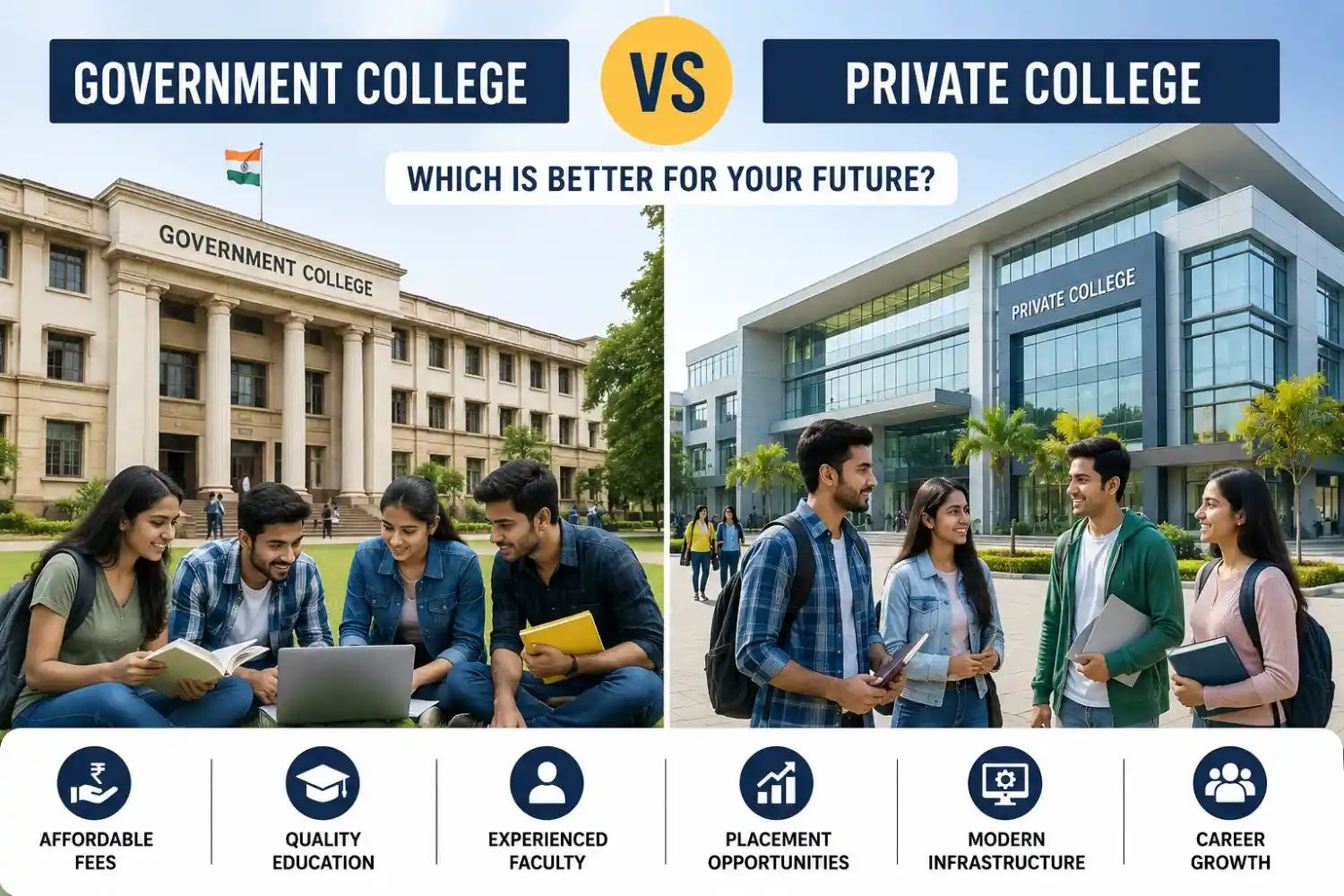
Government College vs Private College: Which Is Better?
Choosing the right college is one of the most important decisions in a student's academic journey. A college not only shapes your education but also influences your career opportunities, professional network, personal development, and future success.
One question that almost every student and parent asks is: Government College vs Private College: Which is Better?
The answer is not as simple as choosing one over the other. Both government and private colleges offer unique advantages and challenges. The right choice depends on your academic goals, financial situation, preferred learning environment, and career aspirations.
If you are exploring colleges, admissions, and career planning, you may also find value in the student guidance resources available on www.vidyaudbhav.com, including career planning guides, admission counseling support, and higher education insights.
In this detailed guide, we will compare government and private colleges across multiple factors to help you make an informed decision.
Quick Answer: Government College vs Private College
Government College is Better If:
- You want affordable education.
- You qualify through competitive entrance exams.
- You prefer experienced faculty.
- You want strong academic credibility.
- Budget is a major concern.
Private College is Better If:
- You want modern infrastructure.
- You seek industry-oriented education.
- You prefer smaller class sizes.
- You want better campus facilities.
- You need flexible admission opportunities.
The best college is ultimately the one that aligns with your career goals and learning preferences.
Understanding Government Colleges
Government colleges are educational institutions funded and managed by the central, state, or local governments.
Examples include public universities, state universities, and government-funded professional institutions.
These colleges receive financial support from government bodies, allowing them to offer education at significantly lower tuition fees.
Key Features of Government Colleges
- Lower tuition fees
- Government funding
- Competitive admissions
- Established reputation
- Experienced faculty
- Strong academic focus
- Larger student populations
Understanding Private Colleges
Private colleges are managed by private organizations, trusts, educational groups, or corporations.
These institutions primarily depend on student fees and private investments for operations and development.
Over the past two decades, private colleges have become a major contributor to global higher education.
Key Features of Private Colleges
- Higher tuition fees
- Modern infrastructure
- Industry partnerships
- Flexible admissions
- Advanced facilities
- Career-focused programs
- Strong student support services
Government College vs Private College: Detailed Comparison
Comparison Table
| Tuition Fees | Low | High |
| Infrastructure | Moderate | Modern |
| Admission Difficulty | High | Moderate |
| Faculty Experience | Often Strong | Varies |
| Industry Exposure | Moderate | Usually Higher |
| Placement Support | Good in Top Institutes | Often Strong |
| Student Diversity | High | High |
| Campus Facilities | Basic to Good | Advanced |
| Research Opportunities | Strong | Growing |
| Scholarships | Extensive | Limited but Available |
Fees Comparison
Government Colleges
One of the biggest advantages of government colleges is affordability.
Students often pay significantly lower fees because governments subsidize educational expenses.
Benefits
- Reduced financial burden
- Lower education loans
- Better return on investment
- Accessible to diverse economic groups
Private Colleges
Private institutions generally charge higher tuition fees.
The higher fees are often used to develop infrastructure, laboratories, technology systems, and student facilities.
Benefits
- Better amenities
- Updated technology
- Industry-integrated learning
- Premium educational experience
Challenge
The financial investment can be substantial.
Faculty Quality Comparison
Many students assume private colleges always have better faculty. That is not necessarily true.
Government Colleges
Government institutions often employ professors with:
- Doctoral qualifications
- Research backgrounds
- Years of teaching experience
- Academic publications
Many professors remain associated with institutions for decades, creating strong academic ecosystems.
Private Colleges
Private colleges frequently recruit faculty from industry and academia.
Advantages include:
- Practical knowledge
- Industry insights
- Updated curriculum delivery
- Corporate exposure
The quality varies significantly between institutions.
Infrastructure and Campus Facilities
This is where private colleges often have an advantage.
Government College Infrastructure
You may find:
- Traditional classrooms
- Established libraries
- Research centers
- Sports facilities
However, modernization can sometimes be slower.
Private College Infrastructure
Many private colleges invest heavily in:
- Smart classrooms
- Digital libraries
- Innovation labs
- Startup incubators
- Modern hostels
- Recreational facilities
Students looking for a technology-driven environment often prefer private institutions.
Placement Opportunities
Placement opportunities are often a deciding factor.
Government College Placements
Top government institutions frequently attract:
- Multinational corporations
- Public sector organizations
- Research institutions
- International recruiters
Institutions with strong reputations often achieve exceptional placement records.
Private College Placements
Many leading private colleges maintain dedicated placement departments.
These colleges often offer:
- Internship programs
- Corporate collaborations
- Industry certifications
- Placement training
One thing many students miss is that placements depend more on the specific college than on whether it is government or private.
Academic Environment
Government Colleges
The academic environment often emphasizes:
- Theoretical understanding
- Research
- Competitive learning
- Academic rigor
Students often interact with highly competitive peers.
Private Colleges
Private colleges frequently focus on:
- Practical skills
- Industry readiness
- Soft skills development
- Professional training
This becomes more important when students aim for immediate employability.
Research Opportunities
Government Colleges
Government institutions traditionally lead in:
- Scientific research
- Academic publications
- Government-funded projects
- Doctoral programs
Students interested in research careers often benefit from these opportunities.
Private Colleges
Research capabilities are growing rapidly.
Many modern private universities now invest in:
- Innovation centers
- Industry research
- International collaborations
- Startup ecosystems
Campus Life and Student Experience
College life extends beyond classrooms.
Government Colleges
Students often experience:
- Diverse peer groups
- Cultural activities
- Student organizations
- Competitive academic culture
Private Colleges
Students may enjoy:
- Modern campuses
- Professional networking events
- Entrepreneurship programs
- Global exposure initiatives
Admission Process Comparison
Government Colleges
Admissions are usually based on:
- Merit lists
- National entrance exams
- State-level entrance tests
- Reservation policies are applicable
Competition can be intense.
Private Colleges
Admissions may involve:
- Entrance tests
- Direct admissions
- Merit-based selection
- Institutional assessments
Students often have more options.
Real-Life Scenario Analysis
Scenario 1: Budget-Conscious Student
A student from a middle-income family qualifies for a highly ranked government engineering college.
Recommended Choice
Government College
Reason:
Lower fees with excellent academic value.
Scenario 2: Industry-Focused Student
A student wants modern infrastructure, internships, and international collaborations.
Recommended Choice
Private College
Reason:
Many private institutions excel in industry integration.
Scenario 3: Research-Oriented Student
A student plans to pursue higher studies and research.
Recommended Choice
Government College
Reason:
Research opportunities are often stronger.
Common Mistakes Students Make
Here is where many students make mistakes.
Choosing Based Only on Brand Name
A famous college may not offer the best program in your field.
Ignoring Placement Records
Always analyze actual placement outcomes.
Looking Only at Fees
Low fees do not automatically mean better value.
Following Friends
Your career goals should determine your decision.
Ignoring Accreditation
Verify institutional recognition and accreditation status.
How to Choose the Right College
Follow this step-by-step approach.
Step 1: Define Your Career Goal
Ask yourself:
- Do I want a job immediately?
- Do I want higher education?
- Do I want research opportunities?
Step 2: Compare Programs
Review:
- Curriculum
- Faculty
- Placement records
- Industry exposure
Step 3: Evaluate Costs
Calculate:
- Tuition fees
- Hostel expenses
- Living costs
- Study materials
Step 4: Check Placement Statistics
Focus on:
- Average packages
- Recruiters
- Internship opportunities
Step 5: Visit the Campus
Whenever possible:
- Meet students
- Interact with faculty
- Explore facilities
Best Practices for Students
Research Thoroughly
Gather information from multiple sources.
Talk to Alumni
Alumni provide realistic insights.
Focus on Outcomes
Evaluate career results rather than marketing claims.
Assess Personal Fit
The best college is the one that matches your goals.
For students planning admissions and career pathways, exploring educational guidance resources and admission planning content available on www.vidyaudbhav.com can help simplify decision-making.
Future Trends in Higher Education
The distinction between government and private colleges is gradually narrowing.
Future developments include:
- Hybrid learning
- Industry-integrated education
- Artificial Intelligence in Classrooms
- Global partnerships
- Skill-based certifications
- Startup incubation programs
Students will increasingly be evaluated based on skills rather than institution type alone.
Expert Tips for Making the Final Decision
- Compare colleges individually, not categories.
- Prioritize program quality over campus appearance.
- Evaluate placement outcomes carefully.
- Consider long-term career objectives.
- Balance affordability with opportunity.
- Speak with current students before applying.
- Focus on value rather than popularity.
Conclusion
The debate between government and private colleges does not have a universal winner.
Government colleges typically excel in affordability, academic credibility, and research opportunities. Private colleges often stand out for infrastructure, industry exposure, flexibility, and student support services.
The smartest approach is to evaluate each college based on your goals, budget, learning preferences, and career ambitions.
A well-chosen college can become the foundation for a successful future, whether government-funded or privately managed.
Students seeking admission guidance, career planning support, college selection strategies, and educational insights can continue exploring relevant resources through www.vidyaudbhav.com.
Frequently Asked Questions (FAQs)
1. Is a government college better than a private college?
Not always. Government colleges are usually more affordable, while private colleges often provide better infrastructure and industry exposure.
2. Which college offers better placements?
Placement quality depends on the specific institution. Top government and top private colleges can both achieve excellent placement results.
3. Are private college degrees valid?
Yes. Degrees from accredited and recognized private colleges are valid and widely accepted.
4. Which is more affordable: government or private college?
Government colleges are generally much more affordable due to government funding and subsidies.
5. Which college is better for research?
Government colleges often offer stronger research opportunities, especially in science, engineering, and academic fields.
6. Do employers prefer government college students?
Most employers focus on skills, knowledge, internships, projects, and performance rather than only the type of institution attended.
7. Can a private college provide better career growth?
Yes. Many private colleges offer strong industry partnerships, internships, and career development programs that can support professional growth.