

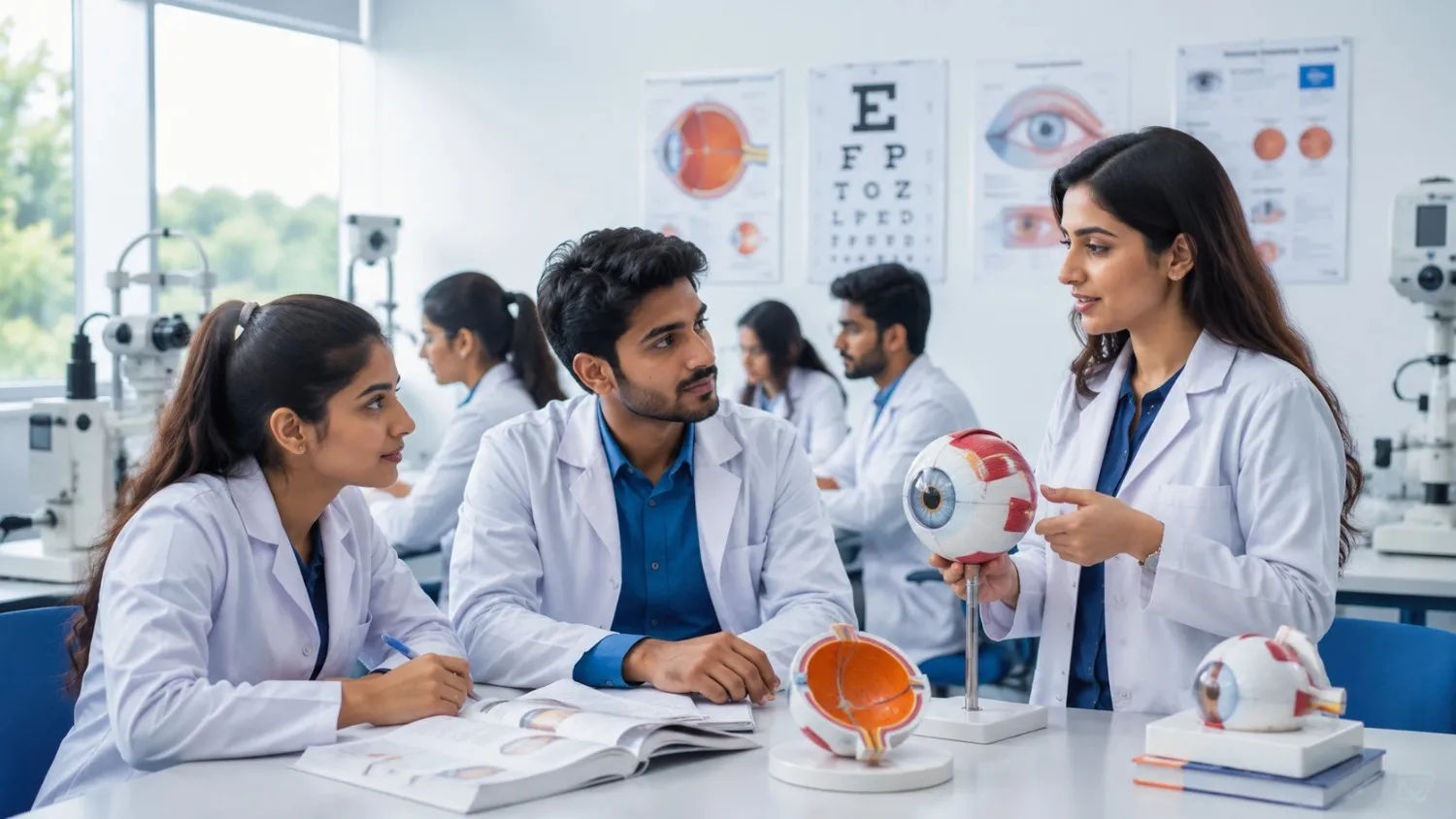
How Many Subjects Are There in Optometry?
Choosing a career in eye care is an excellent decision for students interested in healthcare, patient care, and medical technology. One of the first questions many aspiring students ask is, "How many subjects are there in Optometry?"
The answer depends on the university, country, and curriculum. However, most Bachelor of Optometry (B.Optom) or B.Sc. Optometry programs include 35–50 academic subjects spread across 6-8 semesters, along with clinical training, internships, and practical laboratory sessions.
If you're planning to pursue this career, understanding the subjects you'll study can help you prepare for both academic success and your future profession.
If you're still exploring healthcare careers, you can also browse the healthcare course guides on www.vidyaudbhav.com for detailed career planning resources.
Quick Answer
| B.Sc. Optometry | 4 Years | 35–45 | Yes |
| Bachelor of Optometry (B.Optom) | 4 Years | 40–50 | Yes |
Note: The exact number of subjects varies by university and country.
What Is Optometry?
Optometry is a healthcare profession focused on examining eyes, diagnosing vision problems, prescribing corrective lenses, detecting eye diseases, and assisting patients in maintaining healthy vision.
Unlike ophthalmologists, optometrists generally do not perform major eye surgeries but play a vital role in primary eye care and vision management.
Today, optometrists work in hospitals, eye clinics, optical chains, research organizations, and even multinational healthcare companies.
Understanding the Optometry Curriculum
Most universities design the curriculum by combining:
- Basic medical sciences
- Vision science
- Eye anatomy
- Clinical practice
- Diagnostic techniques
- Contact lens training
- Community eye care
- Hospital internship
This balanced approach ensures students gain both theoretical knowledge and practical experience.
Semester-Wise Major Subjects in Optometry
Although subjects vary across institutions, the following curriculum represents what most universities include.
First Year Subjects
Students begin with the foundations of medical science.
Common subjects include:
- Human Anatomy
- Human Physiology
- Biochemistry
- Ocular Anatomy
- Geometrical Optics
- Physical Optics
- English Communication
- Computer Fundamentals
During this year, students develop an understanding of the human body and the structure of the eye.
Second Year Subjects
Now the focus shifts toward vision science.
Subjects generally include:
- Visual Optics
- Ocular Physiology
- Microbiology
- Pathology
- Pharmacology
- Optometric Instruments
- Clinical Examination Techniques
- Low Vision Care
Students also begin using specialized diagnostic equipment in laboratory sessions.
Third Year Subjects
Clinical learning becomes much more intensive.
Major subjects include:
- Contact Lens Practice
- Binocular Vision
- Orthoptics
- Pediatric Optometry
- Ocular Diseases
- Clinical Optometry
- Community Optometry
- Public Health Ophthalmology
This is where students begin interacting with real patients under supervision.
Final Year Subjects
The last academic year focuses on professional practice.
Subjects may include:
- Advanced Clinical Optometry
- Hospital Management
- Research Methodology
- Evidence-Based Practice
- Practice Management
- Geriatric Optometry
- Specialty Contact Lenses
- Internship Preparation
Students also complete extensive clinical postings before graduation.
Practical Training Is Equally Important
One thing many beginners miss is that optometry is a highly practical profession.
In addition to classroom learning, students spend hundreds of hours practicing:
- Eye examinations
- Vision testing
- Refraction techniques
- Contact lens fitting
- Slit lamp examination
- Retinoscopy
- Ophthalmoscopy
- Patient counseling
Clinical exposure builds confidence and prepares students for real-world healthcare settings.
Skills You Develop During the Course
Beyond academic subjects, students develop valuable professional skills such as:
- Communication with patients
- Clinical decision-making
- Problem-solving
- Attention to detail
- Diagnostic accuracy
- Teamwork
- Time management
- Medical ethics
These skills are highly valued by employers worldwide.
Why Does the Course Include So Many Subjects?
You might be wondering why optometry students study topics beyond the eyes.
Here is what actually works in healthcare education.
A professional eye examination often reveals signs of systemic diseases like diabetes, hypertension, or neurological disorders. Therefore, optometrists need a strong understanding of overall human health, not just vision.
This broader knowledge enables better diagnosis, referrals, and patient care.
Career Opportunities After Studying Optometry
Graduates can pursue careers in multiple healthcare sectors.
Popular career options include:
- Clinical Optometrist
- Contact Lens Specialist
- Pediatric Optometrist
- Vision Therapist
- Low Vision Specialist
- Optical Store Manager
- Hospital Eye Care Consultant
- Medical Equipment Trainer
- Research Associate
- Academic Lecturer
Many professionals also establish their own eye clinics after gaining experience.
For students planning long-term career growth, exploring the career planning guide available on www.vidyaudbhav.com can help you understand additional healthcare pathways.
Benefits of Studying Optometry
Choosing optometry offers several long-term advantages.
High Demand
The global need for qualified eye care professionals continues to grow due to aging populations and increasing screen usage.
Stable Career
Vision care remains an essential healthcare service, making employment opportunities relatively stable.
Good Salary Potential
Experienced optometrists can earn competitive salaries, especially after specializing in areas such as pediatric optometry or contact lenses.
Global Opportunities
Many countries actively recruit trained optometrists, creating opportunities for international careers.
Challenges Students Should Know
Every healthcare course comes with challenges.
Some common ones include:
- Memorizing medical terminology
- Learning complex anatomy
- Managing clinical responsibilities
- Balancing theory and practical sessions
- Continuous skill development
Fortunately, consistent study habits make these challenges manageable.
Beginner Study Strategy
If you're starting an optometry course, consider these practical tips:
- Build a strong foundation in anatomy and physiology.
- Revise clinical concepts regularly.
- Practice using diagnostic instruments whenever possible.
- Participate actively during hospital postings.
- Create concise notes for quick revision.
- Focus on understanding rather than memorizing.
This becomes more important when preparing for practical examinations.
Common Mistakes Students Should Avoid
Here is where many people make mistakes.
- Ignoring practical sessions
- Studying only before exams
- Neglecting communication skills
- Not practicing clinical case discussions.
- Underestimating internship learning
Success in optometry depends on both academic performance and clinical competence.
Useful Learning Tools
Students often benefit from combining traditional learning with digital resources.
Beginner-Friendly
- Flashcards
- Anatomy atlases
- Study planners
Free Options
- YouTube educational lectures
- Open educational resources
- Medical illustration libraries
Premium Options
- Complete anatomy software
- Clinical simulation platforms
- Vision science learning platforms
Choose resources that complement your university curriculum rather than replacing it.
Future Trends in Optometry
The profession is evolving rapidly.
Emerging areas include:
- Artificial intelligence in eye diagnostics
- Tele-optometry
- Digital retinal imaging
- Myopia management
- Specialty contact lenses
- Vision rehabilitation
- Smart diagnostic devices
Students who stay updated with these developments will enjoy better career prospects.
Expert Tips for Success
Experienced professionals often recommend the following:
- Never skip clinical postings.
- Develop excellent patient communication skills.
- Stay updated with new diagnostic technologies.
- Attend workshops and conferences whenever possible.
- Build confidence through regular practice.
A strong combination of knowledge and hands-on experience sets successful optometrists apart.
Final Advice
If your goal is to build a meaningful healthcare career, optometry offers an excellent balance of science, technology, and patient care.
Most programs include 35 to 50 subjects, covering everything from anatomy and optics to advanced clinical practice. While the syllabus may seem extensive, every subject contributes to developing the expertise required to become a competent eye care professional.
Before selecting a college or university, compare the curriculum, internship opportunities, faculty, and clinical exposure. You can also explore the student success roadmap, healthcare career guidance, and admission counseling resources on www.vidyaudbhav.com to make an informed decision.
Frequently Asked Questions
1. How many subjects are there in Optometry?
Most Bachelor of Optometry or B.Sc. Optometry programs include approximately 35–50 subjects, depending on the university and curriculum.
2. Is Optometry difficult to study?
It is moderately challenging because it combines medical science with clinical practice. Consistent study and practical training make it manageable.
3. Does Optometry include practical training?
Yes. Practical sessions, laboratory work, hospital postings, and internships are essential parts of every recognized optometry program.
4. Can I get a good job after studying Optometry?
Yes. Graduates can work in hospitals, eye clinics, optical companies, research organizations, and educational institutions, or even start private practice.
5. What are the most important subjects in Optometry?
Some of the key subjects include Human Anatomy, Ocular Anatomy, Optics, Ocular Diseases, Contact Lens Practice, Clinical Optometry, Binocular Vision, and Pharmacology.
6. Is mathematics required for Optometry?
Basic mathematical concepts are useful, especially in optics and vision science, but advanced mathematics is generally not a major focus of the course.
7. What is the duration of an Optometry course?
Most Bachelor's programs last 4 years, including classroom study, clinical training, and a compulsory internship.