

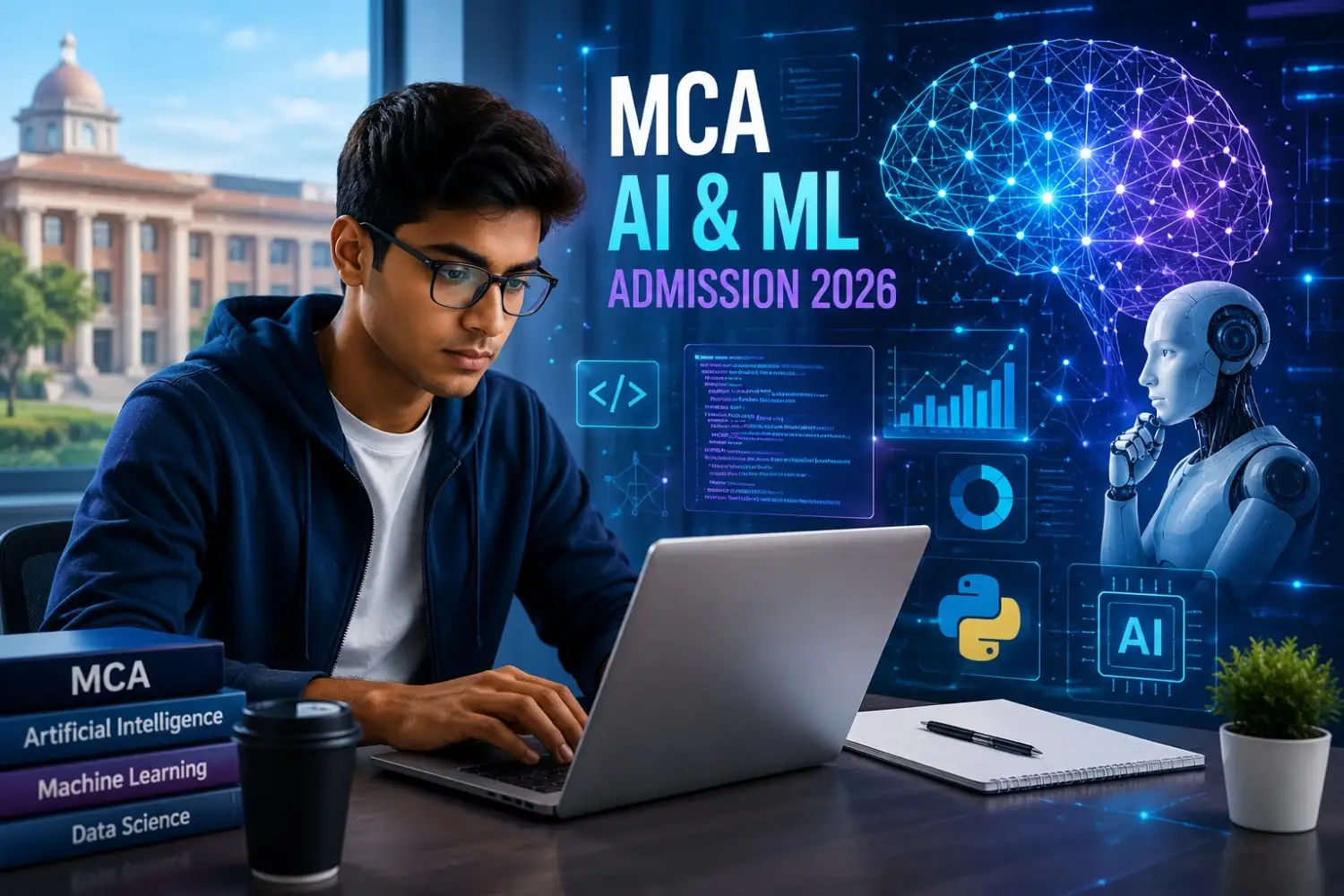
How to Get Admission in MCA AI & ML in 2026
Artificial Intelligence (AI) and Machine Learning (ML) are transforming industries across the world. From healthcare and finance to cybersecurity and automation, organizations are actively seeking professionals with advanced AI skills. As a result, MCA programs specializing in AI & ML have become one of the most popular postgraduate choices for technology graduates.
If you are planning to pursue this specialization, understanding the admission process is the first step toward building a successful career. This guide explains everything you need to know about getting admission into an MCA AI & ML program in 2026, including eligibility, entrance exams, required skills, career opportunities, and expert strategies.
Quick Answer
Getting admission into an MCA AI & ML program in 2026 generally involves:
- Completing a bachelor's degree from a recognized university
- Meeting minimum eligibility criteria
- Qualifying for entrance examinations (if applicable)
- Submitting academic documents
- Participating in counseling or interviews
- Confirming admission after seat allocation
Although requirements vary by institution, preparing early significantly improves your chances.
Understanding MCA AI & ML
MCA (Master of Computer Applications) with a specialization in Artificial Intelligence and Machine Learning is a postgraduate program designed to develop expertise in advanced software development, programming, data science, AI algorithms, and machine learning.
Students typically learn:
- Artificial Intelligence
- Machine Learning
- Deep Learning
- Python Programming
- Data Science
- Natural Language Processing
- Cloud Computing
- Big Data Analytics
- Neural Networks
- Computer Vision
The curriculum combines theoretical knowledge with practical projects, making graduates industry-ready.
Who Should Pursue MCA AI & ML?
This program is ideal for:
- BCA graduates
- Computer Science graduates
- Information Technology students
- Mathematics graduates
- Engineering graduates
- Software developers seeking specialization
- Working professionals interested in AI careers
Even beginners with strong programming fundamentals can succeed with consistent learning.
Eligibility Criteria for MCA AI & ML in 2026
Although eligibility differs slightly among universities, the common requirements include:
| Educational Qualification | Bachelor's Degree |
| Minimum Marks | Usually 50–60% |
| Mathematics Background | Preferred by many institutions |
| Entrance Exam | Required by some universities |
| Age Limit | Generally No Restriction |
Always verify the latest admission guidelines before applying.
Admission Process Step-by-Step
Step 1: Check Eligibility
Review the admission requirements of your preferred institutions carefully.
Pay attention to:
- Educational qualifications
- Required subjects
- Minimum percentage
- Reservation policies
- Entrance examination requirements
Step 2: Prepare Required Documents
Keep these documents ready:
- Graduation mark sheets
- Degree certificate
- Identity proof
- Passport-size photographs
- Transfer certificate
- Character certificate
- Category certificate (if applicable)
Organizing documents early prevents last-minute delays.
Step 3: Apply Online
Complete the application form accurately.
Double-check:
- Personal information
- Educational details
- Uploaded documents
- Payment confirmation
Simple mistakes can delay your application.
Step 4: Appear for Entrance Examination (If Required)
Some universities conduct entrance tests that evaluate:
- Logical reasoning
- Mathematics
- Computer fundamentals
- Programming concepts
- English proficiency
Practicing previous-year questions helps improve confidence.
Step 5: Attend Counseling
Qualified candidates participate in counseling, where seats are allocated based on merit, entrance scores, and availability.
Step 6: Complete Admission Formalities
Once selected:
- Verify documents
- Pay admission fees
- Complete enrollment
- Attend orientation
Essential Skills That Improve Your Chances
Beyond academic qualifications, universities appreciate candidates who demonstrate technical aptitude.
Helpful skills include:
- Python Programming
- Java
- SQL
- Data Structures
- Algorithms
- Basic Statistics
- Mathematics
- Problem Solving
- Communication Skills
Building these skills before admission provides a strong foundation.
Benefits of Choosing MCA AI & ML
Students gain several long-term advantages:
- High-demand specialization
- Excellent salary potential
- Global employment opportunities
- Strong research prospects
- Industry-relevant curriculum
- Practical project experience
- Career flexibility
AI continues to be one of the fastest-growing technology sectors worldwide.
Common Challenges
Many students face similar hurdles during the admissions process.
These include:
- Competitive entrance exams
- Limited seats
- Lack of programming experience
- Poor documentation
- Delayed applications
Fortunately, each challenge can be addressed with proper planning.
Practical Solutions
Here is what actually works:
- Start preparation at least six months in advance.
- Strengthen programming fundamentals.
- Practice aptitude questions daily.
- Learn Python through small projects.
- Keep digital copies of all documents.
- Apply to multiple institutions.
Consistency often matters more than perfection.
Real-World Example
Consider two graduates with similar academic scores.
Student A begins preparing early, learns Python, builds two AI mini-projects, and practices aptitude tests regularly.
Student B waits until application season and focuses only on filling out forms.
Although both meet eligibility requirements, Student A has a much stronger profile and performs better during admissions and interviews.
Preparation creates opportunities.
Beginner Strategy
If you are new to Artificial Intelligence:
- Learn Python basics.
- Understand data structures.
- Study introductory machine learning concepts.
- Practice logical reasoning.
- Complete beginner AI projects.
- Follow a structured study plan.
Small daily improvements lead to significant progress.
Advanced Strategy
For students aiming to stand out:
- Build a GitHub portfolio.
- Participate in hackathons.
- Complete AI certifications.
- Develop machine learning projects.
- Learn cloud computing basics.
- Practice coding regularly.
These experiences strengthen both admissions and future job applications.
Popular Learning Tools
Beginner-Friendly
- VS Code
- Google Colab
- Jupyter Notebook
Free Learning Platforms
- Kaggle
- GitHub
- TensorFlow
Premium Learning Platforms
- Coursera
- Udemy
- LinkedIn Learning
Choose tools based on your learning style and career goals.
Mistakes to Avoid
One thing many beginners miss is that admission preparation extends beyond academic marks.
Avoid these common mistakes:
- Waiting until deadlines
- Ignoring eligibility requirements
- Weak programming fundamentals
- Poor documentation
- Applying without research
- Skipping entrance preparation
Planning ahead makes the process much smoother.
Expert Tips
Admission experts generally recommend:
- Apply early.
- Keep multiple university options.
- Improve coding skills consistently.
- Stay updated with AI industry trends.
- Practice aptitude tests every week.
- Maintain strong academic performance.
These habits not only improve admission prospects but also prepare you for the program itself.
Best Practices
To maximize success:
- Create a study schedule.
- Track admission deadlines.
- Build practical AI projects.
- Participate in coding competitions.
- Learn from open-source communities.
- Develop communication skills.
Balanced preparation leads to better outcomes.
Future Trends in AI & ML
Artificial Intelligence is expected to influence nearly every industry over the coming years.
Emerging areas include:
- Generative AI
- Explainable AI
- Robotics
- AI Ethics
- Edge Computing
- Intelligent Automation
- Healthcare AI
- Cybersecurity AI
Graduates with specialized AI skills are likely to remain in high demand globally.
Actionable Final Advice
If your goal is to secure admission to an MCA AI & ML program in 2026, begin preparing now. Focus on strengthening your programming skills, understanding admission requirements, and building practical experience through projects.
You can also explore additional student success roadmaps, placement preparation strategies, and career guidance resources available at Vidya Udbhav to support your academic journey.
Conclusion
Pursuing an MCA in Artificial Intelligence and Machine Learning can open the door to exciting opportunities in one of the world's fastest-growing technology fields. While admission requirements vary across institutions, early preparation, strong technical skills, and careful planning can significantly improve your chances.
Whether you are a recent graduate or a working professional looking to upgrade your expertise, investing in AI education today can position you for a rewarding career tomorrow.
Frequently Asked Questions (FAQs)
1. What is the eligibility for MCA AI & ML in 2026?
Most institutions require a recognized bachelor's degree with minimum qualifying marks. Some may also require Mathematics and an entrance examination.
2. Is an entrance exam compulsory?
Not always. Some universities offer direct admission, while others conduct entrance examinations.
3. Can BCA students apply?
Yes. BCA graduates are among the most common applicants for MCA AI & ML programs.
4. Is Python necessary before joining?
It is not always mandatory, but learning Python beforehand gives students a significant advantage.
5. What career opportunities are available after MCA AI & ML?
Graduates can work as AI Engineers, Machine Learning Engineers, Data Scientists, Software Developers, Data Analysts, AI Researchers, Automation Specialists, and Cloud AI Engineers.