

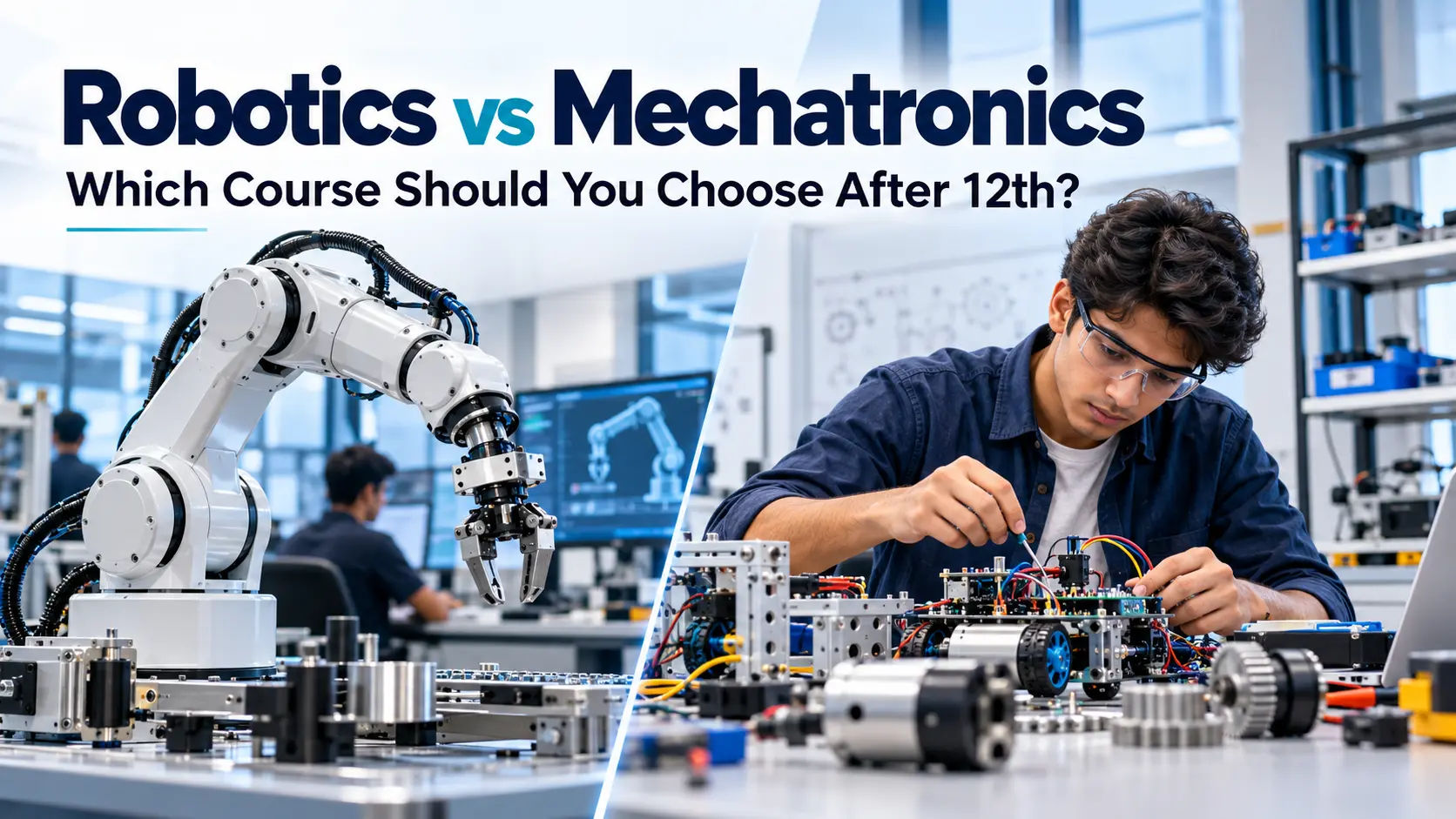
Choosing an engineering course after Class 12 can be challenging, especially when two fields appear closely related. Robotics and mechatronics both involve intelligent machines, automation, electronics, and programming. However, they approach these technologies from slightly different perspectives.
If you enjoy building robots, programming machines, designing automated systems, or understanding how technology interacts with the physical world, both fields are worth exploring.
https://vidyaudbhav.com/blogs/best-online-degree-courses-india-2027
https://vidyaudbhav.com/blogs/online-degree-vs-distance-education
The real question is not simply which course is better. It is which course fits your interests, academic strengths, preferred career, and long-term goals.
In this guide, we compare robotics vs mechatronics, including eligibility, subjects, career opportunities, advantages, challenges, and how to select the right engineering course after 12th.
Quick Answer: Robotics vs Mechatronics
Robotics engineering focuses primarily on designing, programming, and controlling robots. Mechatronics engineering combines mechanical engineering, electronics, control systems, and computing to develop intelligent machines and automated systems.
Choose robotics if you are particularly interested in robot design, autonomous machines, robot programming, and perception systems. Consider mechatronics if you want broader knowledge of mechanical systems, electronics, embedded systems, and industrial automation.
Both fields overlap, and your actual learning experience depends on the university's curriculum and available specialisations.
What Is Robotics Engineering?
Robotics engineering is a branch of engineering concerned with developing machines that can perform tasks automatically or semi-autonomously.
Robotics engineers work on the mechanical structure, electronic components, sensors, control systems, and software that allow robots to operate.
For example, an autonomous mobile robot in a warehouse must detect obstacles, determine its position, calculate a path, and move safely. Robotics engineering brings together the technologies needed to make this possible.
What Do You Study in Robotics Engineering?
Depending on the institution, the curriculum may include:
- Robot design, kinematics, and dynamics
- Programming with Python, C++, or other languages
- Sensors, actuators, and embedded systems
- Control systems and motion planning
- Computer vision and machine perception
- Artificial intelligence and autonomous systems
- Robot simulation and practical laboratory projects
Career Opportunities in Robotics
Graduates may pursue roles such as:
- Robotics Engineer
- Robot Software Developer
- Autonomous Systems Engineer
- Robot Simulation Engineer
- Computer Vision Engineer
- Robotics Research Assistant
These roles are found across manufacturing, logistics, healthcare technology, aerospace, agriculture, and research. Advanced positions may require postgraduate study or specialised experience.
What Is Mechatronics Engineering?
Mechatronics engineering integrates mechanical engineering, electronics, computer systems, and control engineering to create intelligent products and automated equipment.
Rather than focusing exclusively on robots, mechatronics covers a wider range of machines that combine physical components with electronic control and software.
Consider an automatic washing machine. Its motor, sensors, electronic controller, and programmed operating cycles work together to complete a task. Designing and improving such integrated systems involves mechatronics principles.
What Do You Study in Mechatronics Engineering?
Common subjects include:
- Engineering mechanics and machine design
- Electrical and electronic circuits
- Sensors and instrumentation
- Microcontrollers and embedded systems
- Control engineering
- Industrial automation and robotics
- Programmable logic controllers (PLCs)
- Computer-aided design and manufacturing
The exact balance between mechanical, electrical, and computing subjects varies by university.
Career Opportunities in Mechatronics
Possible career paths include:
- Mechatronics Engineer
- Automation Engineer
- Control Systems Engineer
- Embedded Systems Engineer
- Industrial Robotics Engineer
- Manufacturing Systems Engineer
- Product Design Engineer
Mechatronics graduates can work in automotive engineering, smart manufacturing, industrial equipment, medical devices, and other technology-driven industries.
Robotics vs Mechatronics: Key Differences
| Main focus | Designing and controlling robots | Integrating mechanical, electronic, and computing systems |
| Core subjects | Robot programming, motion planning, perception | Mechanics, electronics, control, embedded systems |
| Programming | Often central to robotics specialisations | Important, but emphasis varies |
| Mechanical design | Relevant to robot structures | Often a broader foundation |
| Typical projects | Autonomous robots, robotic arms, mobile robots | Automated machines, smart devices, production systems |
| Career direction | Robotics and autonomous systems | Automation, controls, embedded systems, robotics |
| Best suited to | Students strongly interested in robots and autonomy | Students interested in complete intelligent machines |
Important: These are general distinctions, not fixed boundaries. A mechatronics programme may have advanced robotics modules, while a robotics degree may include substantial mechanical and electronic engineering.
How to Choose the Right Course After 12th
Here is a practical way to compare both options before applying.
Step 1: Check Your Eligibility
Many bachelor's engineering programmes require a recognised Class 12 qualification with Physics and Mathematics, plus any other subjects the institution specifies.
Some programmes also require Chemistry, minimum marks, or entrance examinations. Requirements vary by country and university, so check the official admission criteria before shortlisting courses.
Step 2: Identify Your Technical Interests
Ask yourself what you would enjoy working on every day.
- Do you want to program a robot to navigate independently?
- Are you curious about how sensors and motors work together?
- Would you rather build an industrial automation system?
- Do you enjoy mechanical design as much as coding?
Your answers can help identify which curriculum is more appealing.
Step 3: Compare the Curriculum
Do not choose a degree based only on its title. Download the syllabus and compare the modules, laboratory facilities, programming subjects, industry projects, and elective options.
A mechatronics programme with strong robotics specialisations may suit you better than a robotics programme with limited practical training.
Step 4: Review Practical Learning Opportunities
Look for robotics laboratories, student engineering teams, internships, industry placements, and opportunities to build working prototypes.
Practical experience is valuable because employers need graduates who can apply theory, troubleshoot failures, and explain their technical decisions.
Step 5: Evaluate the Total Cost
Compare tuition, accommodation, laboratory fees, equipment costs, and living expenses. Also check scholarship availability and the institution's accreditation or professional recognition where relevant.
Eligibility and Course Duration
Both fields are commonly available through undergraduate engineering degrees, although programme names and entry requirements vary globally.
| B.Tech/B.E. in Robotics Engineering | 4 years in many countries, including India | Check subject prerequisites and entrance requirements |
| B.Tech/B.E. in Mechatronics Engineering | 4 years in many countries, including India | Review the balance of mechanical, electronics, and computing subjects |
| Diploma in a related engineering field | Often 2–3 years, depending on the country and entry level | Confirm progression and lateral-entry options |
| Master's in Robotics or a related field | Commonly 1–2 years, depending on the country | Usually requires a relevant bachelor's degree or accepted prerequisites |
These are common pathways, not universal rules. Some universities offer combined robotics and mechatronics degrees, while others teach robotics as a specialisation within mechanical, electrical, or computer engineering.
Benefits and Challenges of Both Courses
Advantages of Robotics Engineering
- Offers specialised exposure to robotic systems and autonomous technologies.
- Develops programming, control, and problem-solving skills.
- Provides pathways into research and emerging automation applications.
- Allows students to explore computer vision, intelligent machines, and robot simulation.
Challenges: Advanced robotics can require strong mathematics, programming, electronics, and control theory. Entry-level opportunities may also depend on practical projects and the local availability of robotics employers.
Advantages of Mechatronics Engineering
- Provides a multidisciplinary engineering foundation.
- Opens pathways into robotics, manufacturing, controls, and embedded systems.
- Helps students understand how mechanical and electronic components work together.
- Offers flexibility when exploring different engineering industries.
Challenges: The broad curriculum can make it difficult to master every discipline equally. Students may need to specialise through electives, internships, certifications, or postgraduate education to qualify for certain technical roles.
Robotics vs Mechatronics Salary: Which Pays More?
There is no universal winner. Salaries depend on the country, employer, industry, qualifications, technical skills, and experience.
A robotics software engineer working on advanced autonomous systems may earn more than an entry-level mechatronics graduate. However, an experienced mechatronics engineer specialising in industrial automation or control systems may earn more than a junior robotics engineer.
Rather than comparing job titles alone, investigate:
- Entry-level salaries in your intended country.
- The number and type of relevant vacancies.
- Required programming and engineering skills.
- Internship and graduate employment opportunities.
- Long-term progression into specialist or leadership roles.
For reliable comparisons, use salary surveys and current job listings from the region where you plan to work. Treat advertised salary ranges as estimates, not guarantees.
Practical Example: Which Course Fits Your Goal?
Imagine two students who both enjoy technology but have different ambitions.
Student A wants to build autonomous robots. They are interested in programming robotic arms, developing navigation systems, experimenting with computer vision, and teaching robots to respond to their surroundings. A robotics-focused degree could be a strong match.
Student B wants to automate manufacturing equipment. They enjoy mechanical design, electrical circuits, sensors, motor control, and understanding entire production systems. Mechatronics could provide a suitable foundation, with opportunities to specialise in robotics later.
Neither student has made a universally better choice. They have selected different routes towards their goals.
Tools and Platforms Worth Exploring
Before committing to a degree, try introductory tools that let you experiment with the work involved.
| Beginner programming | Python, Arduino IDE |
| Mechanical design | Autodesk Fusion, SolidWorks |
| Robot simulation | ROS 2, Gazebo |
| Electronics and circuits | Tinkercad Circuits |
| Control and system modelling | MATLAB, Simulink |
Some offer free access, educational licences, or beginner-friendly learning options. Availability and licensing vary. You do not need to master every tool before entering university.
A useful first project is to program a small simulated robot to follow a route or build a basic sensor-controlled device. It can help you discover whether you prefer software, hardware, or their integration.
Beginner Strategy and Advanced Career Planning
If you are still in Class 12, begin with mathematics, physics, and basic programming. Build small projects and document what you learn, including the problems you encountered and how you solved them.
Once you enter university, focus on three areas:
- Core knowledge: Understand mathematics, electronics, mechanics, and programming rather than memorising answers.
- Practical experience: Complete projects, participate in technical clubs, and seek internships.
- Specialisation: Develop deeper expertise in robotics software, embedded systems, industrial automation, machine vision, or control engineering.
Advanced students should also explore research projects, industry placements, technical portfolios, and postgraduate requirements for their preferred roles.
Common Mistakes to Avoid
Here is where many students make mistakes when comparing engineering courses:
- Choosing only by salary: High earnings are not guaranteed by a particular degree title.
- Assuming robotics means only coding: Robots depend on mechanics, electronics, control, and software.
- Assuming mechatronics is less advanced: It can involve complex intelligent systems, automation, and robotics.
- Ignoring the syllabus: Course titles do not reveal the full learning experience.
- Overlooking practical facilities: A strong laboratory and project environment can make a meaningful difference.
- Following friends or trends: Your interests, abilities, budget, and career plans may be different.
- Ignoring accreditation: Verify whether the programme meets relevant professional or licensing requirements for your intended career.
Future Trends in Robotics and Mechatronics
Both fields are evolving as industries adopt more advanced technologies.
Key developments include:
- Collaborative robots: Machines designed to work alongside people in industrial and service environments.
- Artificial intelligence: Systems that help machines interpret information and make decisions.
- Smart manufacturing: Connected equipment, automated production, and real-time monitoring.
- Autonomous systems: Robots and vehicles capable of navigating with limited human intervention.
- Healthcare technology: Assistive devices, rehabilitation robotics, and specialised medical equipment.
These developments create opportunities for engineers with strong fundamentals and practical experience. However, technology adoption differs by industry and region, so students should research actual employment opportunities rather than assume every emerging field guarantees a job.
Best Practices Before Finalising Your Course
Before accepting an offer, complete this checklist:
- Confirm that you meet the admission requirements.
- Compare the complete syllabuses of at least three programmes.
- Review laboratory facilities and internship opportunities.
- Check tuition fees, scholarships, and living expenses.
- Research graduate outcomes and entry-level job requirements.
- Choose a course that matches your interests and long-term plans.
If you are uncertain, professional career counselling can help you evaluate your strengths and compare suitable educational pathways before making a commitment.
Frequently Asked Questions
1. Which is better after 12th: robotics or mechatronics?
Robotics may suit students who want to specialise in robot design, programming, and autonomous systems. Mechatronics may suit students who prefer a broader combination of mechanical engineering, electronics, computing, and automation. The best choice depends on the curriculum and your goals.
2. Can I study robotics engineering after 12th?
Yes. Many universities offer undergraduate robotics engineering programmes. Eligibility commonly includes Mathematics and Physics, but additional subjects, minimum marks, and entrance examinations depend on the institution and country.
3. Is mechatronics engineering a good career choice?
Mechatronics can lead to careers in industrial automation, embedded systems, control engineering, manufacturing, and robotics. Career prospects depend on your technical skills, practical experience, location, and the employers you target.
4. Which course has a higher salary: robotics or mechatronics?
Neither course consistently guarantees a higher salary. Specialisation, experience, employer, and location often have a greater influence on earnings than the degree title alone.
5. Can a mechatronics engineer become a robotics engineer?
Yes. Mechatronics graduates can move into robotics by developing relevant skills in robot programming, control systems, sensors, simulation, and autonomous technologies. Relevant projects and internships can strengthen their applications.
6. Is coding necessary for robotics and mechatronics?
Coding is important in both fields, particularly for robotics software, embedded systems, and automation. The depth of programming required varies by role, but learning Python and later exploring C or C++ can provide a useful foundation.
7. Can I study these courses abroad?
Yes. Universities in several countries offer robotics, mechatronics, or combined programmes. Compare entry requirements, language proficiency requirements, tuition, scholarships, accreditation, and post-study employment rules before applying.
Conclusion: Make Your Choice Based on Your Goals
When comparing robotics vs mechatronics, remember that both fields combine multiple engineering disciplines and offer opportunities to work with intelligent machines.
Choose robotics if developing robots and autonomous systems is your main ambition. Choose mechatronics if you want a broader foundation in mechanical systems, electronics, control, and automation, with the flexibility to move into robotics later.
Most importantly, compare actual course modules, practical facilities, costs, and career outcomes before making your decision. Your skills, projects, and willingness to keep learning will matter throughout your career.
For additional guidance, explore career planning resources after 12th on Vidya Udbhav to make a more informed decision about your future.