

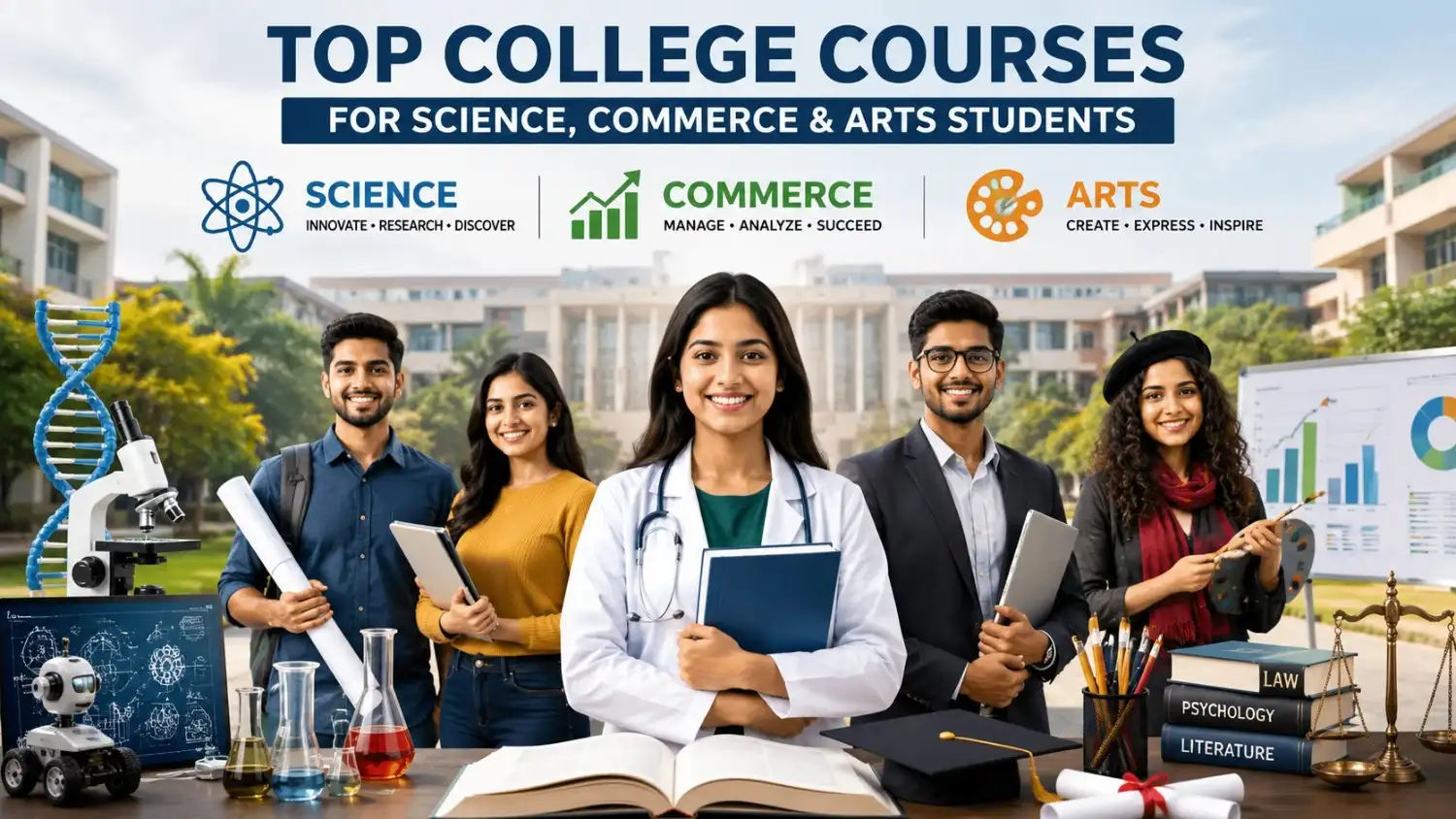
Choosing a college course after completing high school is one of the biggest decisions in a student's life. The right course can open doors to rewarding careers, while the wrong choice may lead to confusion and career changes later.
Whether you belong to the Science, Commerce, or Arts stream, there are hundreds of degree programs available today. The challenge is finding one that matches your interests, strengths, and long-term goals.
If you're still exploring your options, the career planning guide available on Vidya Udbhav can help you understand different educational pathways before making your final decision.
Understanding How to Choose the Right College Course
Before selecting a degree program, ask yourself a few important questions:
- What subjects do I genuinely enjoy?
- Which skills come naturally to me?
- What kind of career do I imagine in the future?
- Am I interested in higher studies or entering the workforce quickly?
- What industries are expected to grow over the next decade?
One thing many beginners miss is that choosing a course should never be based only on popularity or peer pressure. Your interests and career goals matter much more.
Quick Comparison of Courses by Stream
| Science | B.Tech, MBBS, B.Sc, BCA, Pharmacy, Biotechnology | Engineering, Healthcare, IT, Research |
| Commerce | B.Com, BBA, CA, CS, Economics, Finance | Banking, Business, Accounting, Marketing |
| Arts | BA, Journalism, Psychology, Law, Design, Social Work | Media, Education, Civil Services, Creative Industries |
Best College Courses for Science Students
Science students enjoy the widest range of career opportunities because they can move into technology, healthcare, management, research, and even business.
Engineering (B.Tech)
Engineering remains one of the most sought-after choices worldwide.
Popular specializations include:
- Computer Science
- Artificial Intelligence
- Data Science
- Mechanical Engineering
- Civil Engineering
- Electronics Engineering
Graduates can work in technology companies, manufacturing, research organizations, or government sectors.
MBBS and Medical Sciences
Students passionate about healthcare can choose:
- MBBS
- BDS
- BAMS
- BHMS
- Nursing
- Physiotherapy
These fields offer stable careers with long-term growth.
Bachelor of Science (B.Sc)
A B.Sc degree is suitable for students interested in research or specialized careers.
Popular subjects include:
- Physics
- Chemistry
- Mathematics
- Biotechnology
- Microbiology
- Environmental Science
Computer Applications (BCA)
As digital transformation continues worldwide, BCA has become an excellent option for students interested in software development, cybersecurity, cloud computing, and artificial intelligence.
You may also find useful information through the student success roadmap on Vidya Udbhav while exploring technology careers.
Best College Courses for Commerce Students
Commerce offers excellent opportunities for students interested in finance, business, and entrepreneurship.
Bachelor of Commerce (B.Com)
B.Com remains one of the strongest foundations for careers in:
- Accounting
- Banking
- Taxation
- Finance
- Auditing
Bachelor of Business Administration (BBA)
BBA prepares students for management careers and entrepreneurship.
Students develop skills in:
- Leadership
- Marketing
- Human Resources
- Business Analytics
- Operations
Chartered Accountancy (CA)
CA is one of the most respected professional qualifications.
Although challenging, it offers outstanding career opportunities in finance, consulting, auditing, and taxation.
Company Secretary (CS)
Students interested in corporate governance, legal compliance, and business law often choose CS as a professional career.
Best College Courses for Arts Students
Arts students today have more career opportunities than ever before.
Bachelor of Arts (BA)
Students can specialize in subjects like:
- English
- Political Science
- Sociology
- Economics
- History
- Geography
These programs prepare students for teaching, research, government services, and higher education.
Journalism and Mass Communication
Ideal for students who enjoy storytelling, media production, public relations, or digital content creation.
Psychology
Mental health awareness has created growing demand for psychologists, counselors, and behavioral researchers across the world.
Law (Integrated LLB)
Law combines analytical thinking with communication skills and offers careers in litigation, corporate law, public policy, and legal consulting.
Design and Fine Arts
Creative students can build successful careers in:
- Graphic Design
- Animation
- Fashion Design
- Interior Design
- UX/UI Design
Step-by-Step Strategy for Choosing the Right Course
Here is what actually works when selecting your college program:
- Identify your interests and strengths.
- Research future job demand.
- Compare course curriculum.
- Explore salary potential.
- Check internship opportunities.
- Evaluate college placement records.
- Speak with career counselors.
- Choose based on long-term goals rather than short-term trends.
Students can also explore the career counselling resources available on Vidya Udbhav before making a final decision.
Benefits of Choosing the Right Course
A well-chosen degree can provide:
- Better career satisfaction
- Higher earning potential
- Stronger skill development
- Greater job stability
- Opportunities for international careers
- Easier transition into postgraduate studies
Common Challenges Students Face
Many students struggle because they:
- Follow friends instead of personal interests.
- Ignore future industry demand.
- Choose courses based only on salary.
- Lack proper career guidance.
- Don't research college quality.
Now let us understand that avoiding these mistakes can save years of uncertainty.
Practical Example
Consider two students with similar academic scores.
One chooses Computer Science because friends recommend it, despite having little interest in coding.
Another chooses Psychology because they genuinely enjoy understanding human behavior.
Five years later, the second student often performs better because genuine interest leads to stronger motivation, better skills, and continuous learning.
Passion supported by informed decision-making usually produces better long-term outcomes.
Helpful Tools for Career Planning
Free Options
- Google Career Explorer
- LinkedIn Career Insights
- O*NET Career Explorer
Premium Options
- Coursera Career Services
- LinkedIn Learning
- Career assessment platforms
These tools can help students evaluate career paths, required skills, and future opportunities.
Beginner Strategy
If you're unsure about your future:
- Focus on broad degree programs.
- Develop communication skills.
- Learn digital literacy.
- Build practical projects.
- Participate in internships.
This creates flexibility for future career transitions.
Advanced Strategy
Students aiming for competitive careers should:
- Earn industry certifications.
- Build professional portfolios.
- Network with professionals.
- Complete internships every year.
- Learn emerging technologies relevant to their field.
This becomes more important when employers increasingly value practical experience alongside academic qualifications.
Mistakes to Avoid
- Choosing a course only because it is popular.
- Ignoring your strengths.
- Not checking career opportunities.
- Selecting a college without researching placements.
- Waiting until graduation to build skills.
Expert Tips
Education experts generally recommend:
- Research industries before choosing a degree.
- Focus on skill development alongside academics.
- Build communication and problem-solving abilities.
- Stay updated with industry trends.
- Gain practical experience through internships and projects.
Future Trends in Higher Education
The future job market increasingly values interdisciplinary skills.
Growing fields include:
- Artificial Intelligence
- Data Science
- Cybersecurity
- Digital Marketing
- Healthcare Technology
- Renewable Energy
- FinTech
- UX Design
- Biotechnology
Students who combine technical knowledge with communication, creativity, and adaptability will have a competitive advantage.
Final Advice
Choosing the best college course is not about selecting the most popular option—it is about selecting the one that aligns with your interests, abilities, and long-term ambitions.
Take time to research, seek guidance, and evaluate future career opportunities before making your decision. A thoughtful choice today can create opportunities for decades to come.
For more educational insights, career guidance, and admission support, explore the career planning guide, placement preparation strategies, and student success roadmap on Vidya Udbhav.
Frequently Asked Questions
1. Which stream offers the highest-paying careers?
Science often leads to high-paying careers in engineering, medicine, and technology, but Commerce and Arts also offer excellent earning potential with the right skills and experience.
2. Can Arts students pursue management careers?
Yes. Arts graduates can pursue MBA programs, business management roles, marketing, human resources, and entrepreneurship.
3. Is BCA a good option after Science?
Yes. BCA is an excellent choice for students interested in software development, artificial intelligence, cybersecurity, and IT careers.
4. Which Commerce course has the best career prospects?
B.Com, BBA, Chartered Accountancy (CA), and Company Secretary (CS) remain among the strongest career-oriented choices.
5. How should I choose the right college course?
Consider your interests, strengths, career goals, industry demand, placement opportunities, and future growth before making a decision.