

Introduction
Have you ever felt unprepared when switching subjects or starting a new course? That’s exactly where a bridge course comes in.
So, what is a bridge course?
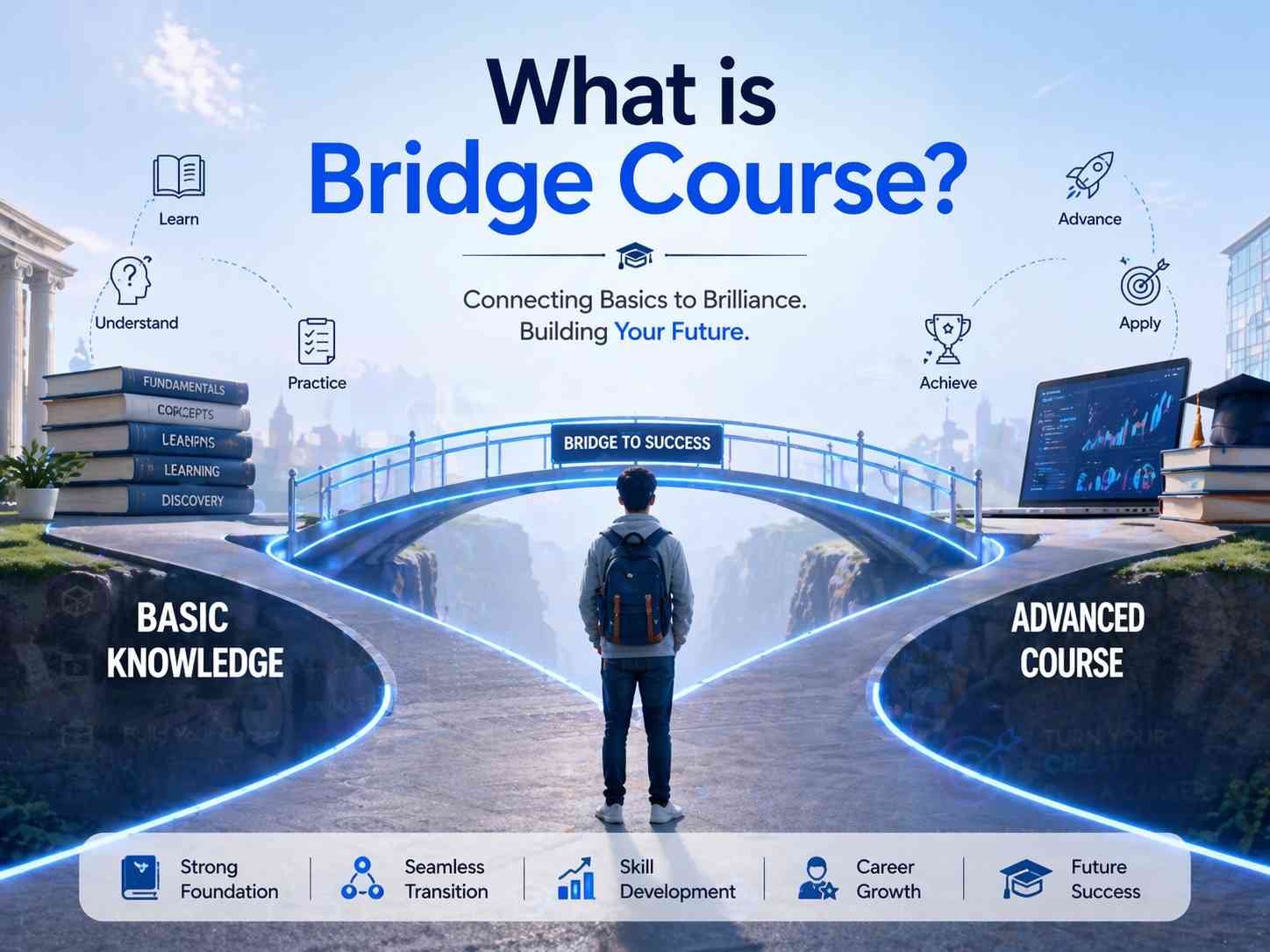
A bridge course is a short-term educational program designed to help students fill the gap between their previous knowledge and the new course or subject they are about to study.
It acts like a “bridge” that connects your current knowledge level to the required level for success in a new academic or professional field.
What is the Bridge Course?
A bridge course is a preparatory course that helps students gain basic knowledge and skills before starting a main course or program.
Simple Definition:
Bridge course = A course that fills knowledge gaps before starting something new.
For example:
- A commerce student joining a science-related program
- A Hindi-medium student moving to English-medium studies.
- A student entering college with weak basics.
Types of Bridge Courses
Bridge courses are available in different forms based on needs.
Academic Bridge Courses
- Help students understand core subjects like math, science, or English.
- Common in schools and colleges
Skill-Based Bridge Courses
- Focus on practical skills.
- Example: communication, computer basics, coding
Professional Bridge Courses
- Help career switchers
- Example: non-IT student learning programming basics
What You Learn in a Bridge Course
Bridge courses are designed to strengthen fundamentals.
Key Learning Areas:
- Basic concepts of subjects
- Communication skills
- Problem-solving techniques
- Study methods and learning strategies
Example:
If you switch to science, a bridge course may include:
- Basic physics concepts
- Mathematics fundamentals
- Scientific terminology
Benefits of the Bridge Course
Bridge courses offer several advantages, especially for beginners.
Key Benefits:
- Helps in a smooth transition between courses
- Builds a strong foundation
- Improves confidence
- Reduces academic stress
- Enhances performance in the main course
Who Should Do a Bridge Course?
A bridge course is ideal for:
- Students changing streams (Arts to Science, Commerce to Arts)
- Students with weak basics
- Beginners entering college
- Students returning to studies after a gap.
- Professionals switching careers
Bridge Course After 12th
Many students take bridge courses after 12th grade to prepare for higher education.
Common Scenarios:
- Commerce student moving to IT.
- Arts student preparing for management studies.
- Science student needing coding basics.
Bridge courses help them adjust quickly and perform better in their chosen field.
Duration and Fees of Bridge Course
Duration:
- A few weeks to 6 months
Fees:
- 5,000 to 50,000, depending on the course and the institute
These courses are usually affordable and short-term.
Is Bridge Course Useful?
Yes, bridge courses are highly useful in today’s competitive world.
Reasons:
- Helps students catch up quickly
- Reduces learning gaps
- Makes difficult subjects easier
- Improves academic performance
However, it is most useful when taken seriously and practiced regularly.
How to Choose the Right Bridge Course
Follow these simple tips:
- Identify your weak areas.
- Choose a course relevant to your stream.
- Check course content
- Prefer practical learning
- Look for certified institutes.
Pro Tip
Always focus on understanding concepts instead of just completing the course. A strong foundation will help you in the long term.
Bonus Tip
If possible, combine a bridge course with self-study using online resources to improve faster.
Conclusion
Now you clearly understand what a bridge course is and why it is important. It is a simple yet powerful way to prepare yourself for new academic challenges or career paths.
Whether you are switching streams, improving basics, or starting something new, a bridge course can give you the confidence and knowledge you need.
Start early, choose wisely, and build a strong foundation for your future.