

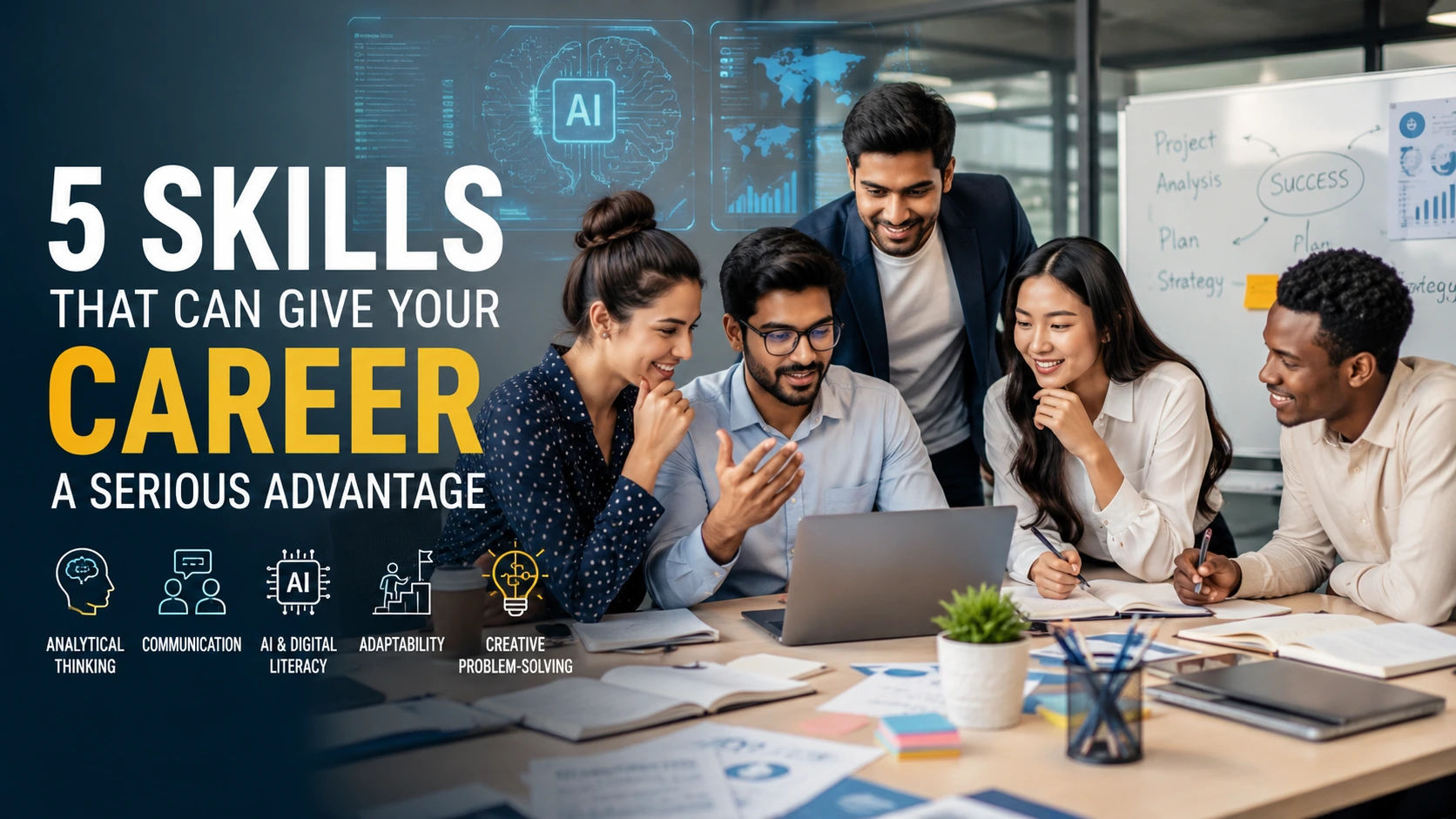
5 Skills That Can Give Your Career a Serious Advantage
The job market is changing quickly. A degree can open the door, but the skills you develop often determine how far you can go once you are inside.
Artificial intelligence, automation, remote work, digital transformation, and changing employer expectations are reshaping careers across industries. The World Economic Forum estimates that 39% of workers’ existing skill sets could be transformed or become outdated by 2030, making continuous skill development more important than ever.
https://vidyaudbhav.com/blogs/which-skills-should-i-learn-for-a-successful-career
So, what skills can actually give your career an advantage?
Here are five career skills that can help students, graduates, and professionals become more capable, adaptable, and valuable in a competitive workplace.
Quick Answer: What Skills Give You a Career Advantage?
The five skills worth developing are:
- Analytical and critical thinking
- Communication and interpersonal skills
- AI and digital literacy
- Adaptability and continuous learning
- Creative problem-solving
These skills are useful because they work across industries. Whether you are studying business, technology, healthcare, education, design, finance, or marketing, they can strengthen your professional profile.
The World Economic Forum lists analytical thinking as the most important core skill among surveyed employers, followed by resilience, flexibility and agility, leadership and social influence, and creative thinking.
Why Career Skills Matter More Than Ever
For a long time, career preparation was closely tied to academic qualifications. A degree is still valuable, but employers increasingly look at what candidates can actually do.
Consider two graduates with similar qualifications.
One has a degree and little practical experience. The other has the same degree but can analyze data, communicate ideas clearly, use modern digital tools, solve problems, and adapt to new technology.
The second candidate has a stronger overall professional profile.
This does not mean degrees are becoming irrelevant. Instead, education and skills work best together.
If you are still deciding on a career direction, start with a structured career-planning guide that considers your interests, strengths, skills, and future opportunities.
1. Analytical and Critical Thinking
Analytical thinking is the ability to examine information, identify patterns, evaluate options, and make logical decisions.
It is valuable in almost every profession.
A marketer may use it to understand campaign performance. A software developer may use it to identify a technical problem. A manager may use it to compare business strategies.
The important point is that analytical thinking is not limited to mathematics.
How to Develop Analytical Thinking
Try these practical exercises:
- Question assumptions instead of accepting information immediately.
- Compare multiple solutions before making a decision.
- Break complicated problems into smaller parts.
- Practice interpreting charts, reports, and data.
- Explain why you reached a particular conclusion.
For students, case studies, research projects, puzzles, business problems, and practical assignments can be excellent ways to strengthen this ability.
Expert insight: Don't just learn an answer. Learn how to arrive at the answer.
2. Communication and Interpersonal Skills
You can have excellent technical knowledge and still struggle professionally if you cannot communicate your ideas effectively.
Communication includes much more than speaking fluent English.
It involves:
- Listening carefully
- Explaining ideas clearly
- Writing professional messages
- Giving presentations
- Asking useful questions
- Understanding different perspectives
- Handling disagreements professionally
This becomes especially important when working with international teams, clients, managers, or customers.
Recent employer research also points to communication, problem-solving, and adaptability as highly valued capabilities alongside technology and AI skills.
A Simple Way to Improve
Choose one topic every week and explain it in two ways:
First: explain it to an expert.
Second: explain it to someone who knows nothing about it.
If you can make both explanations clear, your communication skills are improving.
You can also practice interviews, presentations, professional email writing, and group discussions.
3. AI and Digital Literacy
You do not necessarily need to become an AI engineer to benefit from artificial intelligence.
You do need to understand how modern digital tools can improve your work.
AI and big data are among the fastest-growing skill areas identified by the World Economic Forum, while technological literacy is also expected to become increasingly important.
What Does AI Literacy Mean?
For a beginner, it can include:
- Understanding what AI can and cannot do
- Using AI tools for research and brainstorming
- Checking AI-generated information
- Automating repetitive tasks
- Understanding basic data concepts
- Protecting confidential information
- Using digital productivity tools effectively
For example, a digital marketer might use AI to generate research ideas and organize information, but still rely on human judgment for strategy and brand decisions.
The winning approach is not AI versus people.
It is people who know how to work effectively with AI.
Students interested in technology-focused careers can also explore Vidya Udbhav's guide to career opportunities in artificial intelligence.
4. Adaptability and Continuous Learning
One thing many beginners miss is that career success is no longer about learning something once and using it forever.
Tools change. Industries change. Job responsibilities change.
A skill that is highly valuable today may be supplemented by new technology tomorrow.
Adaptability means being comfortable learning, adjusting, and improving when circumstances change.
The WEF identifies resilience, flexibility, and agility, along with curiosity and lifelong learning, among the skills expected to rise in importance through 2030.
How to Build Adaptability
Use a simple cycle:
Learn → Practice → Apply → Review → Improve
For example, if you learn a new design tool, don't stop after watching tutorials. Create a real project. Ask someone for feedback. Identify weaknesses and improve the next project.
That process builds adaptability far better than collecting certificates without practical application.
5. Creative Problem-Solving
Creativity is not only useful for designers, writers, or artists.
Businesses in almost every industry need people who can find better ways to solve problems.
Creative problem-solving combines imagination with practical thinking.
Suppose a company is receiving fewer customer enquiries. A creative professional does not simply say, "Sales are down."
They may ask:
- Is the target audience changing?
- Is the messaging unclear?
- Has customer behaviour changed?
- Are competitors offering something different?
- Can technology improve the customer journey?
That shift—from identifying a problem to exploring different solutions—is what makes creative problem-solving valuable.
The WEF ranks creative thinking among the leading core skills for today's workforce and expects it to remain increasingly important.
Skills at a Glance
| Analytical thinking | Improves decisions and problem-solving | Case studies, data, research |
| Communication | Helps you explain ideas and collaborate | Presentations, writing, discussions |
| AI & digital literacy | Improves productivity and employability | Digital tools, AI practice, projects |
| Adaptability | Helps you handle changing workplaces | Learn new tools and review progress |
| Creative problem-solving | Helps generate better solutions | Projects, brainstorming, real-world challenges |
How to Build These Skills Step by Step
You do not need to master all five skills simultaneously.
Here is what actually works.
Step 1: Choose One Skill
Start with the skill most relevant to your current career goal.
A computer science student might prioritize analytical thinking and AI literacy.
A business student might begin with communication and problem-solving.
A creative student might combine communication with digital skills.
Step 2: Learn the Fundamentals
Use courses, books, practical tutorials, workshops, or structured learning resources.
Free resources can be useful for beginners, while premium courses may provide more structure, mentorship, and projects.
Step 3: Create Real Projects
This is where learning becomes useful.
Instead of writing "AI knowledge" or "communication skills" on your résumé, demonstrate them.
Examples include:
- Build a small data project.
- Create a marketing campaign.
- Prepare a professional presentation.
- Solve a business case.
- Create a portfolio website.
- Develop a research report.
Step 4: Get Feedback
Ask teachers, mentors, colleagues, or industry professionals to review your work.
Constructive feedback often reveals weaknesses you cannot see yourself.
Step 5: Build Evidence
Create a portfolio, project collection, résumé, LinkedIn profile, or professional record that demonstrates what you can do.
This is especially useful for students entering the job market.
If you are currently in college, you can also explore this guide to building a successful career from college.
Beginner Strategy: The 90-Day Skill Plan
If you are unsure where to begin, try this simple three-month approach.
Month 1 — Learn
Choose one skill and understand its fundamentals.
Month 2 — Practise
Complete small exercises and projects several times a week.
Month 3 — Apply
Create one substantial project that demonstrates your ability.
For example, someone interested in digital marketing could learn analytics, practise by analyzing sample campaigns, and then create a complete marketing strategy as a portfolio project.
The objective is not to become an expert in 90 days.
The objective is to move from knowing → doing → demonstrating.
Advanced Strategy: Combine Skills
One powerful career advantage comes from combining skills rather than developing only one.
For example:
Marketing + AI + Analytics
can create a stronger profile than marketing knowledge alone.
Similarly:
Design + UX + Communication
can create opportunities beyond basic graphic design.
Or:
Finance + Data Analysis + AI
can make a finance professional more effective in a technology-driven environment.
This is sometimes called a skill stack—a combination of complementary abilities that makes your profile more distinctive.
Benefits of Developing Career Skills
Strong career skills can help you:
- Improve employability
- Perform better at work.
- Become more confident
- Adapt to new technology.
- Communicate with teams effectively.
- Solve problems independently
- Build stronger portfolios
- Explore more career opportunities.
- Prepare for leadership responsibilities.
However, skills do not guarantee employment by themselves. Qualifications, experience, industry knowledge, networking, and the quality of your work also matter.
Common Mistakes to Avoid
Learning Too Many Skills at Once
Trying to learn coding, design, AI, marketing, finance, and communication simultaneously usually leads to shallow knowledge.
Start with one or two priorities.
Collecting Certificates Without Projects
Certificates can support your profile, but practical evidence is much stronger.
Ignoring Communication
Technical ability becomes difficult to demonstrate if you cannot explain your work.
Following Every New Trend
Not every trending skill is relevant to your career.
Choose skills based on your target role.
Depending Completely on AI
AI can increase productivity, but blindly accepting its output can weaken judgment and critical thinking.
Always review, verify, and improve the result.
Tools and Platforms to Consider
The right tool depends on your goal.
Beginner-Friendly Options
- Canva
- Google Workspace
- Microsoft Excel
- Notion
- ChatGPT
Technical Learning
- GitHub
- Google Colab
- VS Code
Professional Development
- Coursera
- Udemy
Do not collect tools simply because they are popular. Learn the tools that support the career you actually want.
Real-Life Career Examples
Imagine a B.Com student who wants to enter digital marketing.
Instead of relying only on a degree, they learn:
Communication + Analytics + AI + Digital Marketing
They then create sample campaigns, analyze performance data, build a small portfolio, and apply for internships.
Another example is a computer science student who combines:
Programming + AI + Communication + Problem-Solving
This profile can be more versatile than programming knowledge alone.
The lesson is simple: career advantage often comes from combinations.
Future Trends: Where Career Skills Are Heading
The future workplace is likely to reward people who can combine technology with human judgment.
AI and big data, cybersecurity, technological literacy, creative thinking, adaptability, analytical thinking, and lifelong learning are all expected to become increasingly important.
At the same time, human abilities such as communication, leadership, empathy, collaboration, and decision-making remain highly relevant.
This means the strongest career strategy is not becoming purely technical or purely interpersonal.
It is developing a balanced skill profile.
Expert Tips for Building a Future-Ready Career
Keep these principles in mind:
- Choose skills based on your target career.
- Learn by doing rather than only watching tutorials.
- Build projects that prove your abilities.
- Improve communication alongside technical skills.
- Use AI as a productivity tool, not a replacement for thinking.
- Review your skills every six to twelve months.
- Keep learning even after getting your first job.
The global workforce is changing quickly. The WEF estimates that employers expect substantial skill transformation by 2030, while 85% of surveyed employers plan to prioritize workforce upskilling.
Frequently Asked Questions
1. What are the best skills for career growth?
Analytical thinking, communication, AI and digital literacy, adaptability, and creative problem-solving are highly valuable across many industries.
2. Which skill is most important for getting a job?
There is no single skill that guarantees employment. Analytical thinking is currently identified as the top core skill by the World Economic Forum, but employers also value communication, adaptability, technology literacy, and collaboration.
3. Should students learn AI skills?
Yes. AI is becoming relevant across technology, marketing, finance, education, healthcare, operations, and many other fields. Basic AI literacy can therefore benefit students from both technical and non-technical backgrounds.
4. Are soft skills still important in the age of AI?
Absolutely. Communication, adaptability, leadership, empathy, and problem-solving remain important because technology cannot replace the need for human judgment and collaboration.
5. How can beginners develop career skills?
Choose one relevant skill, learn the fundamentals, practise regularly, complete real projects, seek feedback, and document your work in a portfolio.
6. Can career skills be developed without a degree?
Many skills can be learned independently, particularly digital, creative, communication, and technology-related skills. However, some professions require specific degrees, licences, or formal qualifications.
7. How many skills should I learn at once?
For most beginners, focusing on one primary skill and one complementary skill is more effective than trying to master many areas simultaneously.
Final Advice
Your career advantage will rarely come from knowing one fashionable skill.
It comes from becoming the kind of professional who can think clearly, communicate effectively, use technology intelligently, adapt quickly, and solve meaningful problems.
Start with one skill. Build it through real practice. Then add another skill that complements it.
If you are still unsure which career direction matches your interests and strengths, use a structured career planning approach before deciding what to learn.
The goal is not to chase every new trend.
The goal is to build a skill set that remains valuable as the world of work changes.
Conclusion
A strong career is built through more than qualifications.
Analytical thinking helps you make better decisions. Communication helps you work with people. AI and digital literacy help you stay productive. Adaptability keeps you relevant. Creative problem-solving helps you bring new value to an organization.
Together, these five skills can give your career a serious advantage.
Start small, practise consistently, create evidence of your abilities, and keep learning.
Your degree may describe what you studied. Your skills demonstrate what you can actually do.