

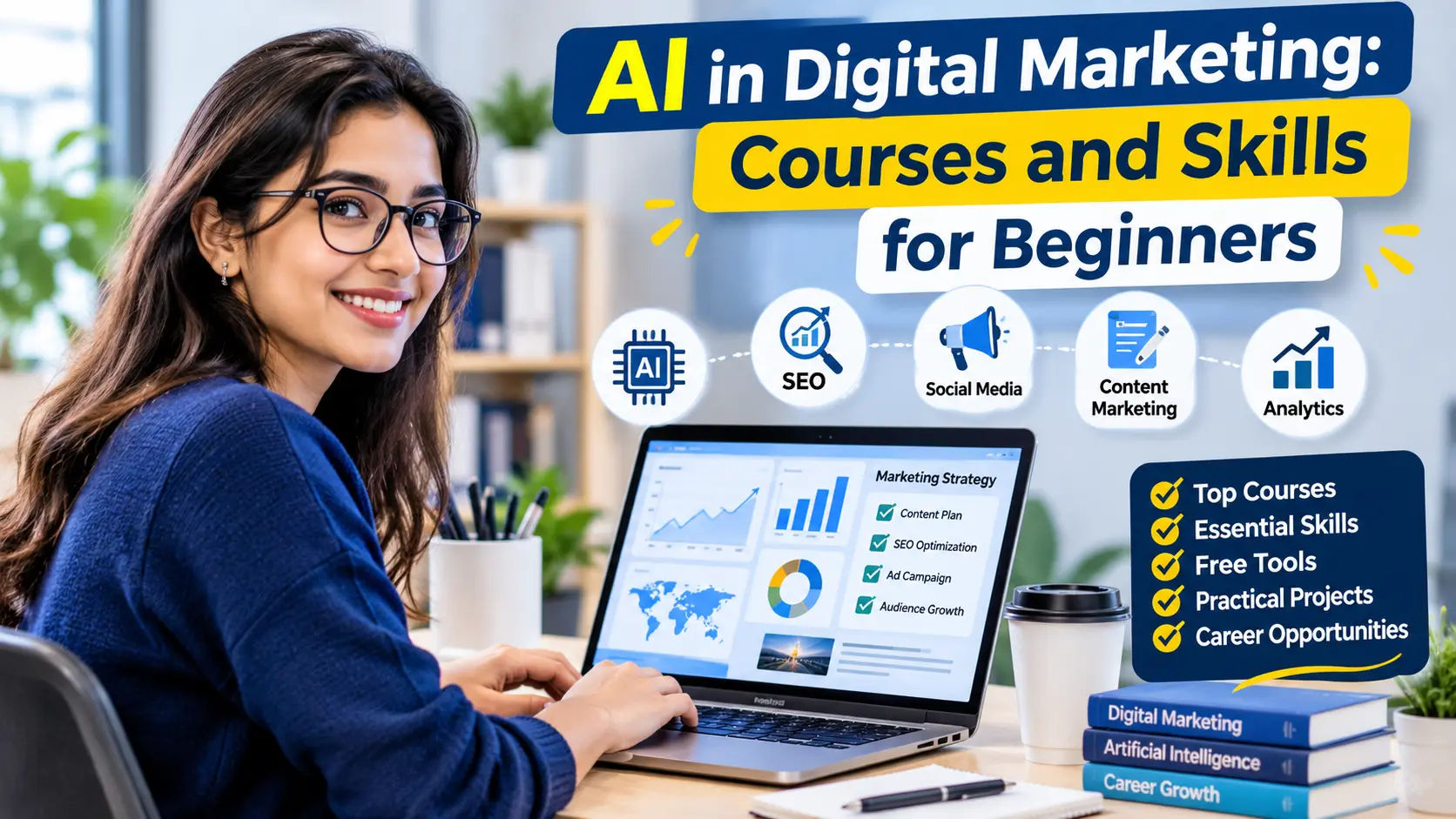
AI in Digital Marketing: Courses and Skills for Beginners
Artificial intelligence is changing how businesses attract customers, create content, analyse data, and manage advertising campaigns. Tasks that once required several hours of research and manual work can now be completed more efficiently with AI-powered tools.
This has created an interesting opportunity for students and beginners who want to build a career in digital marketing. You do not need to be a computer science graduate or an experienced marketer to get started. However, understanding marketing fundamentals and using AI responsibly are essential.
If you are exploring modern career opportunities, AI-powered digital marketing is a field worth understanding. This guide explains the skills you need, beginner-friendly courses, useful tools, practical projects, and how to start learning step by step.
What Is AI in Digital Marketing?
AI in digital marketing refers to using artificial intelligence technologies to plan, create, improve, automate, and analyse marketing activities.
Instead of depending entirely on manual research and repetitive tasks, marketers can use AI to identify patterns, understand customer behaviour, generate content ideas, improve advertising creatives, and make data-informed decisions.
For example, a small business launching a skincare product can use AI to:
- Research potential customer interests.
- Generate social media content ideas.
- Create different advertising concepts.
- Analyse customer feedback.
- Develop personalised email campaigns.
- Identify opportunities to improve campaign performance.
AI supports marketing decisions, but human creativity, experience, and judgement remain important.
Why Should Beginners Learn AI-Powered Digital Marketing?
Digital marketing already includes several specialised areas, such as SEO, social media, content marketing, email marketing, and paid advertising. AI connects these activities by helping marketers work with information and complete certain tasks more efficiently.
Here are some reasons beginners should consider learning it:
- Improved productivity: Complete research, brainstorming, and content planning more efficiently.
- Better customer understanding: Analyse customer interests, questions, and feedback.
- Creative opportunities: Develop new ideas for videos, advertisements, and social media campaigns.
- Data-driven decisions: Identify patterns and understand marketing performance.
- Career flexibility: Develop skills relevant to agencies, businesses, freelance projects, and entrepreneurship.
- Continuous learning: Understand emerging technologies and changing marketing practices.
However, learning AI tools alone does not guarantee employment. Businesses need people who understand marketing objectives and can demonstrate measurable results.
Essential AI Digital Marketing Skills for Beginners
Before selecting a course, understand which skills you should develop. A balanced skill set is more valuable than knowing how to operate dozens of AI applications.
1. AI Prompt Engineering
Prompt engineering means giving AI clear instructions so it can produce relevant and useful results.
For example, instead of asking, "Write an Instagram caption," provide context:
"Write three Instagram captions for a skincare brand targeting women aged 25–40. Use a friendly professional tone, highlight the product's benefits, and include a clear call to action."
Learn to provide context, audience details, objectives, formats, and restrictions.
2. AI-Powered SEO
Search engine optimisation involves improving a website's visibility in organic search results.
AI can assist with:
- Keyword research and search intent analysis.
- Topic clustering.
- Content outlines.
- Competitor content analysis.
- SEO title and meta description ideas.
- Content optimisation.
Useful tools include ChatGPT, Gemini, Semrush, Ahrefs, and Google Search Console.
Remember that AI-generated articles still require original insights, fact-checking, and useful information. Publishing large volumes of unreviewed content is not a sustainable SEO strategy.
3. AI Content Marketing
Content marketing involves creating valuable information that attracts and engages a target audience.
Beginners should learn how to use AI for blog planning, social media calendars, email drafts, video scripts, and content repurposing.
The important skill is editing AI output to make it accurate, distinctive, relevant, and suitable for the intended audience.
4. AI-Powered Social Media Marketing
Social media marketers use AI to understand audience interests, plan content, develop creative concepts, and analyse engagement.
Learn:
- Audience research.
- Content calendar development.
- Reel and short-video scripting.
- Creative testing.
- Caption optimisation.
- Social media performance analysis.
Tools such as Canva, Meta AI, ChatGPT, and Buffer can support these activities.
5. AI in Paid Advertising
Paid advertising requires more than creating attractive advertisements. Marketers must understand audience targeting, campaign objectives, budgets, conversion tracking, and performance measurement.
AI can assist with advertising copy, creative variations, campaign insights, and optimisation.
Learn Google Ads, Meta Ads Manager, conversion tracking, and the fundamentals of return on ad spend (ROAS).
6. Data Analytics and Marketing Automation
A successful marketer should understand what happens after a customer clicks an advertisement.
Learn how to interpret:
- Website traffic.
- Click-through rate (CTR).
- Conversion rate.
- Cost per lead (CPL).
- Customer acquisition cost (CAC).
- Return on ad spend (ROAS).
Explore Google Analytics 4, Looker Studio, HubSpot, and automation platforms such as Make.
Best AI Digital Marketing Courses for Beginners
Choosing the right course can make learning more structured. Beginners should prioritise courses that explain marketing fundamentals, practical AI applications, and responsible AI usage.
The following options offer different learning approaches.
| HubSpot Academy – AI for Marketing | AI content, prompting, personalisation, analytics | Beginners |
| Google Skillshop | Google Ads and marketing measurement | Advertising beginners |
| Meta Blueprint – Generative AI for Marketers | AI prompts and advertising creatives | Social media marketers |
| Coursera – AI for Marketing by Emory University | Segmentation, personalisation, predictive analytics | Structured learners |
| LinkedIn Learning | AI and professional marketing skills | Working professionals |
Which Course Should You Start With?
If you are completely new to AI, start with HubSpot Academy's AI for Marketing course. It introduces prompting, content creation, marketing campaigns, analytics, and responsible AI practices.
After understanding the basics, explore Google Skillshop for advertising and measurement. Meta Blueprint is useful if your interests are more focused on Facebook and Instagram marketing.
Paid learning programmes can offer structured assignments and deeper instruction, but they are not compulsory for getting started.
Before enrolling, check the current syllabus, course duration, certificate requirements, and fees.
Step-by-Step Guide: How to Learn AI in Digital Marketing
You might be wondering how to combine all these skills without becoming overwhelmed. The easiest approach is to follow a structured learning plan.
Step 1: Understand Digital Marketing Fundamentals
Start with SEO, social media, content marketing, email marketing, paid advertising, and analytics.
Understand what each channel does and how businesses use it to attract customers.
Step 2: Learn Two or Three AI Tools
Begin with ChatGPT, Gemini, and Canva.
Practise using them for research, content planning, caption writing, and creative development.
Do not subscribe to multiple premium tools immediately. Understand your requirements first.
Step 3: Develop a Specialisation
Choose one area based on your interests.
- Creative students can explore AI content and social media marketing.
- Analytical students can explore SEO and marketing analytics.
- Business-minded students can explore performance marketing and automation.
Step 4: Complete Practical Projects
Create a sample marketing campaign for a fictional business.
Include keyword research, a content calendar, three social media creatives, an advertising concept, and a performance measurement plan.
Step 5: Build Your Portfolio
Organise your work into a professional portfolio.
Include project objectives, your research, marketing strategy, execution examples, and expected or actual results.
Clearly distinguish sample projects from real client campaigns.
Practical Projects to Build Your AI Marketing Skills
Learning becomes easier when you apply concepts to realistic situations.
Consider these beginner-friendly projects:
Project 1: SEO Blog Strategy
Choose a topic, research keywords, identify search intent, create a content outline, and prepare SEO metadata.
Project 2: Social Media Campaign
Select a business and prepare seven days of content, including captions, creative concepts, and a posting schedule.
Project 3: AI Advertising Campaign
Develop three advertising concepts for the same product. Create different headlines, descriptions, and audience hypotheses.
Project 4: Marketing Performance Dashboard
Use sample campaign data to calculate CTR, conversion rate, CPL, and ROAS. Present your findings in a simple dashboard.
These projects can help demonstrate your practical understanding during internships, interviews, or freelance opportunities.
Benefits and Challenges of Using AI in Marketing
AI offers several advantages, but beginners should also understand its limitations.
| Faster research and brainstorming | Incorrect or outdated information |
| Efficient content planning | Generic or repetitive content |
| Better data analysis support | Incorrect interpretation of data |
| Creative experimentation | Copyright and originality concerns |
| Automation of repetitive tasks | Privacy and security risks |
| Personalisation opportunities | Bias in AI-generated outputs |
The best approach is to use AI as an assistant rather than allowing it to make every marketing decision.
Best AI Marketing Tools for Beginners
Different tools serve different marketing purposes. Start with a small toolkit and expand when necessary.
Beginner-Friendly and Free Options
- ChatGPT
- Gemini
- Canva
- Google Analytics 4
- Google Search Console
- Meta Business Suite
Advanced and Premium Options
- Semrush
- Ahrefs
- Jasper
- Surfer SEO
- HubSpot
- Make
- Zapier
Some platforms offer free plans or limited free features, while others require subscriptions for advanced functionality.
Career Opportunities in AI Digital Marketing
Once you develop practical skills, you can explore different professional roles.
| AI Content Marketer | Content strategy, prompting, editing |
| SEO Specialist | Keyword research, technical SEO, analytics |
| Social Media Manager | Content planning, creative strategy, engagement |
| Performance Marketer | Google Ads, Meta Ads, conversion tracking |
| Marketing Automation Specialist | Workflows, CRM, automation |
| Digital Marketing Analyst | GA4, reporting, data interpretation |
Students from commerce, arts, science, and management backgrounds can explore this field. A technical degree is not compulsory for every marketing role, although certain specialised positions may require additional qualifications.
For more guidance, explore creative career options for students and skills that can give your career a serious advantage.
Common Mistakes Beginners Should Avoid
Here is where many beginners make mistakes:
- Learning AI tools without understanding marketing fundamentals.
- Copying AI-generated content without editing or fact-checking.
- Collecting certificates without completing practical projects.
- Ignoring analytics and campaign performance.
- Spending money on premium subscriptions too early.
- Expecting immediate income after completing a short course.
- Depending entirely on AI for creative and strategic decisions.
A better strategy is to learn one skill, practise it, evaluate your work, and gradually move to more advanced applications.
Expert Tips and Best Practices for Learning AI Marketing
To develop skills that remain useful as technology changes, follow these practices:
- Learn the reason behind every marketing activity.
- Develop strong research and critical-thinking abilities.
- Verify facts before publishing content.
- Understand customer psychology and buying behaviour.
- Practise writing effective prompts.
- Learn analytics alongside content creation.
- Respect customer privacy and intellectual property.
- Keep examples of your projects and document your improvements.
One thing many beginners miss is that understanding customers is just as important as understanding AI. Technology can generate suggestions, but knowing which suggestion solves a genuine customer problem requires human judgement.
Future of AI in Digital Marketing
The future of digital marketing will involve closer collaboration between people and intelligent systems.
Some important developments include:
- AI-assisted search and answer engine optimisation.
- Predictive customer analytics.
- Automated campaign workflows.
- Personalised customer experiences.
- AI-assisted video and creative production.
- Conversational marketing and AI agents.
- More advanced marketing measurement.
Marketers will increasingly need to understand how brands appear across traditional search engines, social platforms, and AI-powered answer experiences.
This makes adaptability, analytical thinking, creativity, and responsible AI usage valuable long-term skills.
A 30-Day Beginner Strategy to Get Started
If you want to begin learning without investing too much time or money, follow this simple roadmap.
| Days 1–7 | Digital marketing and AI fundamentals | Research one business |
| Days 8–14 | Prompt engineering and content | Create a content calendar |
| Days 15–21 | SEO and social media | Prepare an SEO blog and three creatives |
| Days 22–30 | Analytics and advertising | Build a sample campaign report |
Spend approximately one hour daily learning and practising. At the end of 30 days, review your work and identify which specialisation interests you most.
Conclusion
AI in digital marketing is creating new ways to research audiences, develop content, manage campaigns, and understand business performance. For beginners, it offers an opportunity to combine creativity, technology, communication, and analytical thinking.
However, success does not come from knowing how to use ChatGPT or any other single tool. It comes from understanding marketing fundamentals, applying AI thoughtfully, measuring results, and continuously improving your skills.
Start with one course, practise with free tools, complete real-world projects, and build a portfolio that demonstrates your abilities.
If you are unsure which learning path matches your interests, explore career guidance and educational resources at Vidya Udbhav. The right starting point is not necessarily the most popular course. It is the one that helps you develop skills you can confidently apply.
Frequently Asked Questions (FAQs)
1. What is AI in digital marketing for beginners?
AI in digital marketing involves using artificial intelligence to support activities such as SEO, content creation, social media management, advertising, customer research, and marketing analytics.
2. Which AI course is best for digital marketing beginners?
HubSpot Academy's AI for Marketing course is a useful starting point. Beginners can also explore Google Skillshop and Meta Blueprint to develop platform-specific marketing knowledge.
3. Can I learn AI digital marketing without coding?
Yes. Most entry-level digital marketing activities involving AI do not require programming. Skills such as prompting, SEO, content creation, advertising, and analytics can be learned without coding.
4. Which AI tools should beginners learn first?
Start with ChatGPT, Gemini, and Canva. As you develop your skills, explore Google Analytics 4, Google Search Console, Semrush, and marketing automation platforms.
5. Is AI digital marketing a good career option?
It can be a promising career direction for people interested in marketing, technology, creativity, and data. Career opportunities depend on practical skills, experience, specialisation, and the ability to demonstrate results.
6. How long does it take to learn AI in digital marketing?
You can understand the fundamentals within a few weeks. Developing professional skills requires consistent practice, practical projects, and experience with marketing campaigns.
7. Can students learn AI digital marketing after Class 12?
Yes. Students from different academic streams can begin learning digital marketing and AI tools after Class 12. They should start with basic concepts and gradually develop practical skills.
8. Are free AI digital marketing courses available?
Yes. HubSpot Academy, Google Skillshop, and Meta Blueprint offer free learning resources. Some advanced courses, certificates, or platform examinations may have additional charges.
9. Do AI marketing tools replace digital marketers?
AI can automate or assist with certain marketing tasks, but strategy, customer understanding, creativity, critical thinking, and decision-making still require human involvement.
10. How can beginners get practical experience in AI digital marketing?
Start by creating sample SEO strategies, social media campaigns, advertising concepts, and analytics reports. Build a portfolio and look for internships, freelance projects, or opportunities to work with small businesses.