

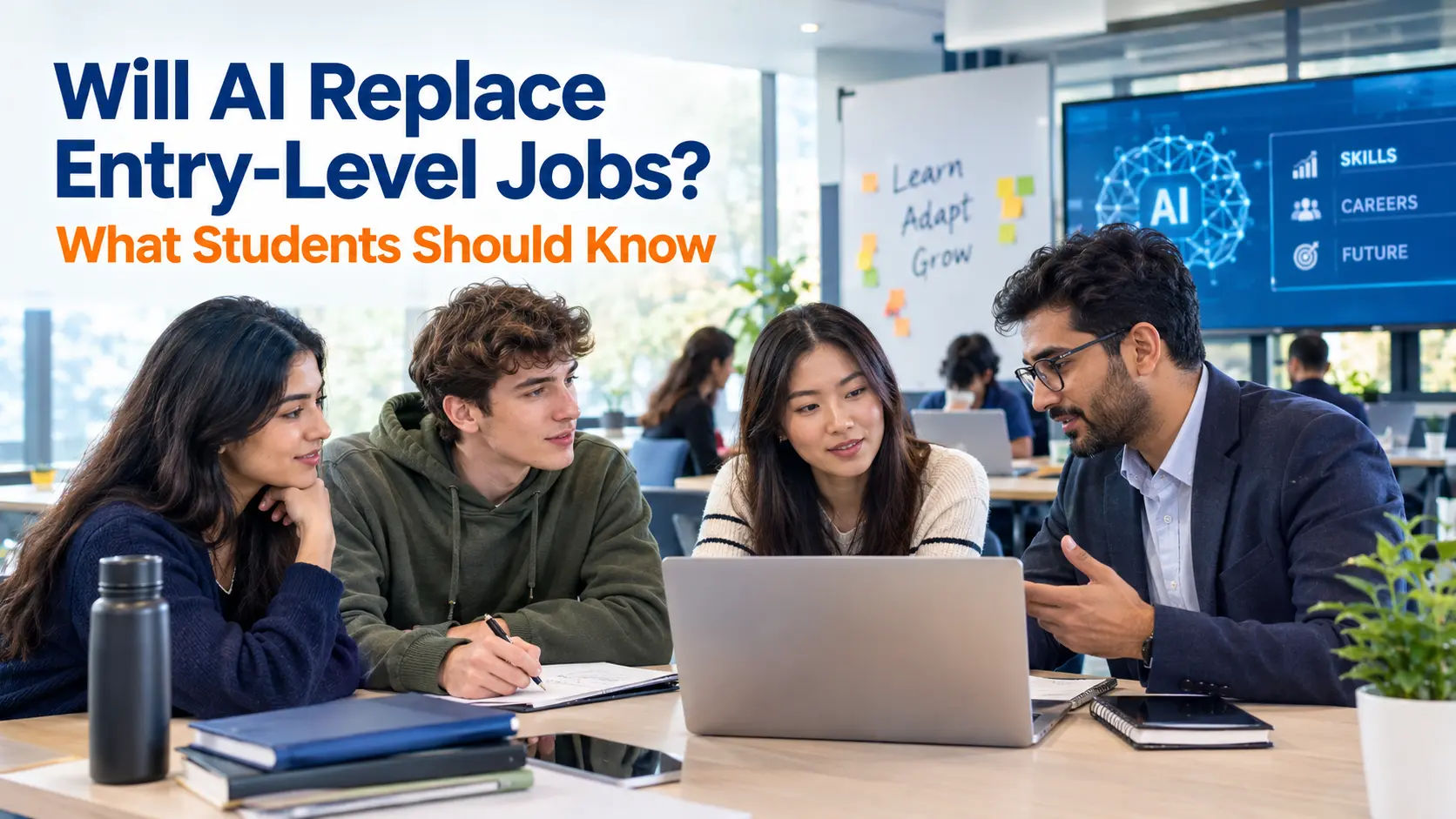
Artificial intelligence is changing workplaces faster than many students expected. Writing, coding, data analysis, customer support, research, design, and administrative tasks can now be assisted or automated by AI tools.
That naturally raises a worrying question: Will AI replace entry-level jobs?
The short answer is some entry-level tasks will be automated, but that does not mean all entry-level jobs will disappear. The bigger change is likely to be in what employers expect from beginners.
The International Labour Organization estimates that about one in four workers globally are in occupations with some exposure to generative AI, while emphasizing that job transformation is more likely than complete replacement.
For students, the lesson is not to avoid technology. It is to learn how to work with it.
Quick Answer: Will AI Replace Entry-Level Jobs?
AI is unlikely to eliminate all entry-level jobs. Instead, it is more likely to automate repetitive tasks and change the responsibilities attached to junior positions.
Students who combine AI literacy + technical skills + communication + critical thinking + practical experience can be better positioned for the changing job market.
The World Economic Forum projects that global labour-market transformation could create 170 million jobs and displace 92 million by 2030, resulting in a net increase of 78 million jobs.
So the real question is not “Will AI take my first job?”
It is:
“Will I have the skills employers need when my first job changes?”
Why Are Entry-Level Jobs More Exposed to AI?
Entry-level employees often begin with repetitive and structured assignments.
For example, a junior employee might spend hours:
- Entering or organizing data
- Creating basic reports
- Drafting routine emails
- Summarizing documents
- Performing simple research
- Preparing first drafts
- Answering common customer questions
- Testing basic software functions
These are exactly the kinds of tasks where AI can increase productivity.
The ILO identifies clerical occupations as having particularly high exposure to generative AI, including roles involving data entry, bookkeeping, administration, and similar routine work.
But there is an important distinction: AI exposure is not the same as job replacement.
A job can contain 20 tasks, and AI may automate five of them while helping a human perform another eight faster. The employee may then spend more time on judgment, communication, problem-solving, and decision-making.
Which Entry-Level Tasks Are Most at Risk?
| Data entry | High | Data analysis and verification |
| Basic content drafting | High | Editing, strategy and storytelling |
| Routine customer support | High | Communication and problem-solving |
| Basic research | Medium–High | Research judgment and fact-checking |
| Simple coding | Medium–High | Software fundamentals and system thinking |
| Graphic production | Medium–High | Design thinking and brand strategy |
| Administrative work | High | Organization, coordination and digital tools |
| Sales support | Medium | Negotiation and relationship-building |
| Healthcare support | Lower for many tasks | Domain knowledge and human interaction |
| Teaching and mentoring | Lower for many tasks | Communication, empathy and subject expertise |
Here is what many beginners miss: learning only how to perform a repetitive task may become risky. Learning why the task matters is much more valuable.
What Skills Will Students Need in an AI-Driven Job Market?
The safest strategy is not to compete against AI at tasks where AI is naturally strong.
Instead, develop capabilities that allow you to use AI effectively.
1. AI Literacy
You do not necessarily need to become an AI engineer.
You should understand how AI tools work, where they are useful, what their limitations are, and how to check their output.
2. Critical Thinking
AI can generate an answer quickly, but speed does not guarantee accuracy.
Employers still need people who can question information, identify mistakes, compare alternatives, and make sensible decisions.
3. Communication
Clear writing, presentations, listening, teamwork, and professional communication remain valuable across industries.
4. Technical Skills
Depending on your career, this could include:
- Data analysis
- Programming
- Cybersecurity
- Digital marketing
- UI/UX
- Cloud technologies
- Video editing
- Business analytics
- AI and machine learning
The World Economic Forum expects technology skills such as AI, big data, and cybersecurity to grow rapidly, while creative thinking, resilience, flexibility, leadership, and collaboration remain important human capabilities.
5. Domain Knowledge
This becomes more important when AI becomes widely available.
If everyone can access the same AI tool, the advantage may come from knowing what problem to solve, which information matters, and whether the result makes sense.
How Students Can Prepare for AI-Related Job Changes
You might be wondering where to start if you are still in school or college.
Here is what actually works.
Step 1: Choose a broad career direction.
Do not select a course simply because it is trending. Consider your interests, strengths, and long-term goals. Students can also explore Vidya Udbhav's guide on how to discover the right career based on your skills and interests.
Do not select a course simply because it is trending. Consider your interests, strengths, and long-term goals. Students can also explore Vidya Udbhav's guide on how to discover the right career based on your skills and interests.
Step 2: Build one strong core skill.
For example, learn programming if you want software development, analytics if you enjoy data, or design fundamentals if you want a creative career.
For example, learn programming if you want software development, analytics if you enjoy data, or design fundamentals if you want a creative career.
Step 3: Learn relevant AI tools.
Use AI to research, brainstorm, practice, automate repetitive work, and improve productivity.
Use AI to research, brainstorm, practice, automate repetitive work, and improve productivity.
Step 4: Build projects.
A student who can show three practical projects may demonstrate more employability than someone who only lists several certificates.
A student who can show three practical projects may demonstrate more employability than someone who only lists several certificates.
Step 5: Develop human skills.
Practice presentations, teamwork, problem-solving, communication, and decision-making.
Practice presentations, teamwork, problem-solving, communication, and decision-making.
Step 6: Get practical exposure.
Internships, freelance projects, volunteering, competitions, and real-world assignments can help you understand how your skills work outside a classroom.
Internships, freelance projects, volunteering, competitions, and real-world assignments can help you understand how your skills work outside a classroom.
Vidya Udbhav also emphasizes profile building through certifications, internships, and skill-based projects as part of its student career guidance approach.
What About Students Choosing Technology Careers?
Technology is not disappearing because of AI. In many areas, AI is increasing the demand for people who understand technology.
The World Economic Forum lists AI and machine-learning specialists, big-data specialists, and other technology-focused roles among fast-growing occupations.
Students considering technology can therefore explore areas such as:
- Artificial intelligence
- Data science
- Software development
- Cybersecurity
- Cloud computing
- Data analytics
- AI-enabled business
- Automation
- Product development
For example, a BCA student should not think, “AI can write code, so programming is useless.”
A better approach is to learn programming fundamentals while also learning how AI-assisted development works. Students comparing technology degrees can explore Vidya Udbhav's BTech vs BCA career guide.
A Real-World Example
Imagine a marketing company hiring a junior content executive.
Five years ago, the employee might have spent most of the day creating first drafts.
Today, AI can produce those drafts within minutes.
But the company still needs someone to understand the target audience, research competitors, identify the right message, edit inaccurate information, maintain brand consistency, analyze campaign performance, and communicate with the client.
The task has changed. The need for a capable employee has not necessarily disappeared.
This is the broader pattern emerging in many occupations.
The Biggest Mistake Students Should Avoid
One thing many beginners miss is that collecting certificates is not the same as becoming employable.
Completing ten AI courses without applying the knowledge may not help much.
A stronger approach is:
Learn → Practice → Build → Get feedback → Improve → Demonstrate
For example, instead of simply completing a digital marketing course, create a small campaign, analyze its performance, prepare a report, and explain what you would change.
That gives employers evidence of your ability.
Beginner Strategy vs Advanced Strategy
If you are a beginner:
- Learn basic AI concepts.
- Choose one career direction.
- Develop one core professional skill.
- Use AI as a learning assistant.
- Create small projects.
If you are already in college:
- Build a portfolio.
- Complete internships or real projects.
- Learn AI tools relevant to your field.
- Improve communication and presentation skills.
- Follow changes in your industry.
If you are preparing for employment:
- Research the skills appearing repeatedly in job descriptions.
- Update your resume around skills and measurable projects.
- Practice AI-assisted workflows.
- Prepare for practical interviews.
- Keep learning after getting your first job.
Students looking for broader guidance can also explore career planning tips for school and college students.
Future of Entry-Level Jobs: What Is Likely to Change?
The entry-level job may look different from what previous generations experienced.
Junior employees may receive fewer repetitive assignments and more AI-assisted responsibilities. They may be expected to review AI output, manage workflows, communicate with customers, solve exceptions, and make decisions earlier in their careers.
This creates both a challenge and an opportunity.
The challenge is that some traditional “learn by repetition” pathways could shrink. The opportunity is that capable young professionals may reach meaningful responsibilities faster.
Recent research in cybersecurity, for example, suggests that AI can improve professionals' work while also making entry into the field harder because some traditional junior learning tasks are being reduced.
That means employers and educational institutions also have a responsibility to create better pathways for beginners.
Best Practices for Students
Keep these principles in mind:
- Do not fear AI; understand it.
- Do not rely completely on AI; verify it.
- Do not learn only tools; learn fundamentals.
- Do not collect certificates without projects.
- Do not choose a career only because it is popular.
- Build communication alongside technical skills.
- Keep your skills updated as technology changes.
- Learn how your chosen industry actually works.
If you are still deciding what direction to take, Vidya Udbhav's career counselling guide for students can help you evaluate career choices more systematically.
Final Advice for Students
AI is going to change entry-level work. Pretending otherwise would be unrealistic.
But believing that AI will simply eliminate every opportunity for young people is equally misleading.
The labour market is being redesigned around a combination of technology skills and human capabilities. The strongest candidates will increasingly be those who know how to use AI without becoming dependent on it.
So, if you are a student today, do not ask only:
“Which job will AI not replace?”
Ask:
“Which valuable problems can I learn to solve with AI, while bringing skills that AI cannot independently provide?”
That is a much more useful question for building a long-term career.
Conclusion
AI will replace some tasks, reshape some entry-level positions, and create demand for new skills. But the future of work is unlikely to be a simple battle between humans and machines.
For students, adaptability is becoming a career skill in itself.
Choose a field that fits your strengths, build practical skills, learn to work with AI, develop strong human capabilities, and keep updating your knowledge.
The goal should not be to become AI-proof.
The goal should be to become AI-capable, adaptable, and valuable.
Frequently Asked Questions
1. Will AI completely replace entry-level jobs?
No. AI is more likely to automate certain tasks within entry-level jobs than eliminate every junior position. The extent of change will depend on the occupation, industry, technology adoption, and human skills required.
2. Which entry-level jobs are most affected by AI?
Routine clerical, administrative, data-entry, basic content, and repetitive digital tasks are among the areas with higher exposure to generative AI.
3. Should students learn AI to get a job?
Yes. Basic AI literacy can help students understand modern workplace tools and workflows. However, AI should complement core professional skills rather than replace them.
4. What skills are safest in an AI-driven job market?
There is no completely “AI-proof” skill. Strong combinations include technical knowledge, critical thinking, communication, creativity, adaptability, domain expertise, and the ability to work effectively with AI.
5. Is studying technology still a good career choice?
Yes. AI is creating and expanding opportunities across areas such as AI, data, cybersecurity, software, cloud computing, and automation. Students should focus on strong fundamentals alongside emerging technologies.
6. How can students prepare for AI-related career changes?
Start by choosing a suitable career direction, developing a core skill, learning relevant AI tools, building practical projects, gaining real-world experience, and continuously improving communication and problem-solving abilities.